Insurance appraisal process

Insurance Appraisal Process

To begin the insurance appraisal process, each party needs an appraiser, including you and your insurance provider. A separate appraiser must be hired by each side. Additionally, the cost of the umpire and appraisal must be divided equally by both sides.

What is an Umpire when it comes to insurance claims?

You and your insurance provider will each employ an appraiser, and the two appraisers will collaborate to choose an appraisal umpire.

If the two appraisers are unable to agree, the appraisal umpire, a qualified, objective, and disinterested person, may make a final legally enforceable decision.

A competent umpire could be anyone capable of providing an objective assessment based on their competence in the field, such as an engineer, contractor, or retired judge.

The two appraisers may take advantage of their current professional relationships to find an umpire for an insurance appraisal. The appraisal umpire will decide if the two appraisers are unable to agree on the size of the loss.

What distinguishes appraisers from adjusters?

Appraisers are tasked with determining the worth of your property and the projected cost of repairs. Adjusters are responsible for deciding whether the insurance should pay for the damages to your car and how much.

Why should you get a property damage appraiser and a reliable attorney?

It is often more beneficial to employ both. Appraisers are typically most helpful during your property claim process. When an insurance company has partially or completely rejected a policyholder’s claim, property insurance attorneys are most helpful.

It’s important to choose the right property damage appraiser and attorney when filing a claim. The insurance appraiser you select should ideally be a specialist who is familiar with the specifics of insurance claims similar to the one you are handling.

Some appraisers might have extensive experience in particular insurance-related industries.

The following are specialists who advertise appraisal services:

You can increase your chances of getting a fair result by choosing an experienced appraiser and attorney.

In conclusion, the actual appraisal procedure varies between properties and insurance policies. For information on how to initiate the appraisal procedure and how a typical appraisal functions, consult the “conditions” portion of your insurance policy.

Is your claim being denied or underpaid? Call Chad T. Wilson Law Firm, PLLC.

Speak with one of our attorneys if you’re having trouble getting your claim processed or if the insurance company is attempting to pay less for the claim than is reasonable.

Contact us: https://cwilsonlaw.com/contact-us/ 

Learn more about our attorneys:
https://cwilsonlaw.com/meet-the-team-chad-t-wilson-law-firm-pllc-insurance-attorney/

Follow us on Social media:
https://beacons.ai/chadtwilsonlaw

Contact our Chad T. Wilson Law Firm Office Locations to Schedule a free Consultation.


Chad T. Wilson is an attorney whose firm specializes in property insurance disputes.

Written By:
Alejandro Caro
How is roof depreciation calculated?

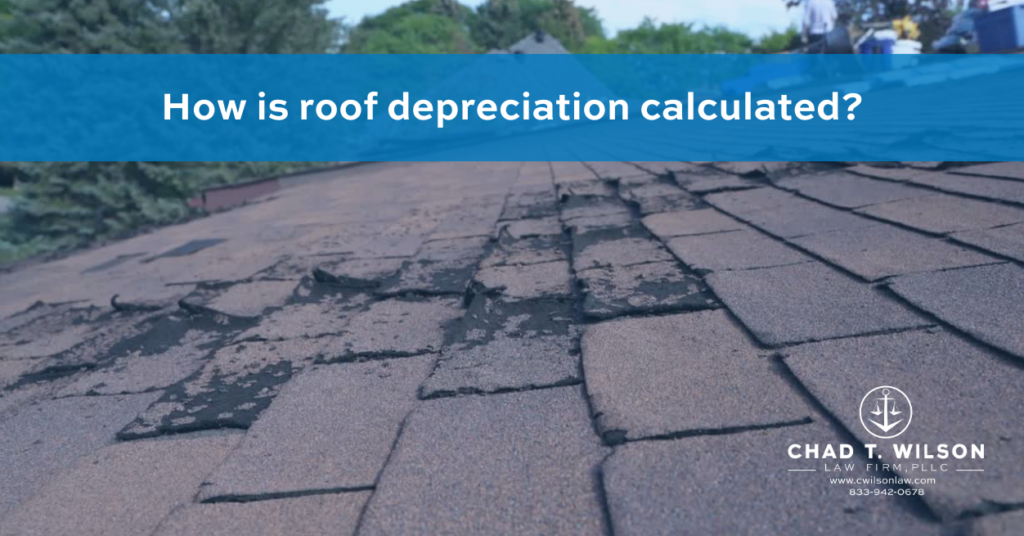
How is roof depreciation calculated?

Insurance companies frequently use different components to determine a roof’s depreciation. The procedure entails determining the roof’s age, estimated lifespan, and degree of wear and tear.

It is simple to determine depreciation depending on age. Assume your roof has a 20-year lifespan and is five years old when it becomes damaged. Yearly, a roof loses around 5-20% of its worth.

When examining a roof, a claims adjuster will take its age and condition into account. There might be little to no adjustment for the condition if the roof is in respectable condition for its age. The adjuster may, however, increase the depreciation estimate if the roof is in bad condition, has received insufficient repairs, or has been the subject of earlier claims.

What Depreciation Means for Your Roof Insurance Claim.

As your house gets older and wears out, its value may decrease. Depreciation is a term used in finance to describe this loss of value. You need to be aware of how depreciation affects the claim procedure if a storm damages the roof of your home.

It’s vital to remember that insurance companies may use various methods to determine the depreciation of roofs. The precise calculation procedures can change depending on the insurer, the conditions of the insurance, and regional laws.

To understand how depreciation is computed in their specific scenario, policyholders should check their insurance policy and speak with their insurance agent or adjuster.

Insurance companies make an estimation of the depreciation value by taking into account the age of the roof, anticipated lifespan, wear and tear, and upkeep. To make sure that homeowners repair their roof to its pre-loss condition while accounting for its current value, this aids in determining the amount withheld and then issued as a depreciation check.

Here is an explanation of how insurance companies often determine a roof’s depreciation:

Age

The age of the roof affects its depreciation considerably. The age of the roof at the time of the claim is taken into account by insurance carriers. Older roofs have a higher likelihood of having noticeable signs of wear and tear, which can lower their value and increase the depreciation rate. The installation date or the homeowner’s information helps calculate the age.

Maintenance

 Maintenance and upkeep affect the roof’s depreciation. The homeowner’s efforts to maintain the roof, such as routine inspections, repairs, and cleaning, may be taken into account by insurance carriers. The lifespan of the roof can be increased, and depreciation can be reduced, with proper maintenance.

Wear and tear

Exposure to different elements, such as sunlight, rain, wind, and temperature changes, can cause wear and tear on the roof. To evaluate the roof’s condition and spot wear and tear indicators like curled or broken shingles, missing granules, or sagging sections, insurance adjusters inspect it. The depreciation estimate takes into account the degree of wear and tear.

Lifespan

Insurance firms also take into account the anticipated lifetime of the roofing material. The lifespans of various roofing materials vary. For instance, metal roofs can last 40–70 years, whereas asphalt shingles normally only last 20–30 years. The amount of depreciation is calculated by the insurance provider using the predicted lifespan as a percentage of the actual lifespan.

Insurance firms compute depreciation using a variety of estimating techniques. Some people may rely on depreciation charts that are considered industry standards and that determine the amount of depreciation based on the age of the roof. Others may use computer systems or internal estimators that take criteria into account while calculating the depreciation value.

Actual Cash Value

The claim’s cash value (ACV) is often determined to include the roof’s depreciation. The ACV is the depreciation-adjusted value of the damaged goods at the time of the loss. The insurance provider deducts the depreciation amount from the roof’s replacement cost value (RCV) to get the ACV.

If your roof is ever damaged, give The Chad T. Wilson Law Firm a call right away. We are here to assist you if your insurance claim is being denied or underpaid.

Is your claim being denied or underpaid? Call Chad T. Wilson Law Firm, PLLC.

Speak with one of our attorney if you’re having trouble getting your claim processed or if the insurance company is attempting to pay less for the claim than is reasonable.

Contact us: https://cwilsonlaw.com/contact-us/ 

Learn more about our attorneys:
https://cwilsonlaw.com/meet-the-team-chad-t-wilson-law-firm-pllc-insurance-attorney/

Follow us on Social media:
https://beacons.ai/chadtwilsonlaw

Chad T. Wilson – News
September 25, 2023
Updated: September 25, 2023 11:20 a.m.
Source: https://cwilsonlaw.com/

What is the Time Limit for Filing a Claim for Property Damage?

People often put off filing their insurance claims for many reasons. If you own a home, live in an apartment, or run a business, you might put off filing your claim. You may also delay calling your insurance provider because of time, work, or life in general. However, some are not aware of the time limit for filing a claim for property damage

What-is-the-time-limit-for-filing-a-claim-for-property-damage

How long do you have to file your claim?

You could be let down if you were hoping for a straightforward response to the question of time restrictions. Unfortunately, solutions to time-related questions can be surprisingly difficult. State regulations may impact the amount of time you have to submit a claim, but your exact deadlines are sometimes determined more by the terms of your insurance policy than by state law. The majority of these questions have their direct answers in your policy. The length of time you have to act, however, may also depend on a variety of other factors.

The best course of action is to file your property damage claim as soon as possible.

You must “give prompt notice” to the insurance company following a loss, which is a requirement of nearly all homeowner’s insurance policies. This duty is frequently stated in the “Your Duties After Loss” clause. Acting fast gives your insurance provider time to look into the claim, identify the damages, and estimate the cost of repairs.

Your claim can be rejected if you don’t provide the insurance company with “prompt notice” of the loss.

The majority of insurance contracts provide that to be covered by the policy (for example, by promptly notifying a loss), you must adhere to all of its terms and conditions. Your claim can be rejected if you don’t provide “prompt notice” of the loss to the insurance company as required under the policy.

When property owners fail to provide “prompt notice” of a loss, the carrier can’t fully assess the cause of the damage or the required repairs because they can’t notice the damage when it’s fresh. Property insurance claims may be rejected, and your window of opportunity to get benefits may close if you disclose them too late.

How does a “prompt notice” work?

In general, prompt notice denotes a fair period of time after you become aware of the loss to report it. You are required by the policy as a property owner to disclose any losses that might be covered right away. You don’t have to wait until you can verify that the incident caused all of the damage or until you have a general contractor give you a price. Reporting the claim as soon as possible is the best line of action.

Get legal representation.

You must move quickly and learn about the deadlines that apply in your state if you are overwhelmed or having problems resolving your claim. Gathering all the data required to take action can take some time.

As you wait for the insurance provider to respond, you should also be prepared to limit further losses. You are responsible for doing everything you can to stop more losses, even though you should wait to make full repairs until everything has been properly documented.

Is your claim being denied or underpaid? Call Chad T. Wilson Law Firm, PLLC.

Speak with one of our attorney if you’re having trouble getting your claim processed or if the insurance company is attempting to pay less for the claim than is reasonable.

Contact us: https://cwilsonlaw.com/contact-us/ 

Learn more about our attorneys:
https://cwilsonlaw.com/meet-the-team-chad-t-wilson-law-firm-pllc-insurance-attorney/

Follow us on Social media:
https://beacons.ai/chadtwilsonlaw

Chad T. Wilson – News
September 25, 2023
Updated: September 25, 2023 11:20 a.m.
Source: https://weather.com/

A weather alert was reported in Central Texas when hail the size of baseballs caused damage to property owners this past weekend.

Sunday night, severe storms swept through Central Texas, producing large hail. Police in Round Rock report that numerous residences and businesses sustained significant property damage. Additionally, there were sporadic power disruptions brought on by the storm.

Central Texas hail the size of baseballs caused damage to property owners

The City of Austin’s Homeland Security and Emergency Management division issued the following advice if your property has hail damage:

  • If you have insurance, get in touch with your agent to submit a claim.
  • Before cleaning up, take pictures and establish a note of all the damages you have.
  • Keep all of your invoices for cleaning and repairing damage.
  • Be wary of unauthorized door-to-door proposals for home remodeling. Your best bet, if your house requires repairs, is to contact a few local home repair companies and then check their references.
  • Selecting a contractor with a recognized physical address is a smart idea. In case issues emerge, you should make sure you can track down everybody who worked on your home.

On Sunday night, the City of Round Rock announced that it was one of the storm’s victims as well. 

In order to submit a claim to your insurance agent or firm, the TDI advised that you should: 

  • Make a note of everyone you spoke with about your business or home.
  • Be prepared to respond to inquiries on the damage.
  • If you require assistance right away, inquire about an advance payment.
  • Ask about the cost of living. If you are unable to reside in your home due to damage that is covered by your insurance, the majority of plans will help with some of your costs. Maintain your receipts for these expenses.

Call the Red Cross at 800-733-2767 if you require emergency shelter, food, or water.

TDI advises the following when it comes to fixing any harm to your property:

  • Make certain that your adjuster and firm have your current phone number.
  • Ensure that the street can see your address. You might need to put up a sign in the yard with your address on it.
  • When the adjuster comes, make an effort to be present and point out all damage.
  • Before you settle the claim, get several quotes from contractors and evaluate them in comparison to the adjuster’s report.
  • Keep the receipts for the deductible you paid on the claim. 

Is your claim being denied or underpaid? Call Chad T. Wilson Law Firm, PLLC.

Speak with one of our attorney if you’re having trouble getting your claim processed or if the insurance company is attempting to pay less for the claim than is reasonable.

Contact us: https://cwilsonlaw.com/contact-us/ 

Learn more about our attorneys:
https://cwilsonlaw.com/meet-the-team-chad-t-wilson-law-firm-pllc-insurance-attorney/

Follow us on Social media:
https://beacons.ai/chadtwilsonlaw

Contact our Chad T. Wilson Law Firm Office Locations to Schedule a free Consultation.


Chad T. Wilson is an attorney whose firm specializes in property insurance disputes.

Written By:
Alejandro Caro
Appraisal Does NOT Stop the Limitations Clock: Do Not Let the Insurance Company Trick You

Appraisal Does NOT Stop the Limitations Clock: Do Not Let the Insurance Company Trick You

Chad T. Wilson – News
September 14, 2023
Updated: September 14, 2023 04:20 p.m.
Source: https://cwilsonlaw.com/

At the Chad T. Wilson Law Firm, we routinely speak with clients, public adjusters, and roofing professionals who are misinformed about the deadline to file a lawsuit in order to preserve an insured’s rights regarding a denied or underpaid insurance claim. Many have been led to believe that the deadline to file a lawsuit, which is often referred to as the “statute of limitations”, is “paused” or “tolled” so long as the insurance company is actively negotiating or agrees to participate in the appraisal process.  Common sense would have you believe this is correct, however, this is absolutely not the case.

In Texas, the deadline to file a lawsuit for bad faith, fraud, and violations of the Deceptive Trade Practices Act and Texas Insurance Code is two years from the date the claim accrues, i.e., two years from the date of the commission of the wrongful conduct. The deadline to file a lawsuit for a traditional breach of contract claim in Texas is four years from the date of the breach. However, importantly, Texas law allows insurance companies to contractually shorten the deadline to file a lawsuit for any legal cause of action, including breach of contract, to two years from the date of the first partial or full denial. Under such a policy, an insurance company’s denial to pay even $1.00 of claimed damages starts the two-year period you must file a lawsuit.

It is imperative to read the policy language of your specific policy under the “Suit Against Us” or “Legal Action” headings. The vast majority of Texas policies now include language limiting the time to file a lawsuit to two years and one day following the date any legal claim accrues. However, to be safe, the Chad T. Wilson Law Firm will typically file a lawsuit as soon as possible.

Oftentimes, public adjusters invoke the appraisal process when they are unable to get an insurer to pay a claim. While the expectation is that appraisal is a relatively quick process, the truth is that the insurance company and its appraiser have no requirement (or incentive) to ensure that the process moves forward quickly. Many claims have been barred forever and policyholders left with no recourse because the statute of limitations expired while the appraisal process was still underway.

For example, a homeowner calls their insurance company to make a claim after being told they need a new roof due to hail damage. An adjuster sent out by the insurance company inspects the property and later sends a small payment along with a letter stating they will cover only a small part of the claimed damage. This is called a partial denial—and per the policy, the deadline to file a lawsuit is now two years and one day from the date of the partial denial letter.  The check is nonexistent or nowhere near enough money to replace the roof so nothing happens.  Later the homeowner notices some ceiling water damage and decides to hire a public adjuster. When negotiations with the insurance company go nowhere, the public adjuster demands appraisal, and the homeowner’s appraiser charges the homeowner $2,000.00 to do the appraisal. At this point, it has been seventeen months since the partial denial letter was issued, meaning there are only seven months until the clock runs out to file a lawsuit.

  Over the next three months, the insurance company’s appraiser makes several excuses for why they need more time to perform their inspection. Finally, the inspection takes place. However, after another three months, the insurance company’s appraiser says he can’t agree with the homeowner’s appraiser, so they’re going to need to bring in an umpire to decide. The homeowner has to pay another $1,600.00, half of the umpire’s fees. Meanwhile, only one month remains until the homeowner’s claim is expired forever. The umpire ultimately issues an award that is even higher than the homeowner had hoped! However, it has now been two years and two days since the first partial denial letter was issued.

When the public adjuster reaches out to the insurance company to pay the amount of the umpire’s award, they will not return calls or emails. Finally, the public adjuster speaks to an attorney and learns that the statute of limitations has expired, and the insurance company can no longer be forced to pay the claim with a lawsuit. The homeowner has spent $3,600.00 during the appraisal process in vain. It sounds WRONG, but unfortunately, this is the current Texas law thanks to the insurance companies.  ALWAYS be aware of how much time you have left to file. 

            Do not let this happen to you! If even a year has passed since the date of the loss, it is wise to consult with an attorney to ensure a lawsuit is filed on time. To reiterate:  it does not matter that the insurance company is still negotiating or has agreed to appraisal: two years is two years. If you are confused or unsure about the legal aspects of your claim, you are not alone. Call the experienced attorneys at Chad T. Wilson Law Firm today.

How to Respond if Your Insurance Claim is Rejected

There are three things you should do if your insurance claim for water damage is rejected:

Call the insurance provider.

An insurance claim is handled by numerous departments within the insurance provider. Based on their personal beliefs, anyone could contest the assertion. It is crucial to get in touch with the insurance provider and learn the precise reasons why the claim was rejected.

Request A Review.

Ask for the claim to be evaluated if you are unable to fix the problem. The insurance adjusters may get the answers to their inquiries and approve the claim through the review procedure.

Call Chad T. Wilsom Law Firm, PLLC.

Speak with a water damage attorney if you’re having trouble getting your claim processed or if the insurance company is attempting to pay less for the claim than is reasonable.

Learn more about our attorneys:
https://cwilsonlaw.com/meet-the-team-chad-t-wilson-law-firm-pllc-insurance-attorney/

Follow us on Social media:
https://beacons.ai/chadtwilsonlaw

Chad T. Wilson – Blog
August 24, 2023
Updated: August 24, 2023 11:12 a.m.
Source: www.cwilsonlaw.com/

Chad T. Wilson Law – Who are Public Adjusters?
If your homeowner’s claim is denied or you believe your insurance company should pay more for repairs, you can hire a public adjuster to help expedite a lawsuit with The Chad T. Wilson Law Firm, PLLC.

Chad T. Wilson Law Firm - We work with Public Adjusters and Contractors like you.

What do Public Adjusters do?
You can employ a public adjuster to discuss a settlement with your insurance company when your claim is denied or underpaid. If you engage a public adjuster, your insurance company may be prohibited from communicating with you about your claim, which makes it easier to file a law suit against them.

What is a Public Adjuster’s duty to you?
The public adjuster should look at your damaged property, contact your insurance company, and get a higher settlement after they contact The Chad T. Wilson Law Firm.

Public Adjusters State Laws and Regulations:

Under some state laws, public adjusters who work on your claim are not permitted to serve as your contractors, and contractors are not permitted to advertise that they will handle your insurance claim.

So, are Public Adjusters Helpful?

It can be helpful to consult with a public adjuster. Requesting assistance from a professional public insurance adjuster after suffering an insured property loss is a step a homeowner can undertake. The sooner you call a public adjuster, the sooner they will assist you in working with The Chad T. Wilson Law Firm.

If you’ve already decided to sue your insurance company, call the Chad T. Wilson Law Firm yourself. Obtain references that demonstrate a successful track record of settling property insurance claims, rather than merely a grasp of property law.

How to Respond if Your Insurance Claim is Rejected

Call Chad T. Wilsom Law Firm, PLLC.

Speak with a Property Damage Attorney if you’re having trouble getting your claim processed or if the insurance company is attempting to pay less for the claim than is reasonable.

Learn more about our attorneys:
https://cwilsonlaw.com/meet-the-team-chad-t-wilson-law-firm-pllc-insurance-attorney/

Follow us on Social media:
https://beacons.ai/chadtwilsonlawWho

Contact our Chad T. Wilson Law Firm Office Locations to Schedule a free Consultation.


Chad T. Wilson is an attorney whose firm specializes in property insurance disputes.

Written By:
Alejandro Caro

Chad T. Wilson – News
August 16, 2023
Updated: August 16, 2023 09:47 p.m.
Source: 
www.9news.com

Large hail is one thing, but what Colorado experienced last week is another.

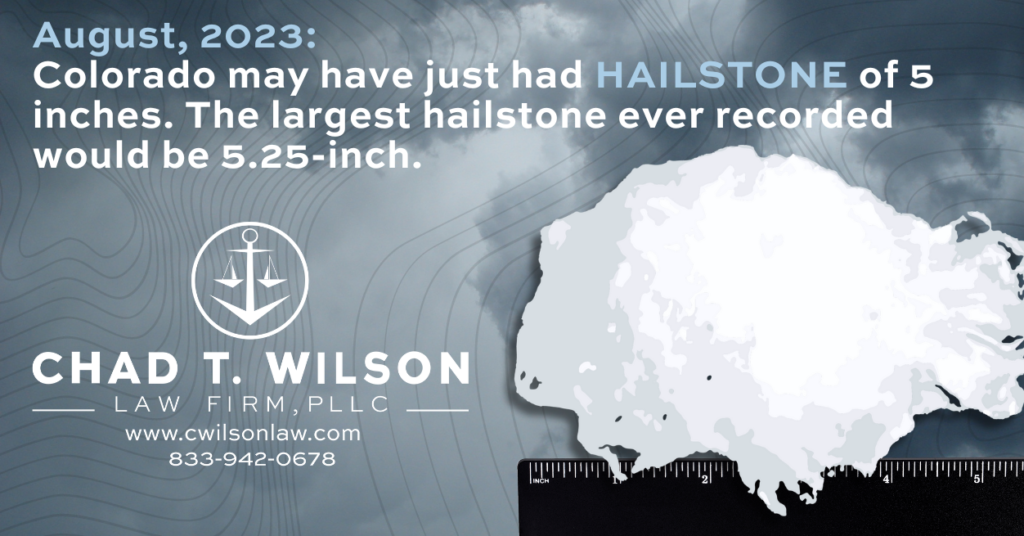
According to accounts from a storm chaser in the region on Tuesday night, a 5-inch hailstone dropped in rural Yuma County. The largest hailstone ever recorded in the state will be set if that hailstone is confirmed, which is likely given the precise measurement and photo that were obtained.

August, 2023: Colorado may have just had HAILSTONE of 5 inches. The largest hailstone ever recorded would be 5.25-inch.

Storm chaser Dan Fitts captured the 5-inch hailstone on camera. The storm that generated the powerful tornado that destroyed at least one home close to Yuma also produced the large hail.

A 4.83-inch hailstone that fell close to Bethune in August 2019 holds the record for the largest hailstone to ever be recorded in Colorado.

The Colorado State Climatologist Office must formally certify the record; this procedure could take weeks or even months.

The damage from the Yuma tornado may be severe enough to merit an EF-4 rating on the Enhanced Fujita scale in addition to the significant hail on Tuesday night. If so, it would be the first EF-4 tornado to hit Colorado since the current scale was introduced in 2007.

This week, the damage caused by the tornado in Yuma County will be evaluated by the National Weather Service office in Goodland, Kansas.

How to Respond if Your Insurance Claim is Rejected

There are three things you should do if your insurance claim for water damage is rejected:

1. Call the insurance provider.
An insurance claim is handled by numerous departments within the insurance provider. Based on their personal beliefs, anyone could contest the assertion. It is crucial to get in touch with the insurance provider and learn the precise reasons why the claim was rejected.

2. Request A Review.
Ask for the claim to be evaluated if you are unable to fix the problem. The insurance adjusters may get the answers to their inquiries and approve the claim through the review procedure.

3. Call Chad T. Wilsom Law Firm, PLLC.
Speak with a water damage attorney if you’re having trouble getting your claim processed or if the insurance company is attempting to pay less for the claim than is reasonable.

Learn more about our attorneys:
https://cwilsonlaw.com/meet-the-team-chad-t-wilson-law-firm-pllc-insurance-attorney/

Follow us on Social media:
https://beacons.ai/chadtwilsonlaw

Contact our Chad T. Wilson Law Firm Office Locations to Schedule a free Consultation.


Chad T. Wilson is an attorney whose firm specializes in property insurance disputes.

Written By:
Alejandro Caro

Chad T. Wilson – News
August 15, 2023
Updated: August 15, 2023 02:20 p.m.
Source: 
wsj.com

Home insurers are charging more and providing fewer coverages. Travelers, a big home insurer, stated that a 19% hike in premiums was only one part of its “profit improvement” strategy

July/August, 2023 News: Home insurers are charging more and providing fewer coverages.

After years of losses due to hurricanes, fires, and inflation, the industry is attempting to recover. So, analysts and insurance brokers, home insurers are trying to recoup their losses from the previous six years by offering less coverage and charging more.

In addition to Florida, California, and other areas vulnerable to hurricanes, floods, or wildfires, managing director at the independent insurance company Goosehead Insurance Lauren Menuey noted that the trend toward greater costs and poorer coverage is widespread. “I don’t think there’s anywhere safe from this right now,” she remarked.

In the first half of this year, house insurance businesses continued to suffer losses. Storms, natural disasters, inflation, and supply-chain hiccups have driven up claims to the point where many insurers are still losing money despite significant premium hikes.

An S&P Global Market Intelligence research for The Wall Street Journal, double-digit rate increases have been allowed in 31 states since the beginning of the previous year. With approval rates ranging from 20% to 30%, Arizona, Texas, North Carolina, Oregon, Illinois, and Utah had the highest amount of allowed hikes. Some insurers have stopped selling new policies in areas like California.

Additionally, businesses are relocating away from some disaster-prone areas. Many major insurers have left Florida and Louisiana, both of which have recently seen storm losses totaling tens of billions of dollars. The insurance industry claims that regulatory restrictions on pricing mean State Farm and Allstate cannot charge enough to cover their costs in wildfire-prone California, where they have ceased writing new home insurance policies. According to California’s insurance regulator, insurers have not requested sufficient rate hikes.

Florida has coverage limitations, higher insurance costs, and “reluctance from insurers to write policies for older homes or homes that don’t have strong wind mitigation,” according to Miami-based Fred Zutel of brokerage Lockton. Now, he continued, “we’re seeing similar, albeit not quite as punitive, restrictions from insurers in other low-lying coastal areas, such as Louisiana, Texas, and the Carolinas.”

Consumers are impacted by higher premiums because they already face higher interest rates and inflation. According to industry insiders and analysts, there is little possibility that the pain associated with home insurance will lessen in the near future for either businesses or policyholders. Dale Porfilio, chief insurance officer at trade organization the Insurance Information Institute, stated that “we’re still seeing the industry having an underwriting loss this year continuing out to 2025.” The institute predicts that “the cycle of continuing to take rates upward is going to continue for the next two years,” according to Porfilio.

A slowing in the increase in repair and replacement costs, which helped drive up the dollar worth of claims, is one good aspect. According to insurance analytics company Verisk, the total cost of reconstruction, including personnel and materials, is up 1.6% so far this year, down from increases of more than 7% in each of the previous three calendar years.

But it seems like the effects of the weather are growing worse. A spate of recent strong storms across the Midwest have caused considerable home insurance losses, according to companies. For instance, Progressive reported that last month’s revenue from home insurance premiums was consumed by 92% of catastrophic losses. The business cited extreme weather across the US. Insurance brokers Aon, insured damage from severe storms, wildfires, floods, and other natural catastrophes has exceeded $90 billion each of the last three years in the United States. According to the Aon data, that is much more than the inflation-adjusted averages for any of the four decades prior, including $54 billion for the 2010s and $40 billion for the 2000s.

According to Porfilio of the Insurance Information Institute, insurers “expect catastrophe losses to remain elevated for all the climate-risk reasons we, scientists, and everyone else have talked about.” According to scientists and brokers, global warming is making some natural disasters more common while population changes into prone areas are raising the expenses at the source.

The substantial rise in costs for the reinsurance coverage that house insurance firms purchase to transfer some of their risk reflects the rising cost of catastrophes. According to Fox, these higher premiums may be passed directly on to homeowners’ bills, depending on the state regulator. According to data from his company, reinsurance rates increased by an average of 33% and 50% for renewals that took place on June 1 and included numerous Florida companies.

How to Respond if Your Insurance Claim is Rejected

There are three things you should do if your insurance claim for water damage is rejected:

Call the insurance provider.

An insurance claim is handled by numerous departments within the insurance provider. Based on their personal beliefs, anyone could contest the assertion. It is crucial to get in touch with the insurance provider and learn the precise reasons why the claim was rejected.

Request A Review.

Ask for the claim to be evaluated if you are unable to fix the problem. The insurance adjusters may get the answers to their inquiries and approve the claim through the review procedure.

Call Chad T. Wilsom Law Firm, PLLC.

Speak with a water damage attorney if you’re having trouble getting your claim processed or if the insurance company is attempting to pay less for the claim than is reasonable.

Learn more about our attorneys:
https://cwilsonlaw.com/meet-the-team-chad-t-wilson-law-firm-pllc-insurance-attorney/

Follow us on Social media:
https://beacons.ai/chadtwilsonlaw

Chad T. Wilson – News
August 8, 2023
Updated: August 8, 2023 12:05 p.m.
Source: www.cwilsonlaw.com

Chad T. Wilson: The National TOP 100 TRIAL LAWYERS

Chad T. Wilson: The National TOP 100 TRIAL LAWYERS

We are thrilled to announce that six of our gifted attorneys at The Chad T. Wilson Law Firm, PLLC, have been recognized by The National Trial Lawyers: Top 100.

Who are the Top 100 National Trial Lawyers?
The National Trial Lawyers Top 100 is an invitation-only professional association made up of the top litigators from each state or region who satisfy strict requirements to practice civil plaintiff and/or criminal defense litigation. Peer nominations and independent research are both used in the thorough, impartial, and consistently applied procedure that determines the winner. Only the top few attorneys from each state or region who exhibit exceptional leadership, reputation, influence, stature, and public profile as measured by fair and uniformly applied standards in accordance with state bar and model rules are granted membership. Learn more about The Top 100 National Trial Lawyers here.

The Chad T. Wilson Law Firm’s, PLLC, recognized Attorneys:

Chad’s accomplishments:
https://thenationaltriallawyers.org/members/chad-wilson/

Jay’s accomplishments:
https://thenationaltriallawyers.org/members/jay-simon/

Michaels’s accomplishments:
https://thenationaltriallawyers.org/members/michael-jack/

Davids’s accomplishments:
https://thenationaltriallawyers.org/members/david-sanders/

Brandon’s accomplishments:
https://thenationaltriallawyers.org/members/brandon-schilter/

Joseph’s accomplishments:
https://thenationaltriallawyers.org/members/joseph-milensky/

We are proud of their achievements and the positive impact they’ve made on our firm.

Congratulations!

Learn more about us:

Call Chad T. Wilsom Law Firm, PLLC.
Speak with a property damage attorney if you’re having trouble getting your claim processed or if the insurance company is attempting to pay less for the claim than is reasonable.

Learn more about our attorneys:
https://cwilsonlaw.com/meet-the-team-chad-t-wilson-law-firm-pllc-insurance-attorney/

Follow us on Social media:
https://beacons.ai/chadtwilsonlaw

Contact our Chad T. Wilson Law Firm Office Locations to Schedule a free Consultation.


Chad T. Wilson is an attorney whose firm specializes in property insurance disputes.

Written By:
Alejandro Caro

Chad T. Wilson – News
August 3, 2023
Updated: August 3, 2023 12:30 p.m.
Source: www.cwilsonlaw.com

What kind of harm does flooding do to your property?

What kind of harm does flooding do to your property?

Most people are aware of the potential devastation that floods could do to cities and towns. If a flood damages your property, you can be forced to pay for costly repairs, depending on how bad the flood was. Everyone is susceptible to flooding, so being aware of the potential effects on your home and the precautions you may take to safeguard it will help you be more prepared.

How can a flood affect my property?

A flood can harm your property, from unstable floors to mold. However, property owners should walk around and physically inspect their property for structural damage and look for downed electrical lines or gas leaks before going inside to assess the damage. When you are unsure whether it is safe to enter the property or not, do not go inside.

Following a flood, you could discover the following types of damage at your house:

Electrical Problems After Water Damage

If the original water damage is not repaired, it could harm your electrical system as well as other gadgets and devices throughout the house. Damaged wiring may arc or result in power surges that could permanently break plugged-in equipment.

Enter your property only when the electricity has been completely turned off by the utility company, the fire department, or a licensed electrician. The only way to entirely disconnect the house from the grid is to remove the meter from the socket. Though someone is running a generator nearby and back-feeding electricity into the damaged electrical infrastructure, you could still be electrocuted in a flooded basement even though you’ve lost power.

Property Appliance Harm

Four Key Precautions: As you evaluate the damage, keep yourself and your family safe by:

1. Wait for a professional to inspect your appliances.

If there is moisture in the electrical components, this could short-circuit the device or, even worse, shock the user, posing a serious and even fatal risk of damage.

The best course of action is to wait until the water has subsided before unplugging any appliances that came into contact with the water during a flood. Avoid performing this while submerged in water. Nanni continues, “Don’t reconnect appliances until a certified technician has examined them.

2. Avoid using the HVAC.

According to the Centers for Disease Control and Prevention’s instructions for re-entering a flooded house, turning on your cooling (or heating) equipment can spread mold throughout your ductwork and home.

Before you turn on your system, have an HVAC expert with knowledge of mold cleanup evaluate it. The CDC states that “professional cleaning will kill the mold and stop future mold growth.” You can use your HVAC system to remove surplus moisture from your home once it is operational and has been determined to be safe.

3. Watch Out for Mold Inside

Your Freezer and Refrigerator.
When you arrive at your house, it’s a positive indicator if the refrigerator or freezer is still on. But that doesn’t necessarily mean the appliance is safe. Wet insulation will dry slowly after the device is powered on and running, which leaves it open to mold growth.

If the water in your kitchen climbed just a few inches, you might be in luck. According to Joe Pacella, the engineer who oversees CR’s tests of refrigerators and freezers, “the refrigerator’s compressor and condenser are sealed, and—unless it’s a built-in model—those parts are located at the bottom of the refrigerator.” “Because it’s higher up, the insulation is probably dry,” Given that it is significantly closer to the floor than the insulation in a refrigerator, the insulation in a chest freezer is most likely moist.

4. Keep an eye on the ice and water inside your fridge.

The icemaker and water dispenser on a refrigerator are connected to your water line. According to Greg Crite, manager of GE Appliances’ Technical Assistance Group, you should change the water filter in your refrigerator if you’ve been without water for a while or are currently under a boil alert. He also suggests the following actions to safeguard your health: Throw away your ice, run the ice-maker for an hour, flush the dispenser for three to five minutes, then clean and disinfect the bins.

Mildew and Mold

Mold can start to grow on any damp surface within 24 to 48 hours, according to the Federal Emergency Management Agency (FEMA). This means that after a flood, mold can impact your personal belongings, such as clothing and furniture, in addition to construction components like drywall, flooring, and insulation. Drying out your home and possessions as soon as you can is one way to aid in preventing the formation and spread of mold. The CDC advises opening the windows and using fans and dehumidifiers to aid in drying out the house if an electrician has confirmed it is safe to use the electricity.

Septic System and Well Water System Damage

The Environmental Protection Agency (EPA) warns that after a flood, septic tank filters may become clogged with debris, which will reduce the tank’s capacity to absorb water. After a flood, make a plan to have it tested and inspected as soon as you can. According to the EPA, flood water may also carry sediment that contaminates drinking water when it enters wells. Prior to consumption, be sure your water has been tested and, if necessary, treated.

What should I do if my home sustains flood damage?

You must promptly notify your insurer of your loss in writing, per your flood insurance policy’s requirements. To get the process started, get in touch with your flood insurance agent or the relevant flood insurance provider. The name of your insurance provider, your policy number, and your contact information will probably be required when filing a claim.

How to Respond if Your Water Damage Claim is Rejected

There are three things you should do if your insurance claim for water damage is rejected:

1. Call the insurance provider.

An insurance claim is handled by numerous departments within the insurance provider. Based on their personal beliefs, anyone could contest the assertion. It is crucial to get in touch with the insurance provider and learn the precise reasons why the claim was rejected

2. Request A Review.

Ask for the claim to be evaluated if you are unable to fix the problem. The insurance adjusters may get the answers to their inquiries and approve the claim through the review procedure.

3. Call Chad T. Wilsom Law Firm, PLLC.

Speak with a water damage attorney if you’re having trouble getting your claim processed or if the insurance company is attempting to pay less for the claim than is reasonable.

Learn more about our attorneys:
https://cwilsonlaw.com/meet-the-team-chad-t-wilson-law-firm-pllc-insurance-attorney/

Follow us on Social media:
https://beacons.ai/chadtwilsonlaw

Contact our Chad T. Wilson Law Firm Office Locations to Schedule a free Consultation.


Chad T. Wilson is an attorney whose firm specializes in property insurance disputes.

Written By:
Alejandro Caro
1 2 3 4 5 6