What the American Mobile Insurance Exchange Exit Means for You
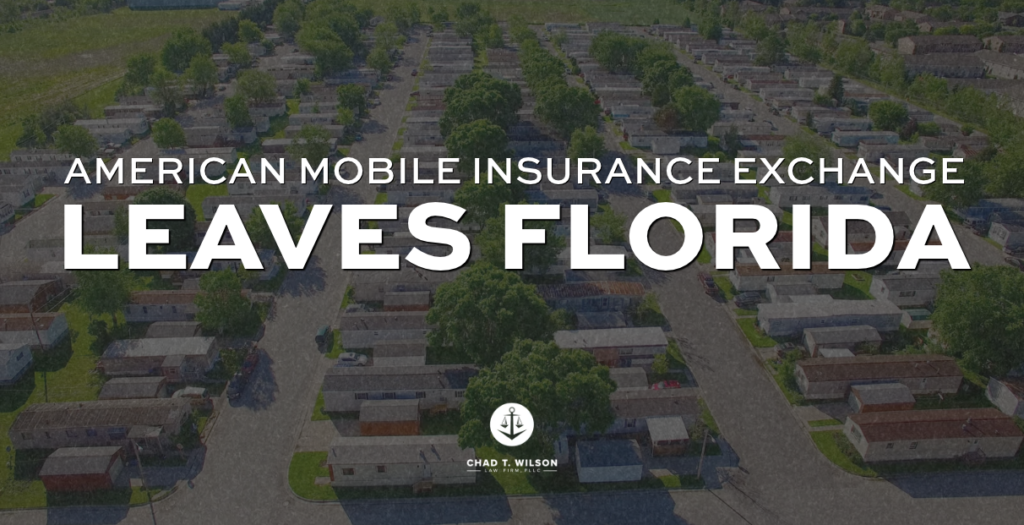
American Mobile Insurance Exchange

By Chad T. Wilson Law Firm Staff, based on reporting by the Florida Office of Insurance Regulation, October 19, 2026. Read the original announcement here.

If your mobile or manufactured home was covered by American Mobile Insurance Exchange, you probably saw the headline and felt your stomach drop. Here is the plain version. On October 19, 2026, Florida regulators announced that American Mobile Insurance Exchange must give up its license to do business in the state. That is a significant step, but it is not the same thing as the company vanishing or your claims disappearing. This post walks through what actually happened, what it does and does not mean, and the records you should gather now.

Key Takeaways

  • On October 19, 2026, the Florida Office of Insurance Regulation announced that American Mobile Insurance Exchange must surrender its Certificate of Authority after a supervised wind-down.
  • Surrendering authority is not a liquidation or a receivership. OIR says any remaining liabilities will be handled under Florida law.
  • The company wrote only manufactured and mobile home coverage in Florida. Back in 2024 it moved about 8,000 policies to another insurer and canceled more than 1,100.
  • Former policyholders should keep every transfer, cancellation, refund, renewal, and claim document in one place.
  • If a claim tied to your old policy was denied, delayed, or underpaid, you still have rights, and there are deadlines worth watching.

What did Florida regulators actually decide?

Insurance Commissioner Mike Yaworsky said American Mobile Insurance Exchange has to surrender its Certificate of Authority, which is the state license a company needs to sell and service insurance in Florida. The regulator found the company was in unsound financial condition. Its policyholder surplus, the cushion an insurer keeps to pay claims, had fallen to $15.09 million from $20.98 million the year before. Florida requires at least $15 million in surplus for companies licensed to write residential property, so the company was sitting right at the line.

The company had received its license in 2020 and wrote only mobile home business, and only in Florida. Regulators also pointed to an earlier threat by the company to move its operation to another state, a move other state regulators declined to approve.

Surrender, supervision, or liquidation: what’s the difference?

These words get used loosely, and the difference matters for you. Administrative supervision is when the state steps in and watches a struggling company closely, approving its decisions and protecting customers while it stabilizes or winds down. OIR placed American Mobile under supervision in March 2024. Surrendering authority is the company handing back its license to operate. Liquidation is a court-supervised process that happens when an insurer cannot pay what it owes, and it can trigger the state guaranty association to step in on covered claims.

The October 19 action is a surrender of authority at the end of a supervised process. The announcement does not describe a new liquidation, a receivership, or a finding that claims will go unpaid. OIR said it worked toward an orderly wind-down, required refunds of unearned premium to canceled policyholders, and stated that “any additional liabilities that might arise from this company’s departure will be handled promptly” and under Florida law. Treat anyone who tells you the company has been liquidated with caution, because that status has not been announced.

Who is affected?

This is a manufactured and mobile home story. If you held an American Mobile policy, your coverage may already have been transferred to a different carrier or canceled during the 2024 wind-down. In March 2024, the company filed a plan to transfer roughly 8,000 policies to another insurer and cancel more than 1,100 policies effective May 31, just ahead of hurricane season. That timing is exactly why your paperwork matters. You need to know, in writing, who insures you today and what happened to any claim you had open.

What former policyholders should do now

Do not assume anything about your current coverage or about who is responsible for an old claim until you have read the actual documents. Pull these together:

  • Your policy and any renewal or non-renewal notices.
  • Any cancellation or transfer notice, and the name of the replacement carrier.
  • Premium payment history and any refund of unearned premium.
  • Claim correspondence, adjuster estimates, and payment explanations.
  • Dates, names, and notes from every phone call about your policy or claim.

If you are not sure who covers you right now, confirm it before you file anything. A quick call to verify your active carrier can save weeks of confusion later.

If your claim was denied, delayed, or underpaid

A carrier changing course does not erase a valid claim. If you had an American Mobile claim that was denied, dragged out, or paid for less than the damage, keep going. Write down what the company told you and when. Ask for any denial or underpayment in writing, with the policy language behind it. Watch your deadlines, because the clock on a claim does not stop just because a company is leaving the market. And remember the money at stake is yours. You paid premiums so that coverage would be there when you needed it.

How Chad T. Wilson Law Firm Can Help

When a carrier winds down, policyholders are the ones left reading fine print and wondering who to call. We help you keep your footing when an insurer changes course. Our team has resolved more than 6,000 property insurance claims, and we represent policyholders, never insurance companies. We can review your transfer and cancellation paperwork, figure out who is actually on the hook for an open claim, and press a denied claim that deserves to be paid. Insurance companies have an army of lawyers, adjusters, and agents. You should not have to face that alone. If you want a second set of eyes, our insurance claim lawyers work on contingency, which means no recovery, no fee. Call (833) 942-0678. Denied, delayed, or underpaid? That is where we start.

Practice Areas

  • Denied insurance claims
  • Delayed insurance claims
  • Underpaid insurance claims
  • Bad faith insurance claims
  • Storm and hurricane damage claims

This article is for general information only and is not legal advice. Regulatory descriptions reflect the Florida Office of Insurance Regulation’s public announcement and are not a statement about any individual policy or claim. No outcome is guaranteed.

Sources: Florida OIR announcement (Oct. 19, 2026); Florida OIR orders and memoranda
State Farm and Allstate Hail Claims Lawsuit: What Oklahoma Homeowners are Facing

Oklahoma State Farm Lawsuit

By Chad T. Wilson Law Firm Staff — based on reporting by Oklahoma Watch (via KGOU), August 17, 2026. Read the original reporting here.

The Oklahoma State Farm Lawsuit: What Homeowners Should Know About Hail Claims

The Oklahoma State Farm lawsuit accuses one of the country’s largest home insurers — along with Allstate — of building its roof-claim process to pay policyholders less. The claims are serious; they’re now backed by newly released internal documents, and — importantly — they have not been proven in court. But for any homeowner who has ever had a hail claim come back lower than expected, the details are worth understanding.

What the Documents Allege

According to lawsuits and reporting drawn from internal materials, State Farm allegedly launched a pilot program it called the “Hail Focus Initiative” in Dallas County in 2020, then expanded it into other states. Attorneys say internal documents credited the program with more than $1 billion in claim-payment “savings” in its first year.

The alleged mechanics are the part homeowners should notice. The program reportedly removed or restricted field adjusters’ authority to approve full roof replacements and subjected approvals — not denials — to extra managerial scrutiny. Internally, State Farm allegedly estimated that each claim closed without payment saved the company roughly $15,000.

In plain terms, the allegation is that the people who actually stood on the roof lost the power to say “this needs to be replaced,” while the decision to pay got second-guessed more than the decision to deny.

Oklahoma by the Numbers

The scale is what moved this from individual disputes to state action. Between 2019 and 2024, State Farm reportedly denied payment entirely on 27,764 Oklahoma wind-and-hail claims, and at least partially denied another 91,588. State insurance regulators and plaintiffs’ attorneys contend those numbers reflect a system, not a series of coincidences.

Allstate Faces Similar Allegations

State Farm isn’t alone. Allstate’s internal materials allegedly characterized roof claims as a major source of “opportunity dollars” — areas where reduced claim payments could improve profitability. Plaintiffs point to an older data point as a preview: after a 1997 claims-process test in Albuquerque, payment rates allegedly fell from 75.9% to 29.2% for wind claims and from 82.8% to 11.1% for hail claims.

Oklahoma Attorney General Gentner Drummond filed suit against State Farm on June 24, 2026, and a comparable action against Allstate on July 7, 2026, alleging violations of consumer-protection and anti-racketeering laws and seeking restitution, civil penalties, injunctive relief, and disgorgement of profits. “This case is about more than individual claim disputes,” Drummond said of the State Farm filing. “The allegations describe a corporate scheme that threatens the integrity of Oklahoma’s insurance marketplace.”

From Private Lawsuits to a State Examination

This is no longer only private litigation. The Oklahoma Insurance Department has confirmed that newly released State Farm materials are now part of an active market-conduct examination of homeowners’ wind-and-hail claim practices — an examination it has described as reviewing “significant” documents, with an information-sharing agreement in place with the Attorney General’s office.

Meanwhile, a judge has authorized the deposition of State Farm’s CEO, State Farm faces a court-ordered deadline to produce documents, and the central Hursh case is scheduled for trial on December 7, 2026. Both insurers dispute the allegations, and nothing has been finally adjudicated.

Why This Matters Even If You’re Not in Oklahoma

Here’s the through-line for policyholders everywhere: the alleged tactics — remote reviewers, managerial overrides, undisclosed definitions of “hail damage,” and performance metrics that rewarded lower payouts — aren’t unique to one state or one storm. They describe a way of handling claims that could, in theory, show up anywhere.

So the question worth asking isn’t just “did my claim get denied?” It’s: who actually made that decision? If your roof claim was reviewed and reduced by someone who never set foot on your property, that’s worth a second look.

What You Can Do

If you suspect your hail or wind claim was underpaid or wrongly denied:

  • Request your full claim file, including the adjuster’s original report and any internal review notes.
  • Ask who reviewed the claim — the field adjuster who inspected your roof, or a remote reviewer who didn’t.
  • Get an independent inspection and compare it against the carrier’s scope, line item by line item.
  • Document the adjuster’s original recommendation if it differed from the final decision.

You already paid for your roof when you paid your premiums. You have the right to understand how — and by whom — your claim was decided.

How Chad T. Wilson Law Firm Can Help

At Chad T. Wilson Law Firm, we represent policyholders across the United States whose property claims were denied, delayed, or underpaid — and we know how carrier claim systems are built. With more than 6,000 claims resolved, we can review your hail or wind claim, examine how it was handled, and help you understand your options when the insurance company’s first answer doesn’t add up.

Denied, delayed, or underpaid? Let’s set your case on course. Contact us today for a free claim review.

Practice Areas

Do not lose hope if you have filed an insurance claim and were denied or underpaid. Let the Chad T. Wilson Law Firm get justice for you.

Name

Was Your TWIA Hurricane Beryl Claim Underpaid After the Inspection?

TWIA Hurricane Beryl Claims Underpaid

By Chad T. Wilson Law Firm Staff — based on reporting by Ezra Amacher, Insurance Journal, August 17, 2026. Read the original reporting here.

TWIA Hurricane Beryl Claims Underpaid

When a windstorm adjuster walks your property after a hurricane, you expect the number they write down to be the number your insurer honors. A new federal lawsuit alleges that, for some Hurricane Beryl policyholders, that isn’t what happened

Lawsuit Alleges: TWIA changed Insurance Estimate

Three Texas homeowners have filed a proposed federal class action against the Texas Windstorm Insurance Association (TWIA) and its claims vendor, Leading Edge Claims Service (now operating as Hansen), alleging the two systematically reduced Hurricane Beryl damage estimates after field inspections were complete. According to the complaint, an out-of-state supervisor assumed electronic control of adjusters’ estimates and “wrongfully removed or reduced covered repairs” — while the final document still carried the original field adjuster’s name.

One adjuster reportedly found that 23 of 29 estimates he reviewed had been revised downward. In one cited claim, an approximately $90,948 field estimate became a $30,816 payment — a cut of roughly two-thirds — even though the paperwork continued to identify the original adjuster as its author.

The plaintiffs are seeking class-action status and both actual and treble damages under the federal RICO statute. TWIA does not comment on active litigation but has stated that “the Association’s claim adjusting procedures are compliant with applicable Texas and federal laws.” The allegations have not been proven in court.

Why This Matters for Houston and Galveston Homeowners

Beryl came ashore on the Texas coast in July 2024, and TWIA is the wind-and-hail insurer of last resort for much of that coastline — including Galveston and the surrounding counties. If the allegations hold up, this isn’t a story about one unlucky claim. It’s about a gap between what the adjuster saw and what the carrier paid — and about homeowners who had no way of knowing the two didn’t match.

That’s the uncomfortable part. If your estimate was quietly trimmed, the name on the report is still the adjuster who stood in your yard. The number, the lawsuit alleges, may have been someone else’s.

In an Estimate Dispute, the File Is Your Compass

Property estimates today are written in software like Xactimate, which keeps a revision history — a record of what was added, removed, or changed, and when. Carrier audit trails and an adjuster’s original field notes can reveal whether the scope you were paid on matches the damage that was actually documented on site. That paper trail is often the difference between a hunch and a provable underpayment.

What to Do If You Suspect TWIA Underpaid Your Beryl Claim

If your TWIA Hurricane Beryl claim felt low, it’s worth a closer look:

  • Request your complete claim file, including the full estimate and any revision history.
  • Compare the carrier’s final scope against your contractor’s estimate and your own photos.
  • Note any line items you expected — roof, decking, interior water damage — that were removed or reduced without explanation.
  • Ask whether the adjuster who inspected your home recognizes the final estimate as their own work.

You paid your premiums. You have the right to an estimate that reflects the damage an adjuster actually found.

How Chad T. Wilson Law Firm Can Help

Headquartered in Webster, Texas, Chad T. Wilson Law Firm has helped policyholders resolve more than 6,000 property insurance claims. We understand how carrier estimates are built — and how they can be quietly taken apart. If your TWIA Hurricane Beryl claim was denied, delayed, or underpaid, we can
review your file, measure it against the real scope of your damage, and help you understand your options.

Contact us today for a free claim review. Your recovery is our mission.

Practice Areas

Judges in Citizens Insurance Arbitration Cases Funded by Insurer

Judges in Citizens Insurance Arbitration Funded by Insurer

By Chad T. Wilson Law Firm Staff — based on reporting by Kate Hussey, WPTV News, November 13, 2025. Read the original reporting here.

Florida Homeowners in Citizens Insurance Arbitration Face Uphill Battle

For thousands of Florida homeowners, the fight to get a fair insurance payout has taken a troubling turn. According to a WPTV investigation by Kate Hussey, the very judges deciding property damage disputes against Citizens Insurance are funded by Citizens itself.

Under a 2023 agreement approved by state lawmakers in House Bill 799, the state-run insurer began routing policyholder disputes through mandatory arbitration—a process where administrative law judges, not juries, make final decisions. Those judges’ salaries, roughly $250,000 per year, are paid directly through a contract funded by Citizens Insurance.

That setup is raising serious constitutional and ethical concerns about impartiality and fairness. As one insurance attorney told WPTV, “Judges are human. They have mortgages, they buy groceries. It’s hard to believe they can be completely impartial when the insurer signing their paycheck is also one side of the case.”

A System That Favors Insurer

Records show that Citizens wins 99% of the cases that go to final hearings. Out of 54 fully litigated disputes between May 2024 and May 2025, judges sided with Citizens in all but one.

More than 1,000 cases have now been funneled through this arbitration system. While Citizens data claims that 37% of policyholders reached “favorable settlements,” many of those “wins” amount to only a few hundred dollars. One attorney told WPTV, “Usually it’s $500—take it or leave it. And if you don’t settle, Citizens threatens to make you pay their legal fees if you lose.”

These outcomes have left many Florida families questioning whether they ever truly had a fair shot.

When the Deck Is Stacked Against Policyholders

For Glorida and Jason Nitch of Vero Beach, the fight has been exhausting. Their home was damaged by a tornado ahead of Hurricane Milton, leaving their roof leaking and walls separating. A private engineer estimated $65,000 in damage, yet Citizens denied the claim, blaming “wear and tear.”

When the Nitches appealed, their case was automatically sent to arbitration—without their consent. They later learned that the judge deciding their case was being paid by Citizens. “I think it’s extremely unfair,” Glorida told WPTV. “We didn’t even know this was in our policy.”

Their case remains unresolved, and their home continues to deteriorate while they wait.

Constitutional Concerns and Legal Pushback

Legal challenges are now piling up. In August, a Florida circuit court judge issued a statewide injunction halting the Citizens insurance arbitration process, siding with homeowners who argued the clause strips them of their constitutional right to a jury trial.

Attorney Joey Padilla, who represents policyholders in multiple cases, called the system “a violation of fundamental rights.” Roughly 400 Citizens arbitration cases are now paused while courts decide whether the entire process is even legal.

Despite that, Citizens Insurance stands by its system, claiming it saves money and resolves disputes faster—85 days on average versus 622 days in court. But the speed seems to come at a steep cost for fairness and transparency.

What Homeowners Can Learn from This

At The Chad T. Wilson Law Firm, we fight for policyholders who’ve been pushed into unfair systems or denied rightful compensation. Whether you’re facing a Citizens Insurance arbitration, a storm damage claim denial, or a delayed payout, our team knows how to challenge these practices and hold insurers accountable.

Here’s what you can do:

  • Review your policy documents carefully before renewal. Look for arbitration clauses.
  • Document all damage and keep records of every communication with your insurer.
  • Be wary of low settlement offers—once you accept, you may waive your right to pursue a larger claim.
  • Consult an experienced Insurance Attorney if you’ve been denied, underpaid, or forced into arbitration.

How Chad T. Wilson Law Firm Can Help

At The Chad T. Wilson Law Firm, we’ve helped thousands of Texans rebuild after storms — from tornadoes and hurricanes to hail and wind damage. When insurers don’t hold up their end of the deal, we step in to make things right.

Contact us today for a free consultation. Your recovery is our mission.

Practice Areas

Do not lose hope if you have filed an insurance claim and were denied or underpaid. Let the Chad T. Wilson Law Firm get justice for you.

Name

State Farm Lawsuit Raises Questions about Fairness

state farm lawsuit

By Chad T. Wilson Law Firm Staff — based on reporting by Brianne Nemiroff, Yahoo News, December 7, 2025. Read the original reporting here.

Insurance Fails Sunland Park Resident

For generations, State Farm built its reputation on a simple slogan: “Like a good neighbor, State Farm is there.” But for one New Mexico homeowner, that promise now feels hollow.

According to a federal lawsuit filed by Koteiba Azzam, a resident of Sunland Park, the insurance giant engaged in a systemic effort to underpay and deny legitimate claims—even after his home was severely damaged by a burst pipe. Azzam says the company’s investigation was “insufficient and unreasonable,” leaving his home in disrepair and his claim prematurely closed.

His case is more than a single complaint. It’s part of a growing pattern where major insurers appear to prioritize profit margins over policyholders.

The State Farm Lawsuit: Profits Before Policyholders

The State Farm lawsuit, with the guidance of consulting firm McKinsey & Company, alleges that the insurance giant implemented an internal program called “Fire ACE.” The plan, according to the filing, aimed to transform State Farm’s claims department into a profit center—rewarding employees for denying or minimizing payouts and discouraging fair settlements.

Under this system, claims were assigned preset payment values that didn’t reflect true market costs for repairs. Policyholders like Azzam were left shouldering thousands in unreimbursed damages for issues their policies were supposed to cover.

If these claims are true, the implications go far beyond one homeowner’s case. It would suggest a deliberate attempt to make insurance payouts harder to obtain, even for customers who’ve paid their premiums faithfully for years.

A Widespread Problem in an Era of Extreme Weather

The State Farm lawsuit comes at a time when Americans are filing record numbers of property damage claims. From hurricanes and wildfires to floods and winter freezes, catastrophic events are increasing—and so are disputes with insurers.

In California alone, the 2025 Los Angeles County wildfires generated more than 41,000 insurance claims totaling over $20 billion in payments. Yet nearly 39,000 of those were only partially paid, leaving families struggling to rebuild.

When insurers systematically underpay, those gaps don’t just cost money—they cost stability, safety, and peace of mind. Homeowners can’t afford to wait months or years for justice while their homes sit unrepaired or unsafe.

Why Policyholders Deserve Accountability

Insurance is meant to be a safeguard, not a gamble. When insurers turn claim management into a profit strategy, families pay the price. These tactics—if proven—represent a violation of both trust and good faith, the foundation of every insurance contract.

As weather grows more extreme and claims become more complex, policyholders deserve transparency, fairness, and accountability from the companies they rely on most.

What You Can Do If Your Insurance Claim Is Underpaid or Denied

If your insurance claim was denied, delayed, or lowballed after a storm or disaster:

  • Request written documentation for all claim decisions.
  • Compare repair estimates with independent contractors or appraisers.
  • Keep records of all emails, phone calls, and adjuster visits.
  • Consult a qualified Insurance Attorney to review your case and protect your rights.

You’ve paid your premiums. You’ve upheld your end of the contract. You have the right to expect your insurer to do the same.

How Chad T. Wilson Law Firm Can Help

At The Chad T. Wilson Law Firm, we’ve helped thousands of Texans rebuild after storms — from tornadoes and hurricanes to hail and wind damage. When your insurance claim is denied or underpaid, we step in to make things right.

Contact us today for a free consultation. Your recovery is our mission.

Practice Areas

Do not lose hope if you have filed an insurance claim and were denied or underpaid. Let the Chad T. Wilson Law Firm get justice for you.

Name

Tornados in Northwest Houston:
What Homeowners Need to Know

Tornadoes in Northwest Houston

By Chad T. Wilson Law Firm Staff — based on reporting by Justin Ballard and Caroline Wilburn, Houston Chronicle, November 24, 2025. Read the original reporting here.

Tornadoes in Northwest Houston Tear Through Cypress and Klein

For many Houston residents, their Thanksgiving week started with chaos when tornadoes in Northwest Houston ripped through neighborhoods in Cypress and Klein, tearing roofs off homes, uprooting trees, and knocking out power for more than 21,000 customers.

Firefighters from Klein, Spring, and Cy-Fair spent hours responding to gas leaks and debris blocking roads, while CenterPoint Energy crews worked through the night to restore service. Thankfully, no major injuries were reported — but many families are now facing what comes next: cleaning up, assessing damage, and figuring out how to deal with their insurance companies.

When Tornado Damage Becomes a Legal Battle

Storms like this one remind Texans that tornado season doesn’t always end in spring. In recent years, late-season cold fronts have collided with Gulf humidity, producing violent storms well into winter.

The Houston Chronicle reported that multiple tornado and severe thunderstorm warnings were issued throughout the day, bringing wind gusts up to 50 mph, small hail, and flooding in several communities. For homeowners, that means potential roof damage, water intrusion, or even structural shifting — and that’s where the problems often begin.

We’ve seen it time and again: after a storm, insurers send adjusters who downplay or deny legitimate claims. They might say damage was “pre-existing” or caused by poor maintenance, not the storm. But if your home was hit by a tornado or windstorm, that’s exactly what your policy is supposed to cover.

Hidden Costs of Tornado Damage

Even if your house looks okay from the street, don’t assume everything’s fine. Tornadoes can twist structures in ways that aren’t immediately visible. We’ve heard from homeowners in Memorial Northwest and Riata Ranch who discovered:

  • Leaks spreading from the attic into walls and ceilings
  • Cracked bricks or foundation shifts
  • Warped framing from sudden wind pressure
  • Electrical damage from fallen lines

The worst thing you can do is wait. File your claim, but document everything first — photos, videos, even receipts for temporary repairs. And don’t rely solely on the insurance company’s adjuster. Independent inspections often uncover issues they conveniently “miss.”

What to Do If You’re Facing a Tornado Damage Claim

If your property was damaged in the recent Houston storms, here are a few steps to protect yourself:

  • Get everything in writing. Don’t rely on phone calls — paper trails matter.
  • Avoid lowball offers. Quick checks often come with strings attached.
  • Seek a second opinion. Independent roofers or inspectors can make all the difference.
  • Talk to an Insurance Attorney if your claim has been delayed, denied, or underpaid.

How Chad T. Wilson Law Firm Can Help

At The Chad T. Wilson Law Firm, we’ve helped thousands of Texans rebuild after storms — from tornadoes and hurricanes to hail and wind damage. When insurers don’t hold up their end of the deal, we step in to make things right.

Contact us today for a free consultation. Your recovery is our mission.

Practice Areas

Why Choose a Houston Windstorm Insurance Damage Lawyer?

If your windstorm damage claim has been denied, delayed, or underpaid, the Chad T. Wilson Law Firm can help. Based in Houston, our attorneys specialize in handling windstorm insurance disputes nationwide. We fight for the coverage you’re owed. Contact our team today for a free consultation.

Do not lose hope if you have filed an insurance claim and were denied or underpaid. Let the Chad T. Wilson Law Firm get justice for you.

Name

Oklahoma Attorney General Takes Fight to State Farm on Hail Claims

Oklahoma Attorney General Takes fight to State Farm Over Hail Damage Claims

By Chad T. Wilson Law Firm Staff — based on reporting by Brianne Nemiroff, Yahoo News, December 7, 2025. Read the original reporting here.

When Insurance Fails the People It Promises to Protect

For generations, State Farm built its reputation on a simple slogan: “Like a good neighbor, State Farm is there.” But for one New Mexico homeowner, that promise now feels hollow.

According to a federal lawsuit filed by Koteiba Azzam, a resident of Sunland Park, the insurance giant engaged in a systemic effort to underpay and deny legitimate claims—even after his home was severely damaged by a burst pipe. Azzam says the company’s investigation was “insufficient and unreasonable,” leaving his home in disrepair and his claim prematurely closed.

His case is more than a single complaint. It’s part of a growing pattern where major insurers appear to prioritize profit margins over policyholders.

The Allegations: Profits Before Policyholders

The lawsuit alleges that State Farm, with the guidance of consulting firm McKinsey & Company, implemented an internal program called “Fire ACE.” The plan, according to the filing, aimed to transform State Farm’s claims department into a profit center—rewarding employees for denying or minimizing payouts and discouraging fair settlements.

Under this system, claims were assigned preset payment values that didn’t reflect true market costs for repairs. Policyholders like Azzam were left shouldering thousands in unreimbursed damages for issues their policies were supposed to cover.

If these claims are true, the implications go far beyond one homeowner’s case. It would suggest a deliberate attempt to make insurance payouts harder to obtain, even for customers who’ve paid their premiums faithfully for years.

A Widespread Problem in an Era of Extreme Weather

The lawsuit comes at a time when Americans are filing record numbers of property damage claims. From hurricanes and wildfires to floods and winter freezes, catastrophic events are increasing—and so are disputes with insurers.

In California alone, the 2025 Los Angeles County wildfires generated more than 41,000 insurance claims totaling over $20 billion in payments. Yet nearly 39,000 of those were only partially paid, leaving families struggling to rebuild.

When insurers systematically underpay, those gaps don’t just cost money—they cost stability, safety, and peace of mind. Homeowners can’t afford to wait months or years for justice while their homes sit unrepaired or unsafe.

Why Policyholders Deserve Accountability

Insurance is meant to be a safeguard, not a gamble. When insurers turn claim management into a profit strategy, families pay the price. These tactics—if proven—represent a violation of both trust and good faith, the foundation of every insurance contract.

As weather grows more extreme and claims become more complex, policyholders deserve transparency, fairness, and accountability from the companies they rely on most.

What You Can Do If Your Insurance Claim Is Underpaid or Denied

If you’ve faced delays, denials, or lowball offers from your insurer after a storm or disaster:

  • Request written documentation for all claim decisions.
  • Compare repair estimates with independent contractors or appraisers.
  • Keep records of all emails, phone calls, and adjuster visits.
  • Consult a qualified Insurance Attorney to review your case and protect your rights.

You’ve paid your premiums. You’ve upheld your end of the contract. You have the right to expect your insurer to do the same.

How Chad T. Wilson Law Firm Can Help

At The Chad T. Wilson Law Firm, we’ve helped thousands of Texans rebuild after storms — from tornadoes and hurricanes to hail and wind damage. When insurers don’t hold up their end of the deal, we step in to make things right.

Contact us today for a free consultation. Your recovery is our mission.

Practice Areas

Do not lose hope if you have filed an insurance claim and were denied or underpaid. Let the Chad T. Wilson Law Firm get justice for you.

Name

Charlotte homeowner questions insurance denial of roof claim

Charlotte Homeowner denied roof damage claim
By Chad T. Wilson Law Firm Staff — based on reporting by Jason Stoogenke of Action 9, WSOC-TV, January 2, 2026. Read the original reporting here

Homeowners pay insurance premiums year after year, expecting that when something goes wrong, their insurer will step in. A Charlotte, North Carolina, homeowner recently learned firsthand how difficult the insurance claims process can be when his insurer, ERIE, refused to cover storm‑related roof damage. Bel-Fakir, the homeowner, questioned, “Where’s my money going” He feels like he has been let down as he is “paying for the roof insurance:” (Action 9) His experience, highlighted by Action 9, reflects a growing frustration that homeowners across the country experience with roof damage claims. Homeowners insurance is designed to cover “unexpected damage,” not the ordinary wear and tear that develops on an aging roof. However, following a storm, distinguishing between covered loss and pre‑existing aging can be challenging.

In response, ERIE defends this complaint by noting that “ the claim was handled appropriately.” and “understand the customer is disappointed by the coverage outcome.”  but their decision was “based on the facts, circumstances and terms of the policy.”(Action 9)

Common reasons insurers give for roof denials include:

  • The roof was already aging

  • The damage is “cosmetic” rather than structural

  • The storm did not cause the specific issues claimed

  • The damage does not meet the insurer’s internal threshold for coverage

If Your Roof Damage Claim Was Denied, We Can Help

Understanding your homeowners insurance policy is critical, especially when a claim is denied. If your roof‑damage claim has been denied or underpaid, you don’t have to navigate the process alone. Our firm helps homeowners interpret their policies, understand their rights, challenge unfair decisions, and pursue the compensation they are entitled to under state law.

Schedule your consultation with Chad T. Wilson Law today to secure your peace of mind and protect your home.

Spring Hill Homeowner Vandalism Claim Denied by Citizens

By Chad T. Wilson Law Firm Staff — based on reporting by JC Hallman and John Dobberstein December 3rd, 2025

Tom Luby, a homeowner in Spring Hill, Florida, was twice denied by Citizens Insurance for his nearly $100,000 vandalism claim on his rental property. The property damage is extensive, with stolen and destroyed appliances, significant debris inside and outside the premises, and damaged floors.

According to WFTS, Citizens Insurance stated the extensive damage was an “incomplete remodel” of the home, and not vandalism caused by the evicted tenants. Unfortunately, Mr. Luby is unable to take the insurance company to court due to Florida’s insurance reform laws, after being denied twice. He is “forced into meditation” with the Florida Division of Administrative Hearing. (WTFS) The insurer’s refusal to pay highlights problems with the insurance dispute process, which critics claim unfairly benefits the state-backed insurance company.

Florida’s Insurance Reform Law

Under recent insurance reform laws, such as House Bill 799 and enacted changes in 2023, policyholders with Citizens must resolve disputes through arbitration before the Florida Division of Administrative Hearings (DOAH) rather than filing a lawsuit in regular court. The impact of these changes “would speed up hearings and save money.” (Yahoo Finance)

Controversies Around the DOAH Process

Luby himself stated that “three different attorneys” declined to represent him because they believed you “can’t win” under the current system. (Yahoo Finance). Also, Luby’s attorney, who represents him in the mediation, “questioned the neutrality of the DOAH judges” as many of the judges are “former defense lawyers that represented insurance companies.” Investigations by ProPublica and reporting from Florida media have revealed that Citizens wins more than 90% of final hearings at the DOAH. In contrast, when cases go through traditional circuit courts, the insurer wins roughly 55% of the time. (Yahoo Finance).

This disparity raises concerns that the forced arbitration process:

  • Strongly favors insurers

  • Discourages attorneys from taking cases

  • Leaves homeowners feeling they have “no chance” of justice

In addition, Citizens CEO Tim Cerio “defended the mediation process”, stating that policyholders go through a “6-step review of the claim” before being required to attend a DOAH hearing. He further noted that “all disputed claims sent to DOAH, 37% are settled before the final hearing.” (Yahoo Finance)

Denied Property Insurance Claim?

If your homeowner’s insurance claim has been denied, delayed, or underpaid, call the  property insurance attorneys at the Chad T. Wilson Law Firm at (833) 942-0678. We protect the rights of policyholders around the nation. Reach out to us today for a free consultation.

Homeowners Reduce Insurance Coverage Costs

Growing Insurance Costs Push Homeowners

By Chad T. Wilson Law Firm Staff — based on reporting by JC Hallman and John Dobberstein December 3rd, 2025

As we head into 2026, many homeowners are renewing their insurance policies only to find higher deductibles and more complex coverage terms than in past years. Escalating insurance expenses have become increasingly prevalent over the last several years, forcing homeowners to make difficult decisions about coverage.

According to a recent home insurance study by J.D. Power, “47% of homeowners in 2025 have experienced a premium increase in the past year.”

A Growing Trend Toward Higher Out-of-Pocket Costs

To manage rising insurance expenses, more homeowners are opting to accept the risk of a higher deductible. According to the Insurance Information Institute, “increasing your deductible from $500 to $1,000 may decrease your premium by approximately 10% to 25%” (Realtor.com).

Deductibles are the amount you must pay before your insurance coverage applies, and they are rising across many markets. One strategy homeowners are using to lessen premium increases is “opting for higher deductibles” (Realtor.com). While this can reduce insurance costs, it also means homeowners bear more of the financial risk if property damage occurs.

What Areas Are Being Impacted the Most

Homeowners in risk-prone areas are experiencing the most significant changes. According to the National Bureau of Economic Research, insurance premiums often rise fastest in areas with the highest risk of natural disasters, such as hurricanes or wildfires (“insurance premiums often rise in areas with the highest risk of natural disasters such as hurricanes or wildfires”) (Realtor.com).

Additionally, Rick McCathron, President and CEO of Hippo Home Insurance, has stated that “higher deductibles are becoming more common across the Midwest and other regions heavily affected by hail and convective storms,” highlighting the increasing severity of weather patterns (Realtor.com).

Start the Year by Reviewing Your Coverage

Before renewing your homeowners insurance policy, it is important to take the time to evaluate your current coverage. Insurance companies routinely adjust policy terms year to year, and 2026 is no exception.

With rising construction costs, inflation, and more frequent severe weather events, insurers are changing how policies are structured by including how deductibles are calculated and applied. A careful review now can help homeowners avoid unpleasant surprises later and better prepare for potential claims.

Protect Yourself Before a Claim Happens

Taking the time to review your policy now is critical, but understanding how those provisions are applied during a claim is equally important. If your claim is delayed, underpaid, or denied, you do not have to face the insurance company alone.

At Chad T. Wilson, we help businesses and homeowners hold insurers accountable for the full benefits they are owed under their policies. If you need assistance with a property insurance claim, contact our firm today for a free consultation.

1 2 3 … 13