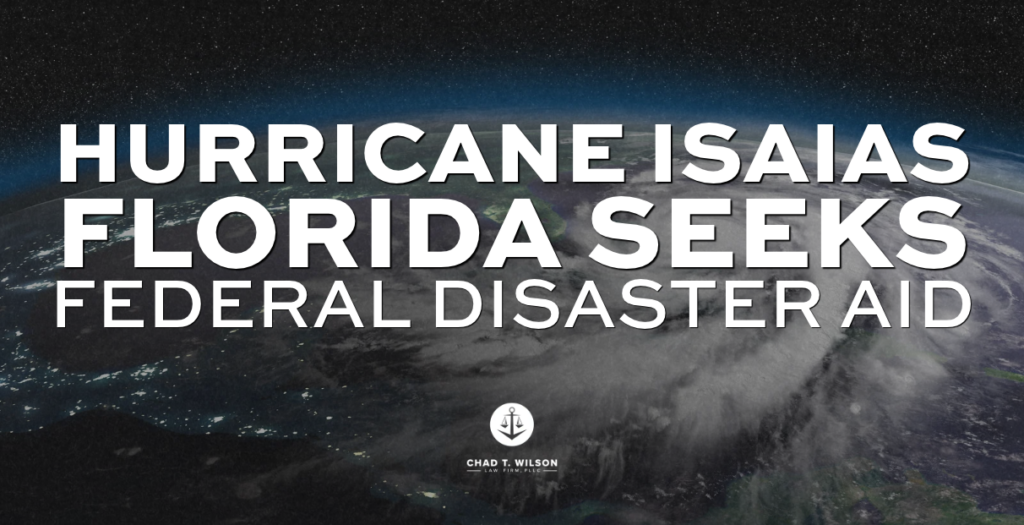
Florida Requests a Hurricane Isaias Major Disaster Declaration
By Chad T. Wilson Law Firm Staff — based on reporting by the Florida Governor’s Office and Florida Phoenix, October 16, 2026. Read the original reporting here.
On October 16, 2026, Florida formally asked the federal government for a Hurricane Isaias major disaster declaration, seeking broader federal support for communities across the Northwest Florida Panhandle. For homeowners and business owners still sorting through storm damage, the headline is encouraging — but the details matter. A request is not an approval, and federal aid works alongside your insurance, not in place of it. Here is a calm, plain-language look at what was requested and what it means for your claim.
Key Takeaways
- On October 16, 2026, Florida formally requested a federal major disaster declaration for Hurricane Isaias.
- The request seeks Public Assistance for 15 Northwest Florida counties and Individual Assistance for eight counties.
- The declaration has not been approved, and FEMA registration for this request is not yet open.
- Federal assistance does not replace an insurance claim and generally cannot duplicate benefits already paid by your insurer.
- Policyholders should keep documenting losses and pursuing their insurance claims now, rather than waiting for federal action.
What Florida’s Major Disaster Request Actually Covers
The state’s filing asks for two kinds of help. The first is Public Assistance, requested for 15 counties: Bay, Calhoun, Escambia, Franklin, Gadsden, Gulf, Holmes, Jackson, Jefferson, Liberty, Okaloosa, Santa Rosa, Wakulla, Walton and Washington. If approved, Public Assistance can reimburse eligible state and local governments and certain nonprofits for debris removal, emergency protective measures, and the repair or replacement of damaged roads, bridges, public buildings and utilities.
The second is Individual Assistance, requested for eight counties: Bay, Escambia, Gulf, Holmes, Okaloosa, Santa Rosa, Walton and Washington. If approved, Individual Assistance can help eligible households with temporary housing, basic home repairs, essential personal property and other necessary disaster expenses — with particular focus on uninsured or underinsured losses.
Requested Is Not the Same as Approved
This is the part worth slowing down on. As of now, the federal government has not approved the Hurricane Isaias major disaster declaration. Individual Assistance eligibility has not been established, and FEMA registration for this request is not yet open. Earlier in the month a separate federal emergency declaration was approved, but that is a narrower form of help and is not the same as the major disaster declaration now under review.
If the request is granted and registration opens, residents would apply through the official channels — DisasterAssistance.gov or 800-621-3362. Until then, be wary of anyone claiming that aid is already “available” or urging you to “apply now.” The honest answer today is that the request is pending.
How Federal Assistance and Your Insurance Claim Fit Together
Think of it as two separate currents that should not be crossed. Federal assistance is designed to help close the gap left by uninsured or underinsured losses — it generally cannot duplicate benefits your insurer has already paid or should pay. Your hurricane damage claim remains the primary path to recovering what your policy covers, and the two do not cancel each other out.
That is why the single most useful thing you can do right now is keep your insurance claim moving. Do not pause it to wait for a federal decision. Document the cause and chronology of the damage — wind, rain, surge or flooding — note whether your home is habitable, and keep every receipt for emergency repairs, temporary housing and additional living expenses. If you later receive public assistance, report it to both your insurer and your legal team so the records stay clean.
If Your Claim Was Denied, Delayed, or Underpaid
Storms like Isaias generate a flood of claims, and that volume is often where policyholders run into trouble. A few steady habits protect your position:
- Keep a written log of every call, adjuster visit and payment, with dates.
- Save all correspondence from your insurer, including denial or partial-payment letters.
- Photograph and inventory damaged property before making permanent repairs.
- Do not accept a low estimate as final simply because it arrives first.
- Ask for the specific policy language behind any denial or reduction.
If your insurer has accepted, limited, delayed or denied payment in a way that does not match your storm damage and your coverage, that is worth a second look.
How Chad T. Wilson Law Firm Can Help
Chad T. Wilson Law Firm represents policyholders — never insurance companies — and has resolved more than 6,000 property insurance claims for homeowners and businesses nationwide. Headquartered in Webster, Texas, our team helps families read the fine print, document their losses, and hold carriers to the policies they sold. We work on contingency: no recovery, no fee. If you are facing a hurricane or storm claim and the numbers do not add up, our insurance claim attorneys can review your situation at no cost. Denied, delayed, or underpaid? Call (833) 942-0678.
Practice Areas
- Hurricane and windstorm damage claims
- Storm and hail damage claims
- Denied, delayed and underpaid claims
- Water and flood damage claims
- Bad faith insurance disputes
This article is for informational purposes only and is not legal advice. Any descriptions of federal programs reflect a request that has not been approved; eligibility is not established and FEMA registration is not yet open. No outcome is guaranteed.
Sources: Florida Governor’s Office, Florida Phoenix, Florida Division of Emergency Management