Alabama Residents Sue State Farm

Alabama Residents Sue State Farm​

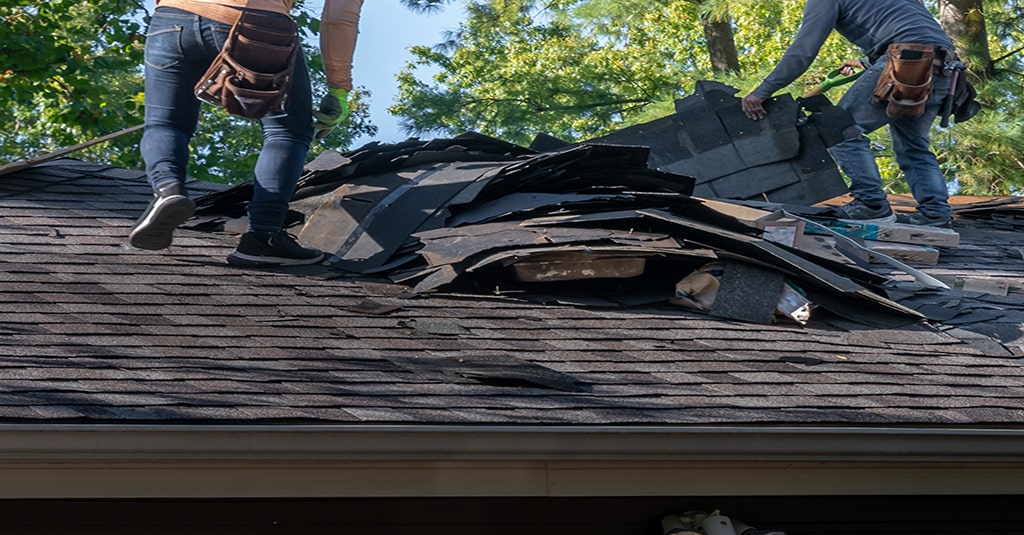
More than 20 homeowners in Dothan, Alabama, are taking legal action against State Farm Fire and Casualty Company, claiming the insurer denied valid property insurance claims after a series of hailstorms earlier this year.

The lawsuit, filed August 5th, is spearheaded by attorney Gantt Pierce, who represents residents from the Grove Park neighborhood and surrounding areas. According to Pierce, the pattern became obvious after repeated denials from State Farm in response to hail damage claims.

“You could ride around Grove Park and pick out who had State Farm insurance, and we knew that when they weren’t getting their roof fixed,” said Pierce. “We came to find out why not.”

What the Lawsuit Alleges

According to the complaint, plaintiffs sustained roof damage from hail between March and June 2025. Many also reported subsequent interior issues like ceiling stains and drywall damage due to delayed repairs. Despite being fully insured under what they believed were comprehensive homeowners policies, their claims were denied with little explanation.

The complaint further states that State Farm’s insurance adjusters and agents misrepresented policy coverage, specifically, that hail damage would be included. These homeowners, some of whom have been with State Farm for over two decades, now find themselves paying out of pocket for roofing and structural repairs they expected would be covered.

Damages in the complaint are estimated between $18,000 and $20,000 per property. In addition to roof damage, many of the homes sustained water damage to personal belongings, insulation, and even HVAC system components.

Insurance Companies and Trust

“When the insurance company doesn’t do what they say they’re going to do, that creates real trust problems,” Pierce said. “We want to hold them accountable for what they promised to do within their insurance agreements—and that’s to take care of families in need.”

In cases like these, the homeowners are seeking more than reimbursement—they’re seeking justice. These types of delays or denials are often referred to as bad faith practices, and can severely disrupt families trying to recover from natural disasters.

Hail Damage and Your Insurance Policy

Hail damage is one of the most common causes of residential roofing claims in storm-prone regions. When an insurance company refuses to approve a legitimate hail claim, it not only leaves homeowners vulnerable—it also risks leading to further issues, such as mold damage, decking deterioration, and compromised roof insulation. The longer the delay in addressing the cause of loss (COL), the more likely homeowners are to experience additional water damage or even foundational leaks.

This case follows a broader trend across the U.S., where policyholders are challenging insurance companies on claim denials related to hail storms, wind damage, and other natural disasters. It also highlights the growing importance of understanding the details in your insurance policy, such as your deductible, coverage limits, and whether you are operating on actual cash value (ACV) or replacement cost value (RCV) terms.

Our Hail Damage Attorneys Fight For You

At the Chad T. Wilson Law Firm, we stand with policyholders who’ve been denied fair treatment. We handle residential and commercial damage claims, working closely with clients, public adjusters, and field adjusters to ensure the insurance company honors its end of the deal.

If your roof damage claim has been delayed, denied, or underpaid, you don’t have to face it alone. Our team is here to fight for you and make sure your insurance company delivers the protection you’ve been paying for.

📞 Contact us today for a free consultation.

Your recovery is our mission.

Source: WTVY – Attorney representing over 20 residents in lawsuit against State Farm after hail damage claim denials

Do not lose hope if you have filed an insurance claim and were denied or underpaid. Let the Chad T. Wilson Law Firm get justice for you.

Name

Insurance Attorney Can Be Your Beacon After Texas Storms

In the wake of the devastating storms that swept through Texas, countless residents are now embarking on the challenging journey of recovery. This path is often complicated by the daunting task of navigating insurance claims, particularly when faced with denials or underpayments by insurance companies. This is where the Chad T. Wilson Law Firm emerges as your advocate and guide, ensuring that you traverse these complex legal pathways with confidence and obtain the compensation you rightfully deserve.

Our firm is anchored by a formidable team of dedicated property insurance attorneys, who specialize in the nuances of storm damage claims, including Texas windstorm and hail damage. The Chad T. Wilson Law Firm operates on the foundational belief that justice for policyholders should be unwavering and pursued with tenacity. Our legal expertise encompasses a broad spectrum of storm-related damages, highlighting our role as a leading hail damage claim and wind damage attorney. We stand as a beacon of hope and unwavering support for Texans who find themselves at the mercy of an insurance system that too often seeks to minimize payouts rather than alleviate loss.

Why You Need a Champion in Your Corner

Our firm has consistently observed countless instances where insurance companies, under the guise of complex policies and provisions, deny or undervalue legitimate claims. This practice, unfortunately common, leaves policyholders stranded. The aftermath of the Texas storms has vividly illustrated this issue, with innumerable families and businesses discovering their pathways to recovery unjustly obstructed by insurance denials.

The necessity of engaging a storm damage lawyer in these situations is paramount. The Chad T. Wilson Law Firm not only provides you with stalwart legal representation but a team deeply familiar with both the Texas environment and the unique challenges posed post-storm. Our attorneys excel at unraveling the complex language of insurance policies and identifying key elements that can transform a denied hail damage claim into a successful recovery, all within the hail damage claim time limit.

Your Recovery is Our Priority

Our strategy is rooted in thorough analysis and assertive representation. When we take on your case, it becomes a mission. We meticulously assess the damages, carefully review your insurance policy’s terms, and craft a strong case aimed at securing your rightful compensation. Our considerable success stories echo our legal prowess and steadfast commitment to our clients’ welfare.

The Chad T. Wilson Law Firm works on a contingency basis, affirming our confidence in our ability to deliver results. This means you incur no out-of-pocket expenses; our compensation is tied to the successful outcome of your case. In essence, our interests align perfectly with yours — securing the maximum recovery for your storm-related losses.

Empowerment through Legal Advocacy

At the core of our practice is empowerment. By lifting the legal burden from your shoulders, we enable you to focus on rebuilding, knowing your claim is managed by experienced professionals. Our team diligently navigates legal complexities, liaises with insurance companies on your behalf, and fights for the compensation you legally deserve.

The unpredictable Texas weather can wreak havoc, leaving behind a path of destruction. Yet, the journey to secure a fair insurance settlement in the wake of such events should not exacerbate your stress. With the Chad T. Wilson Law Firm at your side, representing you as your trusted wind damage attorney and storm damage lawyer, you’ve secured a formidable ally against the injustices of the insurance claims process.

The Path Forward

Recovery from the Texas storms is a daunting challenge. However, with the Chad T. Wilson Law Firm by your side, you have an empowered ally to guide you through the chaos that follows. We invite you to take advantage of our expertise, compassion, and relentless pursuit of justice for Texas policyholders.

The journey to recovery is undoubtedly filled with hurdles, but it’s a journey you don’t have to make alone. Contact us for a free consultation — let’s explore how our dedicated team can help you reclaim your peace of mind and secure the compensation necessary for rebuilding. In the face of a storm’s aftermath, remember, you have rights. Let Chad T. Wilson Law Firm be your voice.

Is your claim being denied or underpaid? Call Chad T. Wilson Law Firm, PLLC.

Speak with one of our attorney if you’re having trouble getting your claim processed or if the insurance company is attempting to pay less for the claim than is reasonable.

Contact us: https://cwilsonlaw.com/contact-us/ 

Follow us on Social media: https://beacons.ai/chadtwilsonlaw

Contact our office locations to schedule a free consultation.


Chad T. Wilson is an attorney whose firm specializes in property insurance disputes.

Schedule a free Consultation

Chad T. Wilson – Blogs and Resources
February, 27th 2024
Updated: February, 27th 2024 12:30 p.m.
Source: https://cwilsonlaw.com/

Types-of-Hail-Damage-Claims

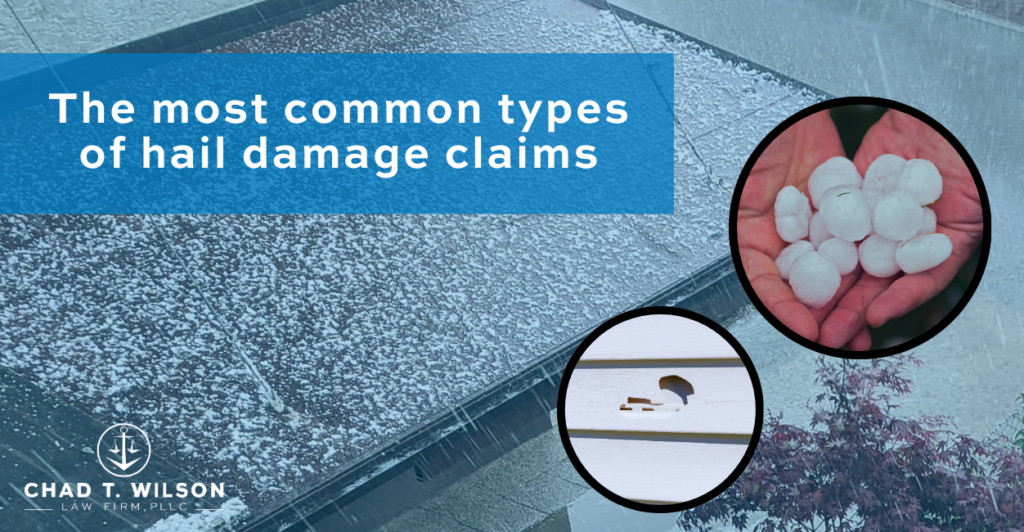
What are the most common types of hail damage claims?

Hailstorms can cause various types of property damage, leading to property insurance claims. The most common types of hail damage claims include:

It’s crucial to file a property hail insurance claim for a number of reasons:

  • Financial Protection: Your property, including cars, windows, siding, and roofs, may sustain major damage from hailstorms. You can pursue financial reimbursement for the repair or replacement of the damaged items by submitting an insurance claim. If you didn’t have insurance, you would have to pay for these things yourself.
  • Risk Mitigation: Insurance is a tool for risk transfer, or risk mitigation. You shift the financial risk of hail damage to the insurance provider by purchasing hail insurance. This guarantees that you may recover from the losses brought on by the hailstorm and helps safeguard your financial stability.
  • Policyholder’s Rights: If hail damage is covered by a current insurance policy, you are entitled to make a claim and be compensated in accordance with the terms of your policy. Making a claim is a requirement of the contract between you and the insurance company, and insurance companies are required to honor legitimate claims.
  • Preserving the Value of the Property: After a hailstorm, prompt repairs can help preserve the value of your property and stop additional damage. Ignoring hail damage and waiting to fix it could eventually result in more complex and expensive repairs.
  • Legal and commercial obligations: Should you own a mortgage on your home, the lender may demand that you keep up your insurance. In case you neglect to report hail damage and take appropriate action, you can be in breach of your mortgage contract.
  • Community Safety: If a hailstorm damages a community as a whole, submitting insurance claims jointly can help with the process of recovery and reconstruction. It facilitates the more efficient recovery of communities following natural disasters.

To guarantee a seamless and effective claims procedure, it’s critical to fully record the damage, give your insurance company precise information, and submit the claim as soon as possible. See your Property Insurance Attorney for advice if you have any questions concerning the coverage or the claims procedure.

Is your claim being denied or underpaid? Call Chad T. Wilson Law Firm, PLLC.

Speak with one of our attorney if you’re having trouble getting your claim processed or if the insurance company is attempting to pay less for the claim than is reasonable.

Contact us: https://cwilsonlaw.com/contact-us/ 

Learn more about our attorneys:
https://cwilsonlaw.com/meet-the-team-chad-t-wilson-law-firm-pllc-insurance-attorney/

Follow us on Social media:
https://beacons.ai/chadtwilsonlaw

Contact our Chad T. Wilson Law Firm Office Locations to Schedule a free Consultation.


Chad T. Wilson is an attorney whose firm specializes in property insurance disputes.

Written By:
Alejandro Caro

Schedule a free Consultation

Chad T. Wilson – Blogs and Resources
February, 5th 2024
Updated: February, 5th 2024 01:55 p.m.
Source: https://cwilsonlaw.com/

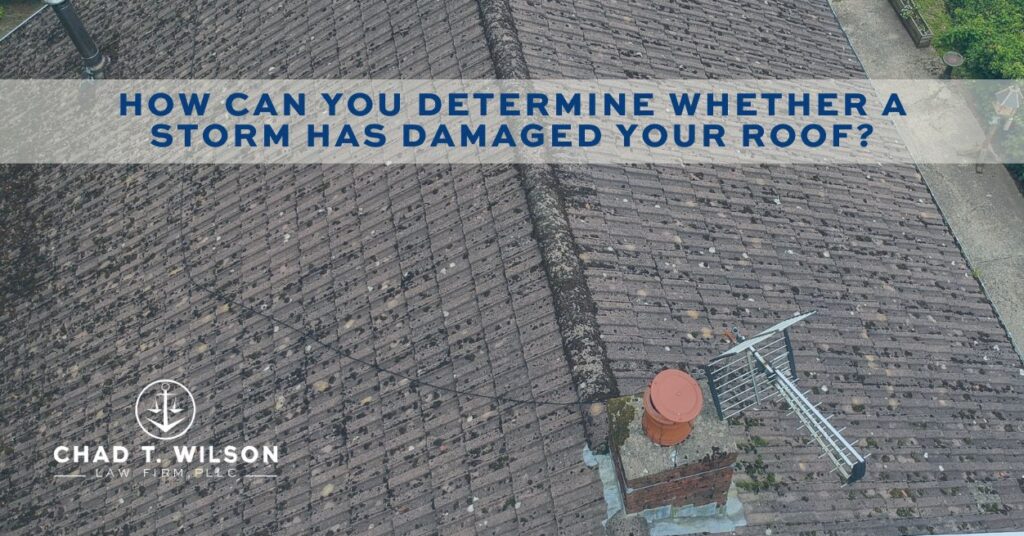
How can you determine whether a storm has damaged your roof?

Detecting damage on your roof is essential for timely repairs and insurance claims after any storm. If your home was hit by a hailstorm, windstorm, hurricane, tornado, fire, or other natural disaster, you should follow the following inspection steps.

Note: Before inspecting your roof, ensure your safety. Use a sturdy ladder and take necessary precautions to prevent accidents.

How can you determine whether a storm has damaged your roof?

What should you examine on your roof after a storm?

  • Check gutters, downspouts, and vents:
    Examine your gutters, downspouts, and roof vents for signs of damage. Look for dents, dings, or pockmarks on the metal surfaces.
  • Inspect the roof visually:
    Look for visible signs of damage from the ground. Binoculars may help you get a closer look. Pay attention to any dislodged or missing shingles.
  • Examine shingles:
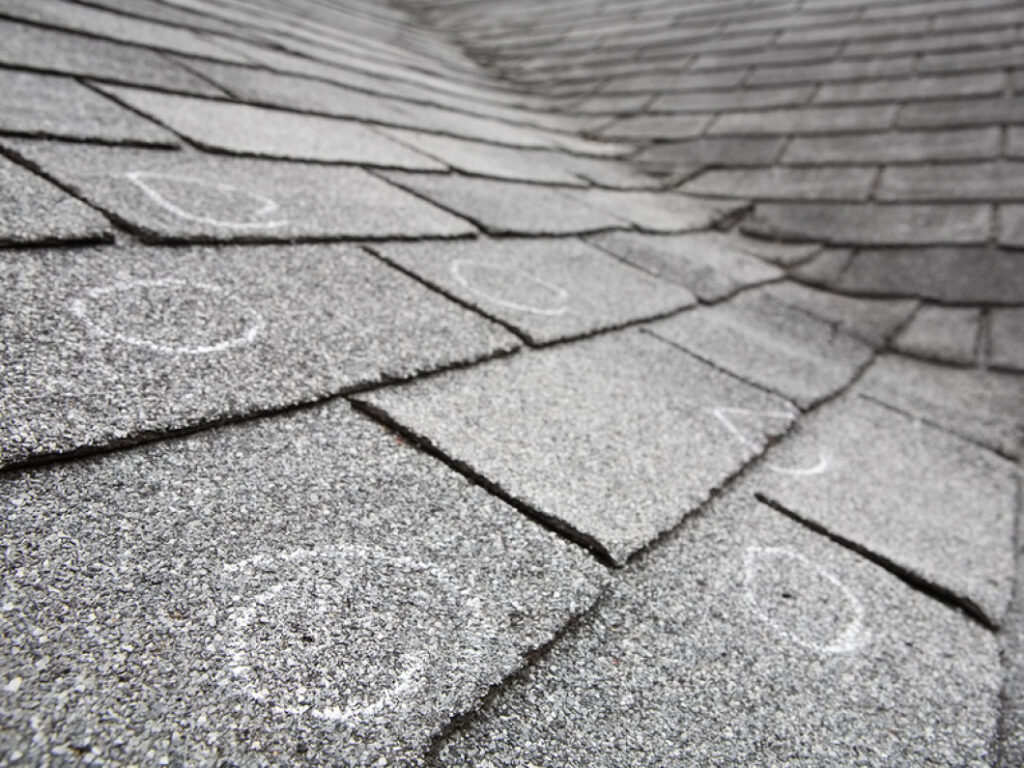
    Go up on the roof to inspect the shingles more closely. Look for circular or semi-circular dents, cracks, or splits in the shingles. Hail damage may also cause granule loss, exposing the underlying asphalt.
  • Check for bruising:
    Press on the shingles gently to check for bruising. Hail damage can sometimes cause soft spots or depressions in the shingles.
  • Inspect metal components:
    Examine metal components such as flashing, vents, and chimney caps for dents or damage.
  • Look for signs of leaks:
    Check your attic for any signs of water leaks. Water stains, dampness, or mold growth are indicators that your roof may be compromised.
  • Document the damage:
    Take clear photographs of any hail damage you find. This documentation can be crucial when filing an insurance claim.
  • Professional inspection:
    If you’re unsure or if the damage seems extensive, consider hiring a professional roofing inspector. They have the expertise to assess the full extent of the damage.
  • Contact your insurance company:
    If you find roof damage, contact your insurance company as soon as possible. Provide them with the documentation and photographs you’ve taken. Follow their instructions for filing a claim.

Remember that roof damage may not always be immediately apparent. It’s advisable to inspect your roof after a severe weather event, especially if there has been hail. Early detection and prompt repairs can prevent further damage and ensure the longevity of your roof.

Is your claim being denied or underpaid? Call Chad T. Wilson Law Firm, PLLC.

Speak with one of our attorney if you’re having trouble getting your claim processed or if the insurance company is attempting to pay less for the claim than is reasonable.

Contact us: https://cwilsonlaw.com/contact-us/ 

Learn more about our attorneys:
https://cwilsonlaw.com/meet-the-team-chad-t-wilson-law-firm-pllc-insurance-attorney/

Follow us on Social media:
https://beacons.ai/chadtwilsonlaw

Chad T. Wilson – Blogs and Resources
February, 5th 2024
Updated: February, 5th 2024 01:55 p.m.
Source: https://cwilsonlaw.com/

How can you determine whether a storm has damaged your roof?

Detecting damage on your roof is essential for timely repairs and insurance claims after any storm. If your home was hit by a hailstorm, windstorm, hurricane, tornado, fire, or other natural disaster, you should follow the following inspection steps.

Note: Before inspecting your roof, ensure your safety. Use a sturdy ladder and take necessary precautions to prevent accidents.

How can you determine whether a storm has damaged your roof?

What should you examine on your roof after a storm?

  • Check gutters, downspouts, and vents:
    Examine your gutters, downspouts, and roof vents for signs of damage. Look for dents, dings, or pockmarks on the metal surfaces.
  • Inspect the roof visually:
    Look for visible signs of damage from the ground. Binoculars may help you get a closer look. Pay attention to any dislodged or missing shingles.
  • Examine shingles:
    Go up on the roof to inspect the shingles more closely. Look for circular or semi-circular dents, cracks, or splits in the shingles. Hail damage may also cause granule loss, exposing the underlying asphalt.
  • Check for bruising:
    Press on the shingles gently to check for bruising. Hail damage can sometimes cause soft spots or depressions in the shingles.
  • Inspect metal components:
    Examine metal components such as flashing, vents, and chimney caps for dents or damage.
  • Look for signs of leaks:
    Check your attic for any signs of water leaks. Water stains, dampness, or mold growth are indicators that your roof may be compromised.
  • Document the damage:
    Take clear photographs of any hail damage you find. This documentation can be crucial when filing an insurance claim.
  • Professional inspection:
    If you’re unsure or if the damage seems extensive, consider hiring a professional roofing inspector. They have the expertise to assess the full extent of the damage.
  • Contact your insurance company:
    If you find roof damage, contact your insurance company as soon as possible. Provide them with the documentation and photographs you’ve taken. Follow their instructions for filing a claim.

Remember that roof damage may not always be immediately apparent. It’s advisable to inspect your roof after a severe weather event, especially if there has been hail. Early detection and prompt repairs can prevent further damage and ensure the longevity of your roof.

Is your claim being denied or underpaid? Call Chad T. Wilson Law Firm, PLLC.

Speak with one of our attorney if you’re having trouble getting your claim processed or if the insurance company is attempting to pay less for the claim than is reasonable.

Contact us: https://cwilsonlaw.com/contact-us/ 

Learn more about our attorneys:
https://cwilsonlaw.com/meet-the-team-chad-t-wilson-law-firm-pllc-insurance-attorney/

Follow us on Social media:
https://beacons.ai/chadtwilsonlaw

Chad T. Wilson – Resources
January 15, 2024
Updated: January 15, 2024 09:20 a.m.
Source: https://cwilsonlaw.com

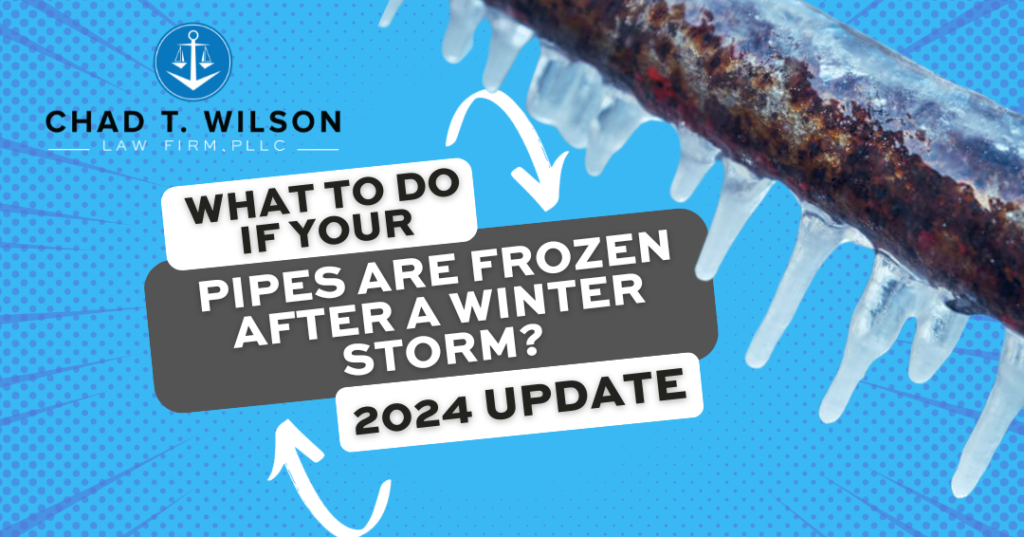
What to do if your pipes freeze during a winter storm 2024 Update

  • In frigid weather, set your home’s thermostat above 55 degrees.
  • Pour cold water into the faucet that is furthest away from your main valve. Water in motion prevents pipes from freezing.
  • Find emergency shut-off valves.
  • In locations without heat, insulate pipes.
  • To warm the pipes, open the cabinets and vanities.
  • Shut off the internal water supply valves.
  • Open the outside spigots to allow to drain water out.
  • Keep the outside valve open to allow any leftover water in the pipe to expand without rupturing.
  • Turn off the water at outside spigots and remove all water from the line when freezing weather is predicted.

Water utilities are responsible for water mains and pipe lines that connect to your home, but not pipes located on your property. If a pipe bursts on your property, call a plumber immediately for repairs. Help protect your pipes from potential damage and avoid costly repairs by following these steps.

Here are some tips to help avoid frozen pipelines in the future:

  • In frigid weather, set your home’s thermostat above 55 degrees.
  • Pour cold water into the faucet that is furthest away from your main valve. Water in motion prevents pipes from freezing.
  • Find emergency shut-off valves.
  • In locations without heat, insulate pipes.
  • To warm the pipes, open the cabinets and vanities.
  • Shut off the internal water supply valves.
  • Open the outside spigots to allow to drain water out.
  • Keep the outside valve open to allow any leftover water in the pipe to expand without rupturing.
  • Turn off the water at outside spigots and remove all water from the line when freezing weather is predicted.

Water utilities are responsible for water mains and pipe lines that connect to your home, but not pipes located on your property. If a pipe bursts on your property, call a plumber immediately for repairs. Help protect your pipes from potential damage and avoid costly repairs by following these steps.

How can you Prevent Your Pipes From Freezing During a Winter Storm in the future?

The pipes in unheated interior spaces, such as garages, attics, and basements, are the most vulnerable. However, pipes that pass through external walls or cupboards may also freeze. The good news is that you can maintain dry conditions in your home and running water by taking a few easy steps.

The American Red Cross, which deals with emergency preparedness, and the IBHS both offer helpful tips on how to keep your pipes from freezing and how to thaw them if they do.

Why Pipe Freezing is Such a Serious Problem:

One peculiar characteristic of water is that it expands when it freezes. Anything holding it in place, such as metal or plastic pipes, is under extreme pressure from this expansion. Expanding water has the potential to shatter pipes, regardless of how sturdy the container is.

The most commonly freezing pipes are:

  • Pipes that are subjected to extreme cold, such as sprinkler lines, swimming pool supply lines, and outdoor hose bibs.
  • Water supply pipes in unheated interior places such basements and crawl spaces, attics, garages, or kitchen cabinets.
  • Pipes that run against exterior walls that have minimal or no insulation.

Here are some tips to help avoid frozen pipelines in the future:

  • In frigid weather, set your home’s thermostat above 55 degrees.
  • Pour cold water into the faucet that is furthest away from your main valve. Water in motion prevents pipes from freezing.
  • Find emergency shut-off valves.
  • In locations without heat, insulate pipes.
  • To warm the pipes, open the cabinets and vanities.
  • Shut off the internal water supply valves.
  • Open the outside spigots to allow to drain water out.
  • Keep the outside valve open to allow any leftover water in the pipe to expand without rupturing.
  • Turn off the water at outside spigots and remove all water from the line when freezing weather is predicted.

Water utilities are responsible for water mains and pipe lines that connect to your home, but not pipes located on your property. If a pipe bursts on your property, call a plumber immediately for repairs. Help protect your pipes from potential damage and avoid costly repairs by following these steps.

What to do if your pipes freeze during a winter storm: 2024 Update

Even interior pipes can freeze in subzero conditions.

The likelihood of your pipes freezing and rupturing increases dramatically when the weather drops. According to the Insurance Institute for Business and Home Safety, burst pipes are one of the most frequent reasons for property loss during extremely cold weather. They can quickly result in thousands of dollars worth of water damage, or even more. If you experience frozen pipes at your home or business after a winter storm, continue reading this article.

Here are several steps you can take if your pipes freeze during a winter storm this 2024:

  • Activate the faucet and leave it running. In the future, a burst pipe can be avoided by letting the faucet drip, even a little bit.
  • Use a hair dryer to gently apply heat to the frozen spot. Air should be directed toward the faucet end of the pipe and progressively moved toward the coldest part. Take caution not to blow a fuse or overheat the hair dryer. Avoid using a propane torch since it might cause damage to the pipe and increase the risk of a fire.
  • Don’t stop heating until the water pressure is fully restored. Keep applying heat. Even so, after the pipe has thawed, it’s a good idea to leave the faucet open for a few minutes. This will allow the ice to get far enough away from the line.
  • Examine every faucet in your house to look for any further frozen pipes and prevent pipes from freezing in the future. It’s possible that other pipes have been impacted by one frozen pipe.

The pipes will probably take half an hour to thaw. This might change, though, based on the temperature, the length of time the pipe has been frozen, and its location. If none of the aforementioned actions work for you, you should contact a plumber for help.

How urgent is a burst pipe?

Put an end to the leaky pipes as soon as possible!

Even over brief periods of time, undetected burst pipes can result in significant property damage and higher water costs. Known as “water damage,” this problem can lead to flooding, damage walls and furniture, and ruin existing flooring.

Will homeowner insurance cover damage from frozen pipes?

Most homeowner and commercial property insurance policies, in general, will cover damage from a frozen pipe that bursts.

What to do if your insurance claim is denied or underpaid after a pipe burst causes water damage?

You might be able to file a lawsuit against your insurance provider if a burst pipe caused damage to your property and they either rejected your claim or paid you significantly less than the true cost of the damage. A pipe damage attorney can assist you in determining what to do next. Allow The Chad T. Wilson Law Firm insurance lawyers in Houston to defend your rights to justice and recompense. For a free consultation, reach out to us today. If your lawsuit is unsuccessful, there will be no payment due.

How can you Prevent Your Pipes From Freezing During a Winter Storm in the future?

The pipes in unheated interior spaces, such as garages, attics, and basements, are the most vulnerable. However, pipes that pass through external walls or cupboards may also freeze. The good news is that you can maintain dry conditions in your home and running water by taking a few easy steps.

The American Red Cross, which deals with emergency preparedness, and the IBHS both offer helpful tips on how to keep your pipes from freezing and how to thaw them if they do.

Why Pipe Freezing is Such a Serious Problem:

One peculiar characteristic of water is that it expands when it freezes. Anything holding it in place, such as metal or plastic pipes, is under extreme pressure from this expansion. Expanding water has the potential to shatter pipes, regardless of how sturdy the container is.

The most commonly freezing pipes are:

  • Pipes that are subjected to extreme cold, such as sprinkler lines, swimming pool supply lines, and outdoor hose bibs.
  • Water supply pipes in unheated interior places such basements and crawl spaces, attics, garages, or kitchen cabinets.
  • Pipes that run against exterior walls that have minimal or no insulation.

Here are some tips to help avoid frozen pipelines in the future:

  • In frigid weather, set your home’s thermostat above 55 degrees.
  • Pour cold water into the faucet that is furthest away from your main valve. Water in motion prevents pipes from freezing.
  • Find emergency shut-off valves.
  • In locations without heat, insulate pipes.
  • To warm the pipes, open the cabinets and vanities.
  • Shut off the internal water supply valves.
  • Open the outside spigots to allow to drain water out.
  • Keep the outside valve open to allow any leftover water in the pipe to expand without rupturing.
  • Turn off the water at outside spigots and remove all water from the line when freezing weather is predicted.

Water utilities are responsible for water mains and pipe lines that connect to your home, but not pipes located on your property. If a pipe bursts on your property, call a plumber immediately for repairs. Help protect your pipes from potential damage and avoid costly repairs by following these steps.

 links roof damage to hailstorm activity

Weather Service Report Links Roof Damage to Hailstorm That Insurance Company Claims Never Happened

Paying a high premium on an insurance policy can be a burden most people are familiar with. At some point in everyone’s life, you will need insurance. Whether that’s to pilot a boat, drive a car, or own a home, insurance is meant to financially compensate the policyholder if their property is lost, damaged, or stolen. Insurance companies make their bread and butter off their policyholders and in turn, those policyholders expect a reasonable investigation and fair compensation when they are required to file a claim because their property is damaged or made unusable.

On the night of April 18th, 2020, Montgomery County experienced a powerful wind and hail storm that blanketed the area in 1.2-inch size hail and wind gusts powerful enough to knock down several trees and powerlines throughout the county. Our client’s home endured the storm that evening. The hail damaged portions of our client’s roof and a storage building. The damage to the roof was severe enough that water had penetrated the roof and made its way inside through the ceiling of a utility room near the rear of the home. The hail also damaged gutters and drainage downspouts on the home.

Due to some unforeseen circumstances, some time passed before the claim was reported in March 2021. The insurance company received the claim—as it would any other—and began investigating the incident. As it would turn out, our client had canceled his policy with the insurance company in December 2020, prior to reporting the claim. The policy was canceled because our client ended up going with a different insurance company.

After its investigation, the insurance company denied our client’s claim. The alleged late reporting of the claim and the fact that the client had canceled his policy prior to reporting the claim likely factored into the insurance company’s decision.

Once the case came into our hands, we filed a lawsuit and pressed the insurance company immediately during discovery. During that process, we learned that the insurance company was using a third-party weather data source to pull aggregated data, which showed that the most recent date for sizable hail at our client’s home was 1-inch or larger hail which fell on September 19th, 2019. It seemed clear that the adjuster for the insurance company did not look at any other weather data. As a result of the tunnel vision that this report created, the insurance company then used this date as the actual date of loss.

Conveniently for the insurance company, there was a provision in the insurance policy stating that if the property damage is reported one year or 365 days after the date of loss, the insurance company can deny the claim.

In other words, with this claim the insurance company used favorable weather data from its preferred third-party vendor—apparently without checking other sources—as an excuse to move the date of loss to an earlier date. It then retroactively relied on the late reporting provision in the policy to deny the claim.

Our own investigation into the claim using other weather data sources—including the Severe Weather Data Inventory database provided by the National Oceanic and Atmospheric Association, or NOAA—uncovered severe hail in the immediate area of our client’s home on April 18, 2020. This date was within the policy period prior to cancellation and within one year of when the claim was reported, meaning that the late reporting provision did not apply.

When confronted with conflicting data, the insurance company initially stood its ground, believing its weather data as gospel. But our negotiating position had been improved and we were able to steer the case into mediation quickly. In mediation, we were able to get the insurance company to agree to a settlement that was favorable for our client and would allow him to complete the repairs to his home.

We are proud to say this case ended in a good recovery for our client and righted a wrong by the insurance company.

Many disputed wind and hail claims depend heavily on documenting and proving that severe weather impacted an insured’s property on a particular date. Insurance companies will use their own preferred third-party vendors to obtain data as part of their investigation, sometimes even consulting multiple services but only providing the insured with the data that supports the insurance company’s position. Our firm is very familiar with this tactic and frequently resolves cases where these issues are involved.

FREE CASE REVIEW

If your home or business was damaged by a wind or hailstorm and your insurance claim has been denied, delayed, or underpaid, call the expert property litigation attorneys at the Chad T. Wilson Law Firm today. Maximize your settlement and make the insurance company pay.

Cosmetic Damage Exclusions

Cosmetic Damage Exclusions & Property Litigation

Recently proposed property exclusions have created intense debates among agents, adjusters, insurers and insureds. As chaotic weather conditions across the country continue to rise, these exclusions claim to focus on the type of roof damage in an effort to circumvent coverage.  Essentially, what the insurer deems as “cosmetic damage” is excluded from coverage when/if the insurers choose to use this type of endorsement.

That’s where our client, BCD (a family partnership) needed our help. On June 6th, 2018 an intense hailstorm produced wind gusts over 59 miles per hour with massive hail, ultimately destroying windshields, skylights, roofs and other exterior structures on numerous homes and businesses throughout the Dallas area.

The following day, roof leaks began to appear causing water to visibly enter 3 of the 6 commercial properties BCD owns. The businesses impacted by the leaks reached out to their landlord, who promptly filed an insurance claim with Covington Insurance.

After filing the insurance claim with their provider, the insurer sent out an adjuster who reviewed the claim for roof leaks and cited “no damage” to any of the properties. When our clients rebuked the adjuster’s findings, the insurer sent a second adjuster who this time claimed the damage was minimal and fell under the deductible but for only one of the properties. Now befuddled and irritated with their insurance company’s confusing findings, BCD hired their own public adjuster. The insurer responded by sending out an engineer who did recognize the roof damage however he now claimed the damage was merely “cosmetic” in nature.

BCD and their public adjuster recognized what Covington was up to and promptly filed suit. Covington Insurance moved the case to Federal court where both parties were ordered to participate in an early mediation. At mediation, the case settled for more than 200 times the original under-deductible estimate written by Covington. Not only was our client delighted, but the public adjuster who they hired attended mediation and was also relieved to see the insured be fully indemnified. Now our client’s tenants could go back to running their businesses without the constant threat of interior leaks and roof damage disrupting their business operations.

A cosmetic damage exclusion means damage to external surfaces, including walls, roofs, doors, and windows that allegedly only impact the appearance (but not the functional purpose) may not be covered under the policy. These are things insurers consider ornamental or cosmetic and are usually very vaguely defined so that the insurer can tailor the damage as one being “merely cosmetic” to deny the claim.

Just because you have a cosmetic damage exclusion does not mean you are out of luck with your insurance claim. Our expert insurance litigation attorneys know how insurance companies operate and the tactics they employ to delay, deny, or underpay your property insurance claim. Our consultations are free, and you owe us nothing until we win your case. Contact us today.

How To Properly Identify Hail Damage To Your Roof
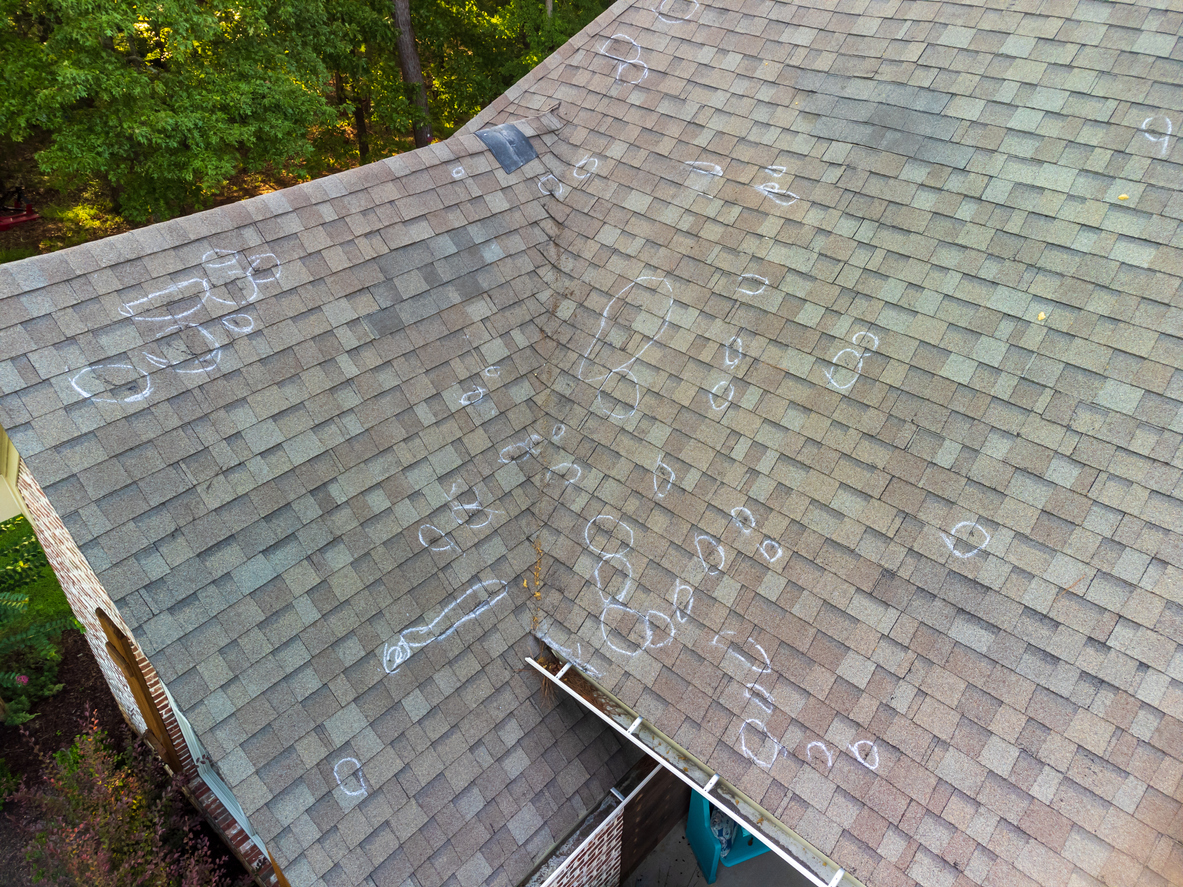
Roof with hail damage and markings from inspection

How To Properly Identify Hail Damage To Your Roof

It’s always a good idea to know how to identify hail damage on your roof, just in case you get hit by an unexpected hailstorm. The most common signs of hail damage are buckling shingles or tiles that have been popped off the roof and broken window panes. It’s also possible for there to be holes in the metal flashing around chimneys, vents, skylights, or pipes. If you see any of these signs on your home after a storm, it may be time to contact a professional to assess damages and repairs. Although hailstorms can be destructive, the amount of damage they cause can vary greatly depending on a number of important factors.

  • Hail Size and Density – The size of the hailstones can greatly affect the degree of damage to your property. A hailstone can be as small as a pea, or as large as a softball. Most hailstones do not have smooth edges, which can also impact the type of damage they cause.
  • Wind – The speed and direction of the wind during a hail event plays a role in how much, if any, damage will occur.
  • Building Materials – Different types of building materials absorb the impact of hail strikes differently. Hail can cause very noticeable dings and knicks in aluminum siding, gutters, or asphalt shingles, but can actually crack vinyl siding. Very large hail even has the ability to puncture a roof under certain circumstances.

What Does Hail Damage To A Roof Look Like?

What to look for when trying to identify hail damage to a roof varies depending on the type of shingles. Hail damage to composition shingles can look very different than hail damage on wood shingles. It’s important to understand the way different shingle materials absorb hail impacts so that you can accurately assess the damage to your roof should it occur. The most common types of shingles are asphalt and composition or wood shingles.

Asphalt and Composition Damage:

  • Hail hits that are black in color
  • Exposure of the roof felt due to the loss of granules
  • Hail hits that are soft to the touch
  • Asphalt that appears shiny

Wood Shingle Damage:

  • Splits in the shingle that are brown or orange in color
  • Splits in the shingle that have sharp corners and edges
  • Dents or impact marks along the splits


What Looks Like Hail Damage Might Not Be

It’s not always easy to identify hail damage on a roof. There is plenty of other damage to shingles that can occur naturally due to other types of weather events or even just the age of the roof. If you suspect your home has been damaged by a hailstorm, the best thing to do is contact your insurance company as soon as possible and potentially file a claim. You may also want to get a good professional to take a look.  If you do file a hail damage claim and it’s denied, contact us for a free case review.

Texas-Size-Hailstorm-Crushes-Conroe

Texas Size Hailstorm Crushes Conroe

Hail damage is the number one cause of property damage in the US. In 2019-2020 alone the State of Texas has seen more claims related to hail than most states. Severe property damage occurs when a dangerous storm strikes a highly-populated area with hail larger than an inch or more in diameter. Baseball-sized hail (3.5 inches across) is a common occurrence in the Lone Star State and creates devastation in our communities.

On March 18th, 2018, a major hailstorm blew through Montgomery County, impacting Conroe and the surrounding areas. Our client, an 80-year-old retiree, witnessed extensive hail damage to his roof.  As the original owner of the home, built-in 2006,  our client never imagined that he would have to eventually have to face down a hailstorm-homeowner insurance claim. Relying on his faith as a long-term customer with Safeco insurance (12 + years), he filled a hailstorm insurance claim and to his shock, the claim was denied. At that point he knew, he’d be facing down the insurance company in an effort to cover his losses.

The insurance company sent three different inspectors to review the property damage. Each one ended up blaming the manufacturer of the shingles on the roof, calling the product defective. Ironically, these were the same shingles that had been on the house since it was built. The very same shingles Safeco insured the home with, and routinely collected a premium from our client on. Next, the insurer would deploy extensive stalling and delay tactics to keep from paying our client’s insurance claim. Shortly thereafter, fed up and frustrated, our client hired us to pursue the insurer.

Our team of engineers independently reviewed the property damage and determined the roof damage was not due to defective shingles, but actual storm damage. A series of depositions would cast the case in a new light. With the case set to go to trial and the insurer finally realizing the errors of their ways and the poor treatment of our client and his terminally ill spouse (who passed away during the pendency of the case), the insurance company chose to settle the case. This meant that our client would receive the funds necessary to have a new roof installed on his home.

The Law of Hailstorm Damage Insurance Claims

Homeowners that do not file within the statute of limitations can miss the chance to recover their losses, indefinitely. This timeframe is often two years from the date of the incident, even though a case-by-case or a policy-by-policy analysis of the statute of limitations is required.

Our expert attorneys have seen thousands of cases where insurance companies have delayed, underpaid or simply denied the legitimate claims of the policyholders they insure causing an unfathomable amount of emotional and financial damage. In Texas, this is an illegal practice and insurance companies can be held liable for acting in bad faith. Insurance companies participating in these illegal activities can be sued for up to three times the damages reflected in the insurance claim.

Texas Hail Damage Attorneys 

Has your homeowner’s insurance claim been denied? We can help. Representing thousands of homeowners against big insurance companies, our home insurance claims attorneys aggressively protect the rights of the policyholder. Our consultations are free and you owe us nothing until we win your case. Contact us today.

Homeowner's Insurance Claim Gets Back On Track

Homeowner’s Insurance Claim Gets Back On Track

Have you had storm damage and are now struggling with a homeowner’s insurance claim?

Storm damage hits Mineola, Texas, a small community in Wood County about 80 miles east of Dallas. Mineola is a railroad town and can trace its roots back as far as 1873. With a population just under five-thousand, life in this small Texas town tends to move at a slower pace. Some insurance companies prey on these areas. Such was the case for our clients, whose home was savagely beaten by the hailstorm the night of June 19, 2019 when their home was damaged. The homeowner’s insurance claim was initially denied.

We Will Not Be Railroaded

That night hail pounded Wood County, dropping hail the size of golf balls in some areas. The roof damage to our client’s home was so severe that rainwater had penetrated through the damaged portions of the roof and saturated sheetrock and carpeting throughout the home.

After completing a homeowner’s insurance claim with their insurer, our clients’ claim was denied. Refusing to accept a denial as the outcome, our clients’ pleaded with their insurer. The insurance company in turn sent out an engineer to inspect the roof damage. The engineer’s assessment was that the property damage should be covered under the homeowner’s insurance claim, but the amount of the damage was under the deductible.

Insurance Company Has One Track Mind

Knowing that they were in for a hard fight if they wanted any form of recovery, our clients hired us to represent them. The Chad T. Wilson Law Firm sent our clients’ insurer a demand letter that let the insurer know our client’s were serious about their claim. Upon receiving the demand letter, the insurer reversed course and agreed to pay for the roof and interior damage.

Homeowner’s Insurance Claim Gets Approved

From start to finish, this case was resolved in 30 days. There was no need for mediation or court.

Texas Property Insurance Lawyers

Has your homeowner’s or commercial business insurance claim been denied? We can help. Representing thousands of client’s against big insurance companies, our insurance claims attorneys aggressively protect the rights of the policyholder. Our consultations are free, and you owe us nothing until we win your case. Contact us today.

1 2