Reading Your Florida Homeowners Insurance Renewal Premium After a Rate Cut
Florida homeowners insurance renewal premium

By Chad T. Wilson Law Firm Staff — based on reporting by the Florida Office of Insurance Regulation, October 29, 2026. Read the original reporting here.

If you have seen the headlines about rate cuts, you may be expecting a smaller bill — so it is worth understanding why your Florida homeowners insurance renewal premium can hold steady or even rise in the same year a carrier lowers its rate. The Florida Office of Insurance Regulation (OIR) announced October decreases across eight insurers, covering roughly 824,293 policies, with another 450,000 or so pending through January. Good news, genuinely. But a rate filing and the number you actually pay are two different things, and the gap between them is where a lot of homeowners get caught off guard.

Key Takeaways

  • A rate decrease changes a carrier’s base rate, not automatically the final Florida homeowners insurance renewal premium you pay.
  • Insured value, deductibles, mitigation credits, roof age, fees, and assessments all move your premium independently of the filed rate.
  • Compare your new declarations page line by line against last year’s before assuming the cut reached your policy.
  • Your premium and your claim are separate matters — paying in full does not guarantee a full payout after a loss.
  • If a settlement comes back low, an independent estimate and a policyholder attorney can help close the gap.

Base Rate vs. Final Premium

Think of the base rate as the price per unit of coverage a carrier files with the state. Your Florida homeowners insurance renewal premium is what comes out after that rate is applied to your specific home and then adjusted by everything unique to your policy. A carrier can lower its base rate by 8% while your premium still climbs, because the inputs underneath changed. The most common movers:

  • Insured (replacement) value: as construction costs rise, carriers raise the dwelling limit, and a bigger limit costs more to insure.
  • Deductibles: a change to your hurricane or all-other-perils deductible shifts the premium.
  • Mitigation credits: an expired wind-mitigation inspection or a lapsed discount can quietly add dollars back.
  • Roof characteristics and age: an older roof can reduce credits or trigger surcharges.
  • Fees and assessments: policy fees, inspection fees, and state assessments ride alongside the premium.

How to Read Your Renewal the Right Way

When your renewal arrives, resist the urge to glance at the total and file it away. Chart it against last year instead:

  • Pull last year’s declarations page and set it beside the new one.
  • Compare the dwelling (Coverage A) limit — a higher number is the usual reason a “rate cut” year still costs more.
  • Check every deductible, especially the hurricane deductible.
  • Confirm your wind-mitigation and other credits are still applied.
  • Scan the fees and assessments line, which the headline rate never mentions.
  • Ask your agent, in writing, how the filed decrease was applied to your policy.

If the math still does not add up, you are entitled to a clear explanation from your carrier. A steady, documented question often gets a better answer than a frustrated phone call.

Your Premium Is Not Your Claim

Here is the distinction that matters most once a storm arrives. Paying your premium in full, on time, every year does not guarantee that the insurer will pay your claim in full when the roof comes off. Rate relief is about what you pay going in; a claim dispute is about what you receive coming out. Those are governed by different parts of your policy and different incentives, and a lower premium does nothing to change how an adjuster scopes your damage.

If Your Claim Was Denied, Delayed, or Underpaid

When a loss happens, the renewal math fades fast and the claim becomes everything. Protect yourself:

  • Photograph and video the damage before any temporary repairs, and keep receipts.
  • Keep every estimate, letter, and email from the carrier in one place.
  • Do not treat the first settlement figure as the final word.
  • Log every call — who, when, and what was said.
  • Get an independent estimate when the insurer’s offer feels thin.

How Chad T. Wilson Law Firm Can Help

Chad T. Wilson Law Firm stands with policyholders, and only policyholders. We have resolved more than 6,000 claims, and while we are headquartered in Webster, Texas, we represent homeowners and commercial clients nationwide, Florida included. When a claim is denied, delayed, or underpaid, our team reads the policy and the damage against each other — and our underpaid claims attorneys press for the full amount owed, not the first number offered. Because we work on contingency, there is no recovery, no fee, so a conversation with an insurance claim lawyer costs you nothing to start. Denied, delayed, or underpaid? Call (833) 942-0678.

Practice Areas

  • Denied insurance claims
  • Delayed insurance claims
  • Underpaid insurance claims
  • Hurricane and windstorm damage claims
  • Water damage claims
  • Bad faith insurance claims

This article is for informational purposes only and is not legal advice. Premium examples are illustrative; individual policies vary. Figures reflect the Florida Office of Insurance Regulation’s October 2026 announcement. No outcome is guaranteed.

Sources: Florida OIR announcement, The Capitolist, Tampa Free Press
Why a Saltwater Flood Damage Claim Is Different

saltwater flood damage claim

By Chad T. Wilson Law Firm Staff, based on reporting by CBS News Miami, October 28, 2026. Read the original reporting here.

Being trapped in your own home because the street outside is underwater is a miserable way to spend a week. If that has been you this month in South Florida, a saltwater flood damage claim may be coming, and the smartest thing you can do before the water drains is document what it touched. That is because saltwater keeps working on your property long after the tide goes out.

On October 28, Fort Lauderdale officials toured neighborhoods where king-tide flooding reached streets that had not flooded before, including the Himarshee district near downtown and Mayan Drive near the beach. A city expert, Dr. Nancy Gassman, said recent tides ran about six inches higher than previous king tides. One resident said the water kept her from leaving her front door to reach food or a doctor’s appointment.

Key Takeaways

  • Fort Lauderdale’s king tide ran about six inches higher than past king tides and flooded areas that had stayed dry before.
  • Saltwater is the real hazard. It corrodes wiring, HVAC units, elevators, machinery, and metal long after the water is gone.
  • A saltwater flood damage claim turns on proof of what the water reached and when.
  • Coverage depends on your policy. Tidal flooding is generally handled under flood insurance, not a standard homeowners policy.
  • Photograph water lines and save receipts now, before cleanup clears away the evidence.

What happened in Fort Lauderdale

King tides are the highest tides of the year, and this round pushed water inland farther than usual. City staff pointed to new trouble spots and noted both the number of high tides and their peak height have gone up. A Coastal Flood Advisory covered coastal Broward and Miami-Dade counties during the event, with the worst flooding lining up with the daily high tides. No official count of damaged homes, businesses, or vehicles had been confirmed as of this writing.

Why saltwater does more damage than you can see

Fresh rainwater is bad enough. Saltwater is worse, and the harm is often hidden. Salt settles into drywall, insulation, and subflooring, and it attacks anything metal: electrical wiring and panels, air conditioning and heating systems, elevators, pumps, appliances, and the guts of commercial machinery. Corrosion can keep spreading for weeks, so equipment that seemed to survive can fail later. For a ground-floor business, that can mean inventory, fixtures, and seawalls all taking a quiet hit at once.

This is why a quick once-over does not capture a saltwater loss. The damage shows up on a timeline, and your claim is stronger when you have dated proof of what the water reached on day one.

Does your policy cover tidal flooding?

Plain answer: it depends on your policy. Flooding from rising tidal water is generally excluded under a standard homeowners policy and is usually covered instead by separate flood insurance, either through the National Flood Insurance Program or a private flood policy. Other causes can be handled differently. Sewer or drain backup may be covered if you carry that endorsement, wind-driven rain can fall under your homeowners policy, and a flooded vehicle is usually a matter for the comprehensive part of your auto policy rather than your home coverage.

None of that is guaranteed, and the wording in your specific policy controls the result. That is the whole reason to document carefully: good proof is what lets you show which coverage should respond.

What to document before you clean up

Move quickly, but be thorough. A few steps make a real difference later:

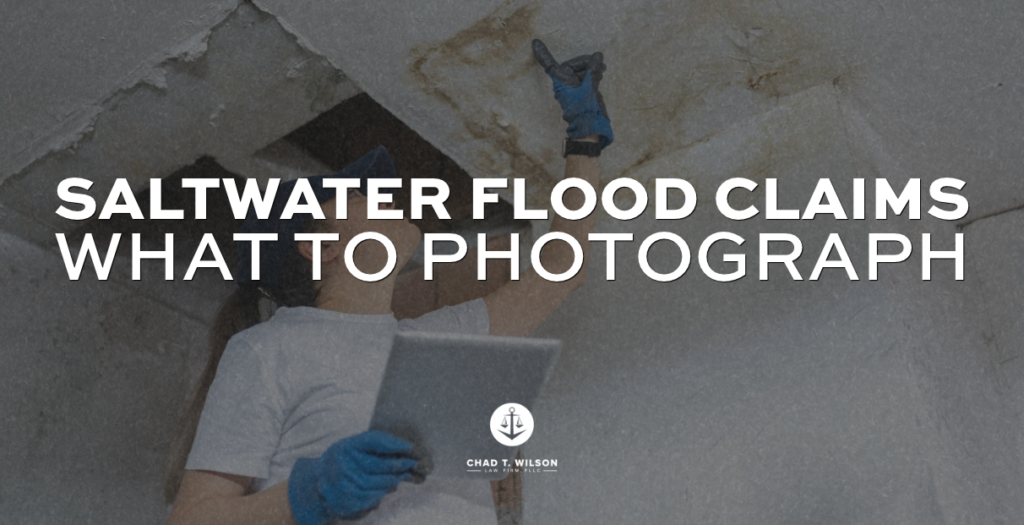
  1. Photograph and video the high-water lines on walls, cabinets, and equipment before anything is cleaned or tossed.
  2. Note which surfaces had saltwater contact, including wiring, HVAC, elevators, machinery, inventory, and ground-floor materials.
  3. Save receipts for towing, temporary repairs, lodging, and replacements, along with any appointment or business cancellations.
  4. Keep written records of contractor delays and anything that slowed your recovery.
  5. Do not start or drive a vehicle that may have taken on water until it is safely assessed.

If your claim was denied, delayed, or underpaid

Carriers sometimes treat saltwater losses as minor because the damage is not obvious on the surface, or they point to a flood exclusion without looking at the full cause of loss. If your offer comes in low, your claim stalls, or a denial does not square with your policy, you can challenge it. Keep your timeline, your photos, and your receipts together, and get your policy reviewed before you accept a number you are not sure about.

How Chad T. Wilson Law Firm Can Help

We stand on the policyholder’s side of the table. Our team has resolved more than 6,000 claims, and we handle water damage claims and coverage disputes of every kind as an insurance claim lawyer for homeowners and businesses nationwide, from our headquarters in Webster, Texas. It is actually your money, and the carrier does not want to give it back. If yours is underpaying, delaying, or denying a legitimate loss, we will read the policy, document the damage the right way, and take the fight to the adjusters for you. We work on contingency, so there is no recovery, no fee, and the first conversation is free. Call us at (833) 942-0678. Denied, delayed, or underpaid? That is exactly what we do.

Practice Areas

  • Water and flood damage claims
  • Denied, delayed, and underpaid claims
  • Bad faith insurance disputes
  • Residential and commercial property damage
  • Business interruption and loss of use

This article is for general information only and is not legal advice. Coverage depends on the terms of your policy and the facts of your loss, and no outcome is guaranteed.

Sources: CBS News Miami, WSVN 7News, FOX Weather.

What Florida's Property Insurance Presuit Notice Ruling Means for Older Policies

Florida property insurance presuit notice

By Chad T. Wilson Law Firm Staff, based on reporting on the Florida Supreme Court’s opinion in Universal Property & Casualty Insurance Co. v. Hughes, October 22, 2026. Read the original reporting here.

If you filed a claim under an older Florida homeowners policy, a new decision from the state’s highest court may matter to you. The Florida property insurance presuit notice law, passed in 2021, requires you to send your insurer a formal notice before you sue. On October 22, 2026, the Florida Supreme Court ruled that this requirement does not apply to policies issued before the law took effect. In plain terms, a procedural step that carriers have used to get some lawsuits dismissed does not reach back to cover contracts written before July 1, 2021.

Key Takeaways

  • The Florida Supreme Court ruled on October 22, 2026 that the presuit notice requirement in section 627.70152 does not apply to policies issued before July 1, 2021.
  • The decision was unanimous and settled a disagreement among Florida’s appellate courts.
  • Presuit notice is still required for policies issued on or after July 1, 2021.
  • The ruling does not reopen old claims or erase other deadlines. Policy dates, time limits, and the facts of each case still control.
  • Homeowners with pre-2021 policies and a pending or denied claim may want a lawyer to review how this affects them.

What is presuit notice, and why does it matter?

Section 627.70152 took effect on July 1, 2021. It says a policyholder has to give the insurer written notice, through the Florida Department of Financial Services, at least 10 business days before filing suit on a property claim. The notice gives the carrier a window to review the claim or make an offer. If a lawsuit is filed without that notice, the statute tells courts to dismiss it. That makes the rule a powerful tool for insurers, because a missed step can end a case before a judge ever looks at the damage.

What did the court actually decide?

The case is Universal Property & Casualty Insurance Co. v. Hughes. The homeowner had a policy running from April 24, 2019 to April 24, 2020 and reported a water damage claim in May 2019. She later sued in August 2021, after the new law was on the books, without sending presuit notice. Universal argued the suit should be dismissed.

The Florida Supreme Court disagreed. In a unanimous opinion, Chief Justice Couriel wrote that the statute carried no clear command to apply it to older contracts, and that “the absence of a statement in the act does not constitute clear evidence of retroactive intent.” The court also rejected the argument that the notice rule was merely procedural, finding that it changed real rights by delaying suits and affecting attorney fee recovery. The decision approved the Sixth District’s result for the homeowner and disapproved a conflicting Fourth District ruling.

What the ruling does not do

This is not a decision that presuit notice never applies. For policies issued on or after July 1, 2021, the requirement still stands, and skipping it can still sink a case. The ruling also does not reopen claims that are already closed, and it does not extend any filing deadline. It answers one question: which law governs a lawsuit brought under an older policy. Your policy’s issue date, your loss date, the time you have left to sue, and the history of your claim all still matter. If someone tells you this ruling erases deadlines in Florida, that is not what the court said.

If your claim was denied, delayed, or underpaid

A court ruling is not a substitute for reviewing your own file. A few steps help protect your position:

  • Find your policy’s declarations page and note the issue date. That date, not the date of your loss, drives much of this issue.
  • Keep every letter, email, and payment record from your insurer in one place.
  • Photograph damage and keep repair estimates and receipts.
  • Do not assume a deadline has passed, and do not assume you have unlimited time. Get the dates checked.
  • Ask a lawyer to read your policy before you make decisions based on a headline.

How Chad T. Wilson Law Firm Can Help

We represent policyholders, not insurance companies. Carriers have an army of lawyers, adjusters, and agents. We help even the odds. Our team has resolved more than 6,000 claims, and we review water damage claims and other disputes to see whether a carrier has treated you fairly. If your file involves an older policy and a presuit argument, we can look at how this ruling fits your facts. Working with an experienced insurance claim lawyer costs you nothing up front. We work on contingency, so there is no recovery, no fee. Call us at (833) 942-0678 for a free review. Denied, delayed, or underpaid? That is the work we do every day.

Practice Areas

  • Denied insurance claims
  • Delayed insurance claims
  • Underpaid insurance claims
  • Water damage claims
  • Storm and hurricane damage claims
  • Bad faith insurance disputes

This article is for general information only and is not legal advice. Court decisions are fact-specific, and outcomes depend on your policy and circumstances. No result is guaranteed.

Sources: Florida Supreme Court opinion, Universal Property & Casualty Insurance Co. v. Hughes (SC2024-0025); Tampa Free Press; Florida Supreme Court case docket.

Florida Homeowners Insurance Rate Decrease: Eight Carriers in October

Florida homeowners insurance rate decrease

By Chad T. Wilson Law Firm Staff — based on reporting by the Florida Office of Insurance Regulation, October 29, 2026. Read the original reporting here.

A Florida homeowners insurance rate decrease took effect this month across eight carriers, touching roughly 824,293 new or renewing policies, according to the Florida Office of Insurance Regulation (OIR). The announced reductions range from 1.2% to 12.1%, and the largest share belongs to Citizens Property Insurance Corporation. If you own a home in Florida, there is a fair chance your carrier is on the list — but a lower base rate is not the same thing as a lower final premium, and it says nothing about how a future claim will be handled.

Key Takeaways

  • Eight Florida insurers have homeowners rate decreases effective in October, covering about 824,293 new or renewing policies.
  • Announced decreases range from 1.2% (Insurance Capital Exchange) to 12.1% (SafePoint), with Citizens at 8.7% on nearly 618,000 policies.
  • OIR says rate decreases for roughly another 450,000 Floridians are pending for November, December, and January.
  • A base-rate decrease is not a guarantee that your final renewal premium falls by the same percentage.
  • Lower rates do not change how an insurer adjusts, delays, or denies a claim after a loss.

Which Carriers Have an October Rate Decrease

OIR highlighted decreases that apply to new policies, renewals, or both. Here is the carrier-by-carrier breakdown as announced:

CarrierDecreasePoliciesApplies to
Citizens Property Insurance Corporation8.7%617,958New & renewal
Tower Hill Prime Insurance Company4.9%137,879New & renewal
Security First Insurance Company5.9%19,114New & renewal
State Farm Florida Insurance Company6.3%5,234New policies
Insurance Capital Exchange1.2%5,102New policies
Modern USA Insurance Company5.6%4,813New & renewal
Florida Peninsula Insurance Company2.2%43,946New & renewal
SafePoint Insurance Company12.1%247New policies

OIR also referenced previously effective filings from American Integrity — 0.3% for about 184,000 consumers and 12.3% for roughly 8,900 — and Florida Family Home at 8% for about 20,700 consumers. State officials have attributed the broader trend to improvements in Florida’s insurance market following recent tort reforms, and Commissioner Mike Yaworsky noted that regulators sometimes press carriers for larger reductions when the actuarial data supports them.

Why a Rate Decrease May Not Lower Your Premium

Here is the part worth reading twice. A Florida homeowners insurance rate decrease is a change to a carrier’s base rate — the starting point from which your premium is calculated. It is not a promise that the number on your renewal declarations page will drop by the same percentage. Several factors can move your premium in the opposite direction at the very same renewal: a higher insured value on your dwelling, a change in territory or coverage limits, adjusted deductibles, the loss or gain of mitigation credits, roof characteristics, underwriting changes, and added fees or assessments.

In plain terms: an 8.7% base-rate cut and a rising replacement cost can land in the same envelope. Before you assume the decrease reached your policy, compare this year’s declarations page against last year’s line by line — dwelling limit, deductibles, endorsements, discounts, and fees — and ask your agent to confirm how the filed decrease was applied.

What a Rate Cut Does Not Change

A lower rate is welcome news for Florida homeowners, but it is a renewal-pricing story, not a claims story. Rate relief does not determine how an insurer will adjust, pay, delay, or deny a claim after a hurricane, windstorm, or water loss. Policyholders who paid every premium still find, too often, that the settlement offer does not match the damage. That is a separate fight, and it is the one we were built for.

If Your Claim Was Denied, Delayed, or Underpaid

Whatever your rate did this year, keep a steady hand when a loss happens:

  • Document everything — photos, video, receipts, and a written timeline from the date of loss.
  • Read your policy’s declarations page and keep every letter and estimate the insurer sends.
  • Do not accept a quick settlement figure as final before you understand the full scope of the damage.
  • Write down names, dates, and what you were told on every call with the carrier.
  • Get an independent estimate if the insurer’s number feels light.

How Chad T. Wilson Law Firm Can Help

Chad T. Wilson Law Firm represents policyholders — not insurance companies — and has resolved more than 6,000 claims. Headquartered in Webster, Texas and representing homeowners and commercial policyholders nationwide, including throughout Florida, our team steps in when a claim is denied, delayed, or underpaid. If your settlement does not reflect the real cost of repair, our underpaid claims attorneys can review the offer and the policy against the damage. We work on contingency — no recovery, no fee — so talking to an insurance claim lawyer costs you nothing up front. Denied, delayed, or underpaid? Call (833) 942-0678 for a free review.

Practice Areas

  • Denied insurance claims
  • Delayed insurance claims
  • Underpaid insurance claims
  • Hurricane and windstorm damage claims
  • Water damage claims
  • Bad faith insurance claims

This article is for informational purposes only and is not legal advice. Figures reflect the Florida Office of Insurance Regulation’s October 2026 announcement and may be updated; individual premiums vary. No outcome is guaranteed.

Sources: Florida OIR announcement, The Capitolist, ClickOrlando / News 6

Southwestern Colorado Flood Recovery: What to Do While Roads Are Still Cut Of

southwestern Colorado flood recovery

By Chad T. Wilson Law Firm Staff — based on reporting by Denver7 (KMGH), October 23, 2026. Read the original reporting here.

Southwestern Colorado flood recovery is now the hard, quiet work that follows the headlines. After the October 2026 floods tore through Archuleta County and the Pagosa Springs area, the river has fallen back below flood stage, but the damage it left behind has not drained away with it. Some residents remain cut off by washed-out roads, and for homeowners and business owners, the recovery phase is exactly when a property insurance claim needs the most care. What you preserve today, before cleanup begins, can steady your claim for the months of rebuilding ahead.

Key Takeaways

  • At the peak, about 100 people were cut off by washed-out roads in the Archuleta County area, with officials reporting them safe but landlocked.
  • The river crested in the early morning hours of Friday, October 23, 2026, at more than a dozen feet, cutting roads at culverts and collapsing at least one roadway.
  • Even as water levels fall, access delays can hold up mitigation, inspections, additional living expenses, and business interruption documentation.
  • Preserve closure notices, contractor communications, receipts, moisture readings, and photographs before you discard anything.
  • Archuleta County’s October flood Crisis Cleanup hotline is 970-283-7325 for help connecting with recovery resources.

Where Things Stand

The flooding peaked in the early morning hours of Friday, October 23, when the river rose to more than a dozen feet, with most of the high water arriving in the dark. Roads were cut where water ran over culverts for 12 to 16 hours, at least one roadway collapsed, and Wolf Creek Pass closed. Crews staged aircraft and swift-water resources, and a Red Cross shelter opened at the Pagosa Lakes Property Association. Since then, the San Juan River at Pagosa Springs has fallen below flood stage and some routes, including U.S. 160 between Pagosa Springs and Durango, have reopened, but the Archuleta County Sheriff has been plain that recovery will be long, and more rain is in the forecast over already-saturated ground.

Why Southwestern Colorado Flood Recovery Is Its Own Claims Challenge

A falling river lowers the immediate danger, but it does not end the claim problems — in many ways it begins them. When roads are still cut off, adjusters and contractors cannot easily reach a property, so inspections slip, drying is delayed, and mold and secondary damage have time to set in. Mountain properties often carry risks a city claim never sees: damaged private wells, failed septic systems, washed-out driveways and culverts, detached garages and outbuildings, and utilities that take weeks to restore. Each of these may be treated differently under your policy, and each deserves its own clear record.

If your home is uninhabitable, your policy may include additional living expenses to cover temporary housing and related costs. If you run a business that was forced to close or cut off from customers, business interruption coverage may apply. These are easy to overlook in the rush to clean up, and they are far harder to claim after the receipts are gone. Keep a running log of every displacement cost and every day your business could not operate normally.

Document Before You Dispose

The single most valuable habit in southwestern Colorado flood recovery is simple: document before you dispose. Photograph and video everything while it still shows the damage — water lines on walls, saturated flooring, ruined appliances and belongings, and the condition of outbuildings, wells, and septic components. Save road-closure notices and detour orders, because they prove why access and mitigation were delayed. Keep moisture readings if a restoration company takes them, and hold on to every contractor estimate, invoice, and text thread. Before you throw out a damaged item, make sure it has been photographed and, where practical, set aside for inspection. A claim built on a complete record is a claim that is hard to lowball.

If Your Claim Was Denied, Delayed, or Underpaid

Denied, delayed, or underpaid? After a disaster of this size, overwhelmed carriers sometimes move slowly, dispute the cause of a loss, or offer far less than the true cost to rebuild. If that happens, stay organized rather than discouraged: keep your policy and endorsements close, ask the insurer to put its coverage position in writing, gather independent repair and replacement estimates, and note the names and dates of every conversation. You have the right to question a denial, to seek a second opinion on the value of your loss, and to be paid what your policy actually promises.

How Chad T. Wilson Law Firm Can Help

Chad T. Wilson Law Firm represents policyholders — not insurance companies — and has resolved more than 6,000 property insurance claims for families and businesses. Our team can review your policy, help you organize and document the full scope of your water damage claims, and push for the complete, fair payment your coverage promises. As a policyholder-focused property damage lawyer, we work on contingency: no recovery, no fee. Headquartered in Webster, Texas, we represent policyholders nationwide, including throughout Colorado. If your claim was denied, delayed, or underpaid, call (833) 942-0678 and let us help you chart the course forward.

Practice Areas

  • Water damage claims
  • Storm damage claims
  • Denied property insurance claims
  • Delayed and underpaid claims
  • Bad faith insurance disputes

This article is for general informational purposes only and is not legal advice. Coverage depends on the specific terms of your policy and the facts of your loss; no outcome is guaranteed. Please consult a qualified attorney about your individual situation.

Sources: Denver7 (KMGH) — Flooding strands dozens in Archuleta County (Oct. 23, 2026); Colorado Public Radio — Heavy rains in southwest Colorado swell rivers (Oct. 22, 2026); Archuleta County — Flood response and cleanup information