Why Is State Farm Denying Property Damage Claims?
Why is STATE FARM Denying Property Damage Claims?

Understanding State Farm Property Damage Denials

Many homeowners are surprised when State Farm denies property damage claims. In 2025, this trend is not just a coincidence. Homeowners nationwide, particularly in Oklahoma, Texas, and Colorado, are sharing similar stories after experiencing storms, wildfires, and other damaging events. Knowing the most common reasons can help you avoid claim rejection and ensure you receive fair coverage for your property damage claim.

Recent State Farm Concerns and Legal Issues

State Farm has faced numerous concerns regarding its handling of insurance claims over the years. For example:

Common Reasons State Farm Denies Claims

1. Cosmetic Damage or Preexisting Issues

State Farm often labels certain damage as “cosmetic” or preexisting, meaning they claim it existed before your policy coverage started.

  • Dents, scratches, or minor wear are frequently categorized this way.

  • To avoid disputes, document your property condition before and after storms.

2. Inaccurate or Low Damage Assessment

Adjusters may report less damage than contractors or underestimate repair costs.

  • This can result in partial payouts or outright claim denial.

  • Independent inspections can provide evidence to support your full claim.

3. Policy Exclusions 

Every homeowner’s insurance policy has specific exclusions. Common examples:

  • Certain roof materials not covered

  • Water damage due to maintenance issues

  • Damage from wear and tear

Understanding your policy can prevent unexpected denials.

4. Filing or Documentation Errors

Claims can be denied if forms are incomplete or deadlines are missed.

  • Always keep photos, repair estimates, and receipts ready

  • Ensure all required documents are submitted in a timely manner

If your claim is turned down, you have the following options:

Obtain the Denial Letter, then carefully read it.

The denial letter should include the insurance company’s perspective on the matter and a detailed explanation of the reasons your claim was rejected. You should carefully read and consider this letter in order to comprehend the reasons for the denial of your claim, as well as your future course of action.

Assemble evidence:

Before taking any further action, find out why the claim was denied and collect any more supporting documentation. This may consist of videos, pictures, witnesses, and more. 

Appeal the final decision:

Make sure you adhere to State Farm’s prescribed processes if you choose to contest the denial. Any errors could end up costing you more time and effort and increasing the risk associated with your claim. To assist you with the procedure, you might also want to think about working with a property damage lawyer.

Don’t give up hope just yet if State Farm rejected your claim! 

There might still be options to pursue in order to recover damages related to the occurrence, depending on the insurer’s justifications for rejecting your claim and your specific situation.

If you believe your claim has been rejected without cause or that your adjuster did not sufficiently examine the claim, you may consider calling The Chad T. Wilson Law Firm for help with your insurance claim.

Frequently Asked Questions:

Can State Farm deny my claim for cosmetic damage?

Yes, if the damage existed before your policy or is considered minor.

Deadlines vary by state and policy. Contact a property damage lawyer immediately to protect your rights.

If the claim is significant or State Farm disputes your evidence, a property damage lawyer can help you get the settlement you deserve.
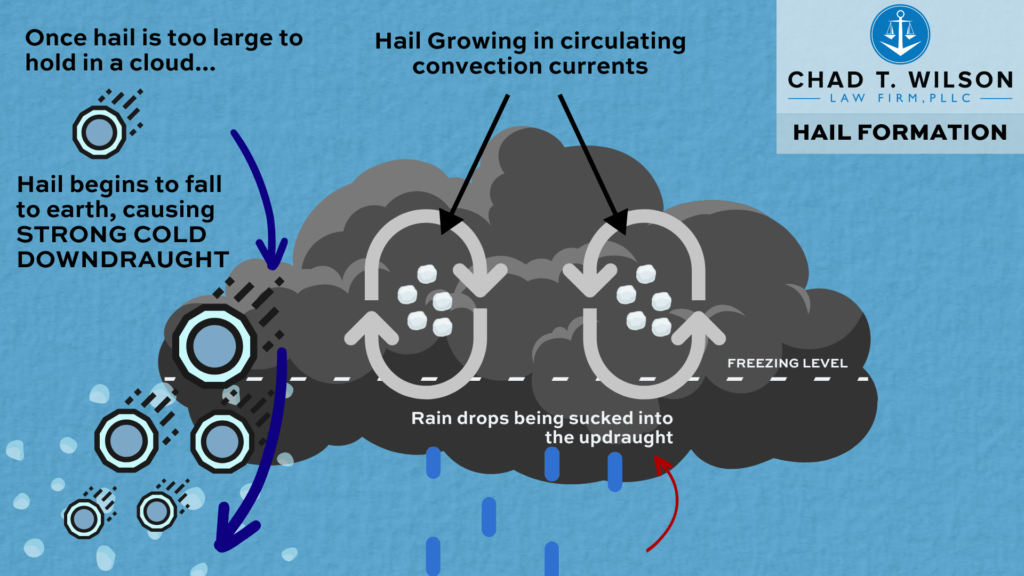
How does hail form?

How does hail form?

The answer is fairly simple: When water droplets are lifted by an updraft from a thunderstorm over the freezing point of the atmosphere, hail is created. The cooled water or water vapor that frozen water droplets accumulate later freezes when they come into contact with the storm. Therefore, hailstones grow as a result of this process.

Hail and other forms of freezing precipitation, such as sleet, are frequently mistaken. Sleet does not occur in thunderstorms and is more common during the colder months. Hail, by contrast, only occurs during thunderstorms because the updrafts created by the storm cause raindrops that are higher in the atmosphere to freeze.

How does Hail form? Watch the video here.

As the hailstone passes through the updraft and encounters various concentrations of water vapor and cooled water, it frequently takes on a ringed appearance.

Hailstones frequently have a ringed look. The rings stand in for the various settings that the hailstone encounters as it travels through the updraft. A white or opaque layer develops when the hailstone is in an atmosphere that is primarily composed of water vapor. This happens because, as the vapor particles freeze, little air pockets become trapped between them. A transparent layer occurs when the hailstone is surrounded by mostly super-cooled water because the super-cooled water instantly freezes into the hailstone.

In a process known as “wet growth,” hailstones can also expand by adhering to one another. Larger hailstones will move more slowly through the updraft than smaller hailstones do. These hailstones may collide and stick together if the outer layer is not totally frozen. A hailstone can expand swiftly if this technique is repeated repeatedly. Because the smaller hailstones that make up the larger hailstone keep their distinct shapes, when these aggregated hailstones hit the ground, they frequently have a rough or spiky appearance.

Hailstorm damage

Hail can cause a great deal of damage to crops and property. The size of a hailstone affects its terminal velocity, or maximum speed, which increases damage to anything the hailstone strikes. Hail the size of a baseball can travel to the ground at a speed of about 70 mph. Larger hailstones have a speed range between 90 and 100 miles per hour. That is comparable to being struck by a Major League fastball!

Hailstorm Crop harm

Hail damage can be extremely dangerous for crops. When a big hail event occurs, smaller cereals like wheat and barley may have significant yield losses. Early to mid-stage corn plants may typically recover from hail shock, while older plants are more vulnerable to harm. Hail can obliterate a plant’s leaves and topple its stalks, causing sterilization or plant death. To guard against yield losses brought on by hail damage, farmers frequently get crop insurance.

Hailstorm property damage

Property can also be seriously threatened by hail. Cars are frequently the most susceptible to damage since the sheet metal that covers them is easily dented. Hail can easily crack and shatter sunroofs, moonroofs, and windshields, which can be deadly if passengers are inside the car. Additionally, hail seriously harms roofing shingles. Larger hailstones have the potential to enter a house through the roof!

Hail that has been blown by the wind can damage siding and smash windows. This extensive damage necessitates pricey repairs and replacements. Since 1949, hail has caused more than $50 billion in property damage in current currencies in the United States. That equals annual hail damage of more than $850 million.

What is the best course of action during a hailstorm?

If you’re inside a building, go into a room inside that isn’t near any windows. Wind-blown hail can hurt people by breaking windows. Stay inside even if the hail has stopped falling since there is still a chance of lightning and high winds during a thunderstorm. Your security is crucial!

If you’re driving, get off the road and into a neighboring parking lot or off to the side. To alert other drivers that you have stopped, make sure to activate your emergency flashers. Driving during hail just makes it more likely that it may harm your car. Vehicle windows and windshields are easily damaged by hail. To shield your head from flying glass, turn your body and head toward the center of the car. In case you are struck by glass, cover yourself with blankets and soft things. Move out from under the glass if your car has a sunroof or moon roof since these roofs are particularly prone to breaking from hail.

Standing beneath a tree for cover may seem like a smart idea, but doing so simply raises your risk of getting hurt. Standing beneath a tree increases your risk of electrocution since trees are frequently struck by lightning.

The most instantly devastating type of precipitation is unquestionably hail. Install a NOAA All Hazards radio in your house or place of business to do your part to be weather-savvy. You may protect yourself from the potentially dangerous threat of hail by keeping up with local thunderstorm predictions from the National Weather Service and thunderstorm outlooks from the Storm Prediction Center.

Is your claim being denied or underpaid? Call Chad T. Wilson Law Firm, PLLC.

Speak with one of our attorney if you’re having trouble getting your claim processed or if the insurance company is attempting to pay less for the claim than is reasonable.

Insurance appraisal process

Insurance Appraisal Process

To begin the insurance appraisal process, each party needs an appraiser, including you and your insurance provider. A separate appraiser must be hired by each side. Additionally, the cost of the umpire and appraisal must be divided equally by both sides.

What is an Umpire when it comes to insurance claims?

You and your insurance provider will each employ an appraiser, and the two appraisers will collaborate to choose an appraisal umpire.

If the two appraisers are unable to agree, the appraisal umpire, a qualified, objective, and disinterested person, may make a final legally enforceable decision.

A competent umpire could be anyone capable of providing an objective assessment based on their competence in the field, such as an engineer, contractor, or retired judge.

The two appraisers may take advantage of their current professional relationships to find an umpire for an insurance appraisal. The appraisal umpire will decide if the two appraisers are unable to agree on the size of the loss.

What distinguishes appraisers from adjusters?

Appraisers are tasked with determining the worth of your property and the projected cost of repairs. Adjusters are responsible for deciding whether the insurance should pay for the damages to your car and how much.

Why should you get a property damage appraiser and a reliable attorney?

It is often more beneficial to employ both. Appraisers are typically most helpful during your property claim process. When an insurance company has partially or completely rejected a policyholder’s claim, property insurance attorneys are most helpful.

It’s important to choose the right property damage appraiser and attorney when filing a claim. The insurance appraiser you select should ideally be a specialist who is familiar with the specifics of insurance claims similar to the one you are handling.

Some appraisers might have extensive experience in particular insurance-related industries.

The following are specialists who advertise appraisal services:

You can increase your chances of getting a fair result by choosing an experienced appraiser and attorney.

In conclusion, the actual appraisal procedure varies between properties and insurance policies. For information on how to initiate the appraisal procedure and how a typical appraisal functions, consult the “conditions” portion of your insurance policy.

Is your claim being denied or underpaid? Call Chad T. Wilson Law Firm, PLLC.

Speak with one of our attorneys if you’re having trouble getting your claim processed or if the insurance company is attempting to pay less for the claim than is reasonable.

Contact us: https://cwilsonlaw.com/contact-us/ 

Learn more about our attorneys:
https://cwilsonlaw.com/meet-the-team-chad-t-wilson-law-firm-pllc-insurance-attorney/

Follow us on Social media:
https://beacons.ai/chadtwilsonlaw

Contact our Chad T. Wilson Law Firm Office Locations to Schedule a free Consultation.


Chad T. Wilson is an attorney whose firm specializes in property insurance disputes.

Written By:
Alejandro Caro

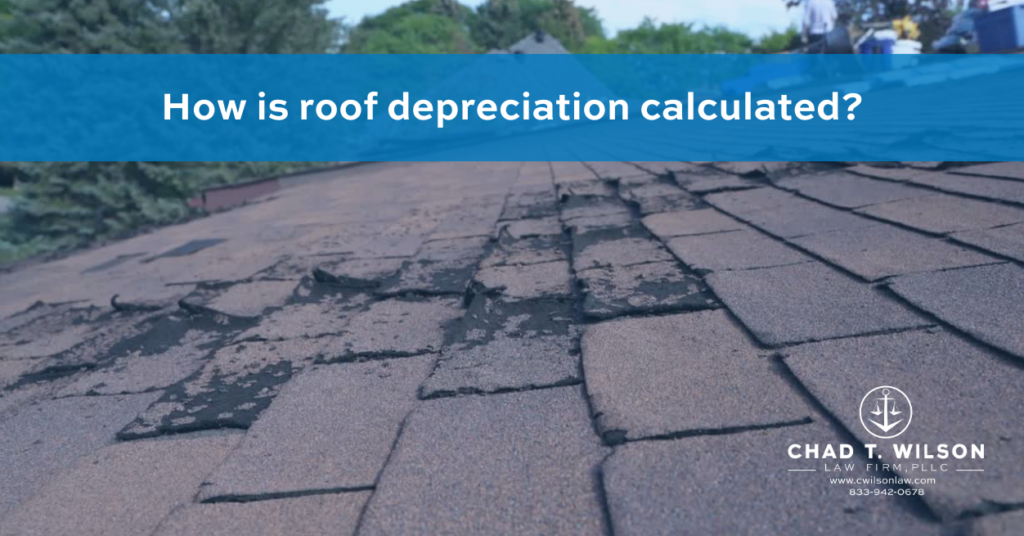
How is roof depreciation calculated?

How is roof depreciation calculated?

Insurance companies frequently use different components to determine a roof’s depreciation. The procedure entails determining the roof’s age, estimated lifespan, and degree of wear and tear.

It is simple to determine depreciation depending on age. Assume your roof has a 20-year lifespan and is five years old when it becomes damaged. Yearly, a roof loses around 5-20% of its worth.

When examining a roof, a claims adjuster will take its age and condition into account. There might be little to no adjustment for the condition if the roof is in respectable condition for its age. The adjuster may, however, increase the depreciation estimate if the roof is in bad condition, has received insufficient repairs, or has been the subject of earlier claims.

What Depreciation Means for Your Roof Insurance Claim.

As your house gets older and wears out, its value may decrease. Depreciation is a term used in finance to describe this loss of value. You need to be aware of how depreciation affects the claim procedure if a storm damages the roof of your home.

It’s vital to remember that insurance companies may use various methods to determine the depreciation of roofs. The precise calculation procedures can change depending on the insurer, the conditions of the insurance, and regional laws.

To understand how depreciation is computed in their specific scenario, policyholders should check their insurance policy and speak with their insurance agent or adjuster.

Insurance companies make an estimation of the depreciation value by taking into account the age of the roof, anticipated lifespan, wear and tear, and upkeep. To make sure that homeowners repair their roof to its pre-loss condition while accounting for its current value, this aids in determining the amount withheld and then issued as a depreciation check.

Here is an explanation of how insurance companies often determine a roof’s depreciation:

Age

The age of the roof affects its depreciation considerably. The age of the roof at the time of the claim is taken into account by insurance carriers. Older roofs have a higher likelihood of having noticeable signs of wear and tear, which can lower their value and increase the depreciation rate. The installation date or the homeowner’s information helps calculate the age.

Maintenance

 Maintenance and upkeep affect the roof’s depreciation. The homeowner’s efforts to maintain the roof, such as routine inspections, repairs, and cleaning, may be taken into account by insurance carriers. The lifespan of the roof can be increased, and depreciation can be reduced, with proper maintenance.

Wear and tear

Exposure to different elements, such as sunlight, rain, wind, and temperature changes, can cause wear and tear on the roof. To evaluate the roof’s condition and spot wear and tear indicators like curled or broken shingles, missing granules, or sagging sections, insurance adjusters inspect it. The depreciation estimate takes into account the degree of wear and tear.

Lifespan

Insurance firms also take into account the anticipated lifetime of the roofing material. The lifespans of various roofing materials vary. For instance, metal roofs can last 40–70 years, whereas asphalt shingles normally only last 20–30 years. The amount of depreciation is calculated by the insurance provider using the predicted lifespan as a percentage of the actual lifespan.

Insurance firms compute depreciation using a variety of estimating techniques. Some people may rely on depreciation charts that are considered industry standards and that determine the amount of depreciation based on the age of the roof. Others may use computer systems or internal estimators that take criteria into account while calculating the depreciation value.

Actual Cash Value

The claim’s cash value (ACV) is often determined to include the roof’s depreciation. The ACV is the depreciation-adjusted value of the damaged goods at the time of the loss. The insurance provider deducts the depreciation amount from the roof’s replacement cost value (RCV) to get the ACV.

If your roof is ever damaged, give The Chad T. Wilson Law Firm a call right away. We are here to assist you if your insurance claim is being denied or underpaid.

Is your claim being denied or underpaid? Call Chad T. Wilson Law Firm, PLLC.

Speak with one of our attorney if you’re having trouble getting your claim processed or if the insurance company is attempting to pay less for the claim than is reasonable.

Contact us: https://cwilsonlaw.com/contact-us/ 

Learn more about our attorneys:
https://cwilsonlaw.com/meet-the-team-chad-t-wilson-law-firm-pllc-insurance-attorney/

Follow us on Social media:
https://beacons.ai/chadtwilsonlaw

Chad T. Wilson – News
September 25, 2023
Updated: September 25, 2023 11:20 a.m.
Source: https://cwilsonlaw.com/

What is the Time Limit for Filing a Claim for Property Damage?

People often put off filing their insurance claims for many reasons. If you own a home, live in an apartment, or run a business, you might put off filing your claim. You may also delay calling your insurance provider because of time, work, or life in general. However, some are not aware of the time limit for filing a claim for property damage

What-is-the-time-limit-for-filing-a-claim-for-property-damage

How long do you have to file your claim?

You could be let down if you were hoping for a straightforward response to the question of time restrictions. Unfortunately, solutions to time-related questions can be surprisingly difficult. State regulations may impact the amount of time you have to submit a claim, but your exact deadlines are sometimes determined more by the terms of your insurance policy than by state law. The majority of these questions have their direct answers in your policy. The length of time you have to act, however, may also depend on a variety of other factors.

The best course of action is to file your property damage claim as soon as possible.

You must “give prompt notice” to the insurance company following a loss, which is a requirement of nearly all homeowner’s insurance policies. This duty is frequently stated in the “Your Duties After Loss” clause. Acting fast gives your insurance provider time to look into the claim, identify the damages, and estimate the cost of repairs.

Your claim can be rejected if you don’t provide the insurance company with “prompt notice” of the loss.

The majority of insurance contracts provide that to be covered by the policy (for example, by promptly notifying a loss), you must adhere to all of its terms and conditions. Your claim can be rejected if you don’t provide “prompt notice” of the loss to the insurance company as required under the policy.

When property owners fail to provide “prompt notice” of a loss, the carrier can’t fully assess the cause of the damage or the required repairs because they can’t notice the damage when it’s fresh. Property insurance claims may be rejected, and your window of opportunity to get benefits may close if you disclose them too late.

How does a “prompt notice” work?

In general, prompt notice denotes a fair period of time after you become aware of the loss to report it. You are required by the policy as a property owner to disclose any losses that might be covered right away. You don’t have to wait until you can verify that the incident caused all of the damage or until you have a general contractor give you a price. Reporting the claim as soon as possible is the best line of action.

Get legal representation.

You must move quickly and learn about the deadlines that apply in your state if you are overwhelmed or having problems resolving your claim. Gathering all the data required to take action can take some time.

As you wait for the insurance provider to respond, you should also be prepared to limit further losses. You are responsible for doing everything you can to stop more losses, even though you should wait to make full repairs until everything has been properly documented.

Is your claim being denied or underpaid? Call Chad T. Wilson Law Firm, PLLC.

Speak with one of our attorney if you’re having trouble getting your claim processed or if the insurance company is attempting to pay less for the claim than is reasonable.

Contact us: https://cwilsonlaw.com/contact-us/ 

Learn more about our attorneys:
https://cwilsonlaw.com/meet-the-team-chad-t-wilson-law-firm-pllc-insurance-attorney/

Follow us on Social media:
https://beacons.ai/chadtwilsonlaw