Charlotte homeowner questions insurance denial of roof claim
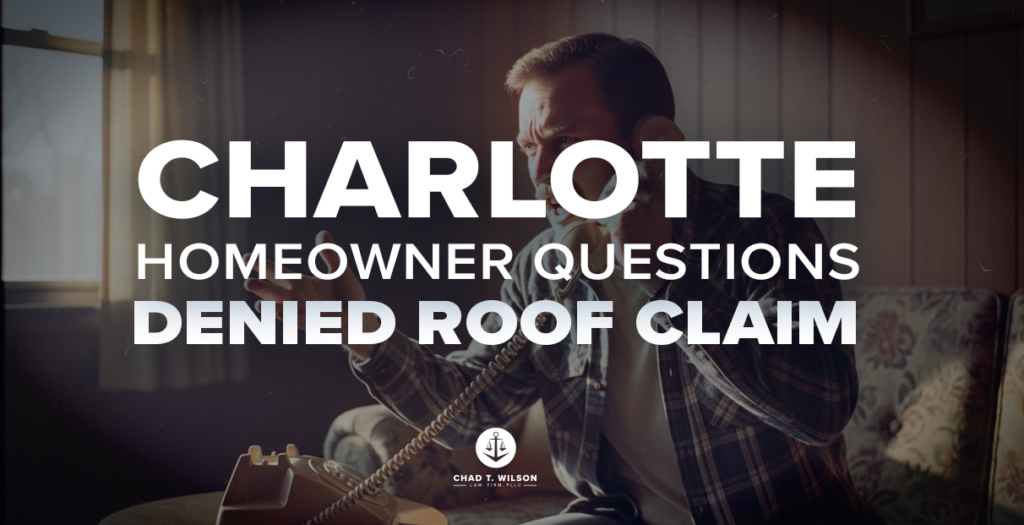
Charlotte Homeowner denied roof damage claim
By Chad T. Wilson Law Firm Staff — based on reporting by Jason Stoogenke of Action 9, WSOC-TV, January 2, 2026. Read the original reporting here

Homeowners pay insurance premiums year after year, expecting that when something goes wrong, their insurer will step in. A Charlotte, North Carolina, homeowner recently learned firsthand how difficult the insurance claims process can be when his insurer, ERIE, refused to cover storm‑related roof damage. Bel-Fakir, the homeowner, questioned, “Where’s my money going” He feels like he has been let down as he is “paying for the roof insurance:” (Action 9) His experience, highlighted by Action 9, reflects a growing frustration that homeowners across the country experience with roof damage claims. Homeowners insurance is designed to cover “unexpected damage,” not the ordinary wear and tear that develops on an aging roof. However, following a storm, distinguishing between covered loss and pre‑existing aging can be challenging.

In response, ERIE defends this complaint by noting that “ the claim was handled appropriately.” and “understand the customer is disappointed by the coverage outcome.”  but their decision was “based on the facts, circumstances and terms of the policy.”(Action 9)

Common reasons insurers give for roof denials include:

  • The roof was already aging

  • The damage is “cosmetic” rather than structural

  • The storm did not cause the specific issues claimed

  • The damage does not meet the insurer’s internal threshold for coverage

If Your Roof Damage Claim Was Denied, We Can Help

Understanding your homeowners insurance policy is critical, especially when a claim is denied. If your roof‑damage claim has been denied or underpaid, you don’t have to navigate the process alone. Our firm helps homeowners interpret their policies, understand their rights, challenge unfair decisions, and pursue the compensation they are entitled to under state law.

Schedule your consultation with Chad T. Wilson Law today to secure your peace of mind and protect your home.
Spring Hill Homeowner Vandalism Claim Denied by Citizens

By Chad T. Wilson Law Firm Staff — based on reporting by JC Hallman and John Dobberstein December 3rd, 2025

Tom Luby, a homeowner in Spring Hill, Florida, was twice denied by Citizens Insurance for his nearly $100,000 vandalism claim on his rental property. The property damage is extensive, with stolen and destroyed appliances, significant debris inside and outside the premises, and damaged floors.

According to WFTS, Citizens Insurance stated the extensive damage was an “incomplete remodel” of the home, and not vandalism caused by the evicted tenants. Unfortunately, Mr. Luby is unable to take the insurance company to court due to Florida’s insurance reform laws, after being denied twice. He is “forced into meditation” with the Florida Division of Administrative Hearing. (WTFS) The insurer’s refusal to pay highlights problems with the insurance dispute process, which critics claim unfairly benefits the state-backed insurance company.

Florida’s Insurance Reform Law

Under recent insurance reform laws, such as House Bill 799 and enacted changes in 2023, policyholders with Citizens must resolve disputes through arbitration before the Florida Division of Administrative Hearings (DOAH) rather than filing a lawsuit in regular court. The impact of these changes “would speed up hearings and save money.” (Yahoo Finance)

Controversies Around the DOAH Process

Luby himself stated that “three different attorneys” declined to represent him because they believed you “can’t win” under the current system. (Yahoo Finance). Also, Luby’s attorney, who represents him in the mediation, “questioned the neutrality of the DOAH judges” as many of the judges are “former defense lawyers that represented insurance companies.” Investigations by ProPublica and reporting from Florida media have revealed that Citizens wins more than 90% of final hearings at the DOAH. In contrast, when cases go through traditional circuit courts, the insurer wins roughly 55% of the time. (Yahoo Finance).

This disparity raises concerns that the forced arbitration process:

  • Strongly favors insurers

  • Discourages attorneys from taking cases

  • Leaves homeowners feeling they have “no chance” of justice

In addition, Citizens CEO Tim Cerio “defended the mediation process”, stating that policyholders go through a “6-step review of the claim” before being required to attend a DOAH hearing. He further noted that “all disputed claims sent to DOAH, 37% are settled before the final hearing.” (Yahoo Finance)

Denied Property Insurance Claim?

If your homeowner’s insurance claim has been denied, delayed, or underpaid, call the  property insurance attorneys at the Chad T. Wilson Law Firm at (833) 942-0678. We protect the rights of policyholders around the nation. Reach out to us today for a free consultation.

Homeowners Reduce Insurance Coverage Costs

Growing Insurance Costs Push Homeowners

By Chad T. Wilson Law Firm Staff — based on reporting by JC Hallman and John Dobberstein December 3rd, 2025

As we head into 2026, many homeowners are renewing their insurance policies only to find higher deductibles and more complex coverage terms than in past years. Escalating insurance expenses have become increasingly prevalent over the last several years, forcing homeowners to make difficult decisions about coverage.

According to a recent home insurance study by J.D. Power, “47% of homeowners in 2025 have experienced a premium increase in the past year.”

A Growing Trend Toward Higher Out-of-Pocket Costs

To manage rising insurance expenses, more homeowners are opting to accept the risk of a higher deductible. According to the Insurance Information Institute, “increasing your deductible from $500 to $1,000 may decrease your premium by approximately 10% to 25%” (Realtor.com).

Deductibles are the amount you must pay before your insurance coverage applies, and they are rising across many markets. One strategy homeowners are using to lessen premium increases is “opting for higher deductibles” (Realtor.com). While this can reduce insurance costs, it also means homeowners bear more of the financial risk if property damage occurs.

What Areas Are Being Impacted the Most

Homeowners in risk-prone areas are experiencing the most significant changes. According to the National Bureau of Economic Research, insurance premiums often rise fastest in areas with the highest risk of natural disasters, such as hurricanes or wildfires (“insurance premiums often rise in areas with the highest risk of natural disasters such as hurricanes or wildfires”) (Realtor.com).

Additionally, Rick McCathron, President and CEO of Hippo Home Insurance, has stated that “higher deductibles are becoming more common across the Midwest and other regions heavily affected by hail and convective storms,” highlighting the increasing severity of weather patterns (Realtor.com).

Start the Year by Reviewing Your Coverage

Before renewing your homeowners insurance policy, it is important to take the time to evaluate your current coverage. Insurance companies routinely adjust policy terms year to year, and 2026 is no exception.

With rising construction costs, inflation, and more frequent severe weather events, insurers are changing how policies are structured by including how deductibles are calculated and applied. A careful review now can help homeowners avoid unpleasant surprises later and better prepare for potential claims.

Protect Yourself Before a Claim Happens

Taking the time to review your policy now is critical, but understanding how those provisions are applied during a claim is equally important. If your claim is delayed, underpaid, or denied, you do not have to face the insurance company alone.

At Chad T. Wilson, we help businesses and homeowners hold insurers accountable for the full benefits they are owed under their policies. If you need assistance with a property insurance claim, contact our firm today for a free consultation.

State Farm Denies Oklahoma Hail Claims

Oklahoma Homeowners Battle State Farm

By Chad T. Wilson Law Firm Staff — based on reporting by JC Hallman and John Dobberstein December 3rd, 2025

Several severe hailstorms struck Oklahoma in October, damaging thousands of homes across the state. To make matters worse, a growing wave of recent lawsuits suggests that many homeowners are being denied or underpaid for hail damage to their roofs by State Farm. If your home in Oklahoma has recently survived a hail storm and your insurance claim was denied or severely underpaid, you may not be alone.

A Growing Number of Homeowners Take State Farm to Court

According to recent investigative reporting and court filings, “More than 100 Oklahoma families have taken the insurance giant, State Farm, to court, alleging the company schemed to deny hail damage claims and pocket billions of dollars.” (KFOR) The high out-of-pocket costs for roof repairs, often totaling thousands of dollars, have been left to Oklahomans to pay.

The Hursh Case 

The October 4, 2023 Storm

On October 4th, 2023, Billy and Lacy Hursh’s home in Broken Arrow suffered significant hail damage to their home. Contractors told the Hurshes that they needed a full roof replacement. Upon filing his claim, Billy Hursh, a policyholder since age 16, received an offer from State Farm in the amount of $1,400 against an estimated $22,000 cost of repairs.

Second Storm, Same Results

Eight months later, a second hailstorm hit. This time, State Farm insisted the total damage was below their deductible. In the end, the Hursh family had to borrow $22,000 against their home to replace the roof. (BASentinel)

A State Farm customer since he was 16, Hursh said the experience “made [him] feel like a sucker,” and that the company was not acting in good faith.

Allegations: The Wind Hail Model Enhancement Team and Pre-denied Claims

Recently, Oklahoma Watch described an internal State Farm initiative launched around 2020: a Wind Hail Model Enhancement Team was formed with the specific goal of cutting hail claim costs by 50% (Medium)

According to those filings (allegations, not facts):

  • A 2020 meeting at a State Farm high-rise in Illinois kicked off a hail claims “enhancement” push
  • Adjusters were allegedly trained to resist full roof replacements, minimize hail as “wear and tear” or “preexisting,” and rely on outside consultants to narrow what counted as covered hail damage.
  • The initiative was allegedly launched in Dallas County, Texas, in June 2020 and was extended to Oklahoma and other “hail states” before going nationwide within six months. (Oklahoman)

Plaintiff’s lawyers say this amounted to “pre-denying” hail claims to save the company billions. State Farm’s attorneys say this was simply a change in claims-handling features and emphatically deny this was a fraudulent scheme.

125 Cases And Multimillion-Dollar Settlements

Before the Hursh lawsuit, an Oklahoma City law firm brought 125 separate hail cases against State Farm. All 125 cases reached confidential settlements. Later court hearings revealed that at least one of those homes had been settled for $3 million. One judge openly questioned why State Farm would pay that kind of money on a relatively modest–$250,000–house unless there were more at stake.

State Farm accidentally disclosed some of these confidential settlement figures by submitting them to CLUE (Comprehensive Loss Underwriting Exchange), a system insurers use to view claim histories. Other carriers saw these huge roof settlements and, according to plaintiffs, either refused new coverage or jacked up premiums for the homeowners involved.

Recent hearings in the Hursh case prompted District Court Judge Amy Palumbo to be rather blunt about the situation, stating, “This is not about $1,400.” With seven lawyers in the room arguing over what counts as a “document”, she suggested this is just the top of a much larger iceberg involving many cases with State Farm.

Why Is It Important For Oklahoma Homeowners

Many Oklahomans are experiencing:

  • Quick denials without thorough inspections
  • Refusal to cover full roof replacement and issuing only partial costs
  • Conflicting adjuster assessments with third parties
  • Homeowners left with large out-of-pocket repairs

What to Do If State Farm Has Denied or Underpaid Your Hail Damage Claim

If you believe your hail damage claim was wrongly denied or underpaid by State Farm, or if your roof was damaged:

Get an independent inspection

Roofing contractors or a third-party inspector may document damage differently from the insurer’s adjuster.

Document everything

Keep a record of:

  • Storm dates
  • Photos before and after the damage
  • Adjuster reports
  • Contractor estimates
  • Preserve all paperwork or correspondence with the insurance company

These documents are essential proof if legal proceedings are needed.

Consult an experienced property damage insurance attorney

Given the number of similar lawsuits and the complex allegations involved, legal guidance may be necessary to secure fair compensation. Many homeowners recover significantly more with representation than they were initially offered.

How Chad T. Wilson Law Firm Can Help

At Chad T. Wilson Law Firm, we have extensive experience in representing homeowners across Oklahoma in hail damage claims against State Farm. Our firm has successfully represented over 9,000 policyholders nationwide, helping families receive the coverage their insurance policies promise.

If your claims were denied or underpaid, you may have legal options. Contact us today for a free consultation on your property damage claim.

Louisiana Plant Explosion Sparks Evacuations and Raises Insurance Questions

Louisiana Plant Explosion

By Chad T. Wilson Law Firm Staff — based on reporting by Meredith Deliso and Nadine El-Bawab, August 24, 2025

Louisiana Plant Explosion

A massive explosion and fire at Smitty’s Supply, a lubricant manufacturer in Roseland, Louisiana, forced hundreds of residents from their homes and left the community grappling with both safety and property concerns.

Local officials ordered a mandatory evacuation within a one-mile radius of the facility after the blast on Friday. By Saturday evening, officials reported the fire was 90% contained, but residents were still urged to remain out of the area or indoors due to concerns about soot containing combustible and hydrocarbon chemicals (ABC7).

What Happened During the Louisiana Plant Explosion

The incident occurred shortly before 1 p.m. Friday in August, when an explosion at the plant sent a large plume of smoke across Tangipahoa Parish. About 800 residents were impacted, with 42 seeking refuge at a shelter. Officials also confirmed debris had entered the Tangipahoa River, prompting environmental testing.

While no injuries were reported, a fact officials called “a godsend”, residents within the evacuation zone faced the sudden disruption of leaving their homes behind, many with only moments to gather essentials or secure pets.

Impact on Residents

Even after containment efforts began, officials warned residents to avoid contact with soot, wash hands frequently, and avoid touching their face. Small overnight explosions continued, underscoring the ongoing risk.

For homeowners, the blast raises serious concerns about potential structural damage, roof damage, and smoke damage. Exposure to soot and chemicals could also affect siding, windows, and even HVAC systems, all of which may later form the basis of property insurance claims.

Those living near the site may face long-term effects, such as lingering odors, compromised air quality, or the need for costly remediation. These are not always obvious right away, something insurers may use to dispute or deny coverage.

Insurance and Accountability

When disasters like this occur, insurance companies are expected to step in. Yet history has shown that insurance adjusters may minimize or deny claims tied to environmental hazards, arguing that certain damages fall under policy exclusions.

Residents impacted by events such as explosions, fires, or smoke often encounter property insurance claim denials or underpayments. This is especially common when insurers dispute whether the cause of loss qualifies for coverage.

For families in Tangipahoa Parish, that could mean fighting for compensation for commercial damage, structural damage, or even water damage stemming from firefighting efforts.

What Homeowners Should Know

If you live in an area affected by the Roseland plant explosion, it’s important to:

  • Document all visible damages, including roof leaks, siding damage, or window and glass damage.
  • Keep receipts for temporary repairs or relocation expenses.
  • Request written explanations from your insurance company if your claim is denied, delayed, or underpaid.
  • Consider seeking help from an insurance attorney if you’re unsure about your coverage or if your insurer refuses to cooperate.

How Chad T. Wilson Law Firm Can Help

At the Chad T. Wilson Law Firm, we specialize in helping policyholders recover after devastating events like fires, explosions, and storms. Our attorneys know the tactics insurance companies use to avoid paying full and fair claims and we hold them accountable.

Contact us today for a free consultation. Your recovery is our mission.

Practice Areas

Why Choose a Houston Windstorm Insurance Damage Lawyer?

If your windstorm damage claim has been denied, delayed, or underpaid, the Chad T. Wilson Law Firm can help. Based in Houston, our attorneys specialize in handling windstorm insurance disputes nationwide. We fight for the coverage you’re owed. Contact our team today for a free consultation.

Do not lose hope if you have filed an insurance claim and were denied or underpaid. Let the Chad T. Wilson Law Firm get justice for you.

Name

State Farm and Illinois Battle Over Data

Illinois Sues State Farm

By Chad T. Wilson Law Firm Staff — based on reporting by Megan Fan Munce, San Francisco Chronicle, October 15, 2025

The nation’s largest home insurer, State Farm, is back in the spotlight, this time for refusing to share key data with state regulators. The Illinois Attorney General has filed a lawsuit claiming the company broke the law by withholding information about insurance premiums, nonrenewals, and risk discounts across every U.S. ZIP code, including those in California.

Illinois sues State Farm

As reported by The San Francisco Chronicle, Illinois regulators asked State Farm for details on its homeowners policies from 2018 to 2024 — everything from how many policies it wrote and how many claims it paid, to how much it charged and where. The goal was to better understand why premiums have been climbing so quickly and why so many homeowners are losing coverage.

State Farm pushed back, saying the request went too far and that Illinois didn’t have authority to demand data from other states. Illinois disagreed — and now it’s up to the courts to decide.

Insurance Hikes Across the Country

This might sound like a behind-the-scenes dispute, but it’s part of a much bigger story. Across the country, homeowners are struggling with rising rates, shrinking coverage, and fewer choices. In California, the situation is especially tense. State Farm General, the subsidiary operating solely in California, is already under investigation for how it handled wildfire claims after the Eaton and Palisades fires. Some policyholders accused the company of dragging out claims or offering low settlements.

Meanwhile, State Farm has spent over a year pushing for a 30% rate hike on homeowners insurance. Regulators approved an interim 17% increase this summer, but a full hearing in December will determine whether the company can raise rates further — or even has to refund part of what it’s already collected.

How Does the State Farm Case in Illinois Affect Me?

If Illinois succeeds in getting this data, it could set a precedent for more transparency nationwide — giving state regulators, and by extension consumers, a clearer picture of how insurers price risk and decide who to cover. That’s a big deal for homeowners who’ve been left in the dark about why their rates keep climbing.

For Californians already reeling from nonrenewals and price spikes, a little sunlight could go a long way.

Has Your Insurance Company Denied Your Claim?

If your insurance company has delayed, denied, or underpaid your claim, don’t just accept it as business as usual. You have rights — and you have options. Talk to someone who knows how to hold insurers accountable and can help you get the coverage you paid for

How Chad T. Wilson Law Firm Can Help

At the Chad T. Wilson Law Firm, we fight for policyholders who have been denied, underpaid, or forced into unfair processes. Whether your dispute involves hail damage, water damage, fire and smoke, windstorm claims, or commercial property losses, we’re here to stand up for your rights.

Contact us today for a free consultation. Your recovery is our mission.

Practice Areas

Do not lose hope if you have filed an insurance claim and were denied or underpaid. Let the Chad T. Wilson Law Firm get justice for you.

Name

Thousands of Harris County Homeowners Dropped from Insurance

This blog draws on reporting from ABC13  (Leleana Pearson, October 10, 2025)

Thousands of Harris County Homeowners Dropped from Insurance

A growing number of Harris County homeowners are being dropped by their insurance companies, leaving many struggling to find new coverage or facing steep premium increases. Recent data reveals the extent of this issue and the factors contributing to it, showing that challenging a property insurance claim denial is an uphill battle. Recent investigations show that Citizens has routed more than 1,500 disputes into a mandatory arbitration system where it wins over 90% of final hearings. By comparison, in Florida’s circuit courts, Citizens wins just over half the time.

Rising Policy Cancellations Across Harris County

In 2023 alone, insurers in Harris County nonrenewed or dropped approximately 4,192 homeowners — about 1% of all policyholders, according to data reviewed by ABC13. Since then, major weather events like Hurricane Beryl and the May 2024 derecho have likely driven that number even higher.

Nationwide, homeowners in disaster-prone regions lose coverage at nearly twice the rate of those in less vulnerable areas — and Harris County’s exposure to flooding, hurricanes, and rising construction costs makes it especially vulnerable.

Why Insurance Companies Are Pulling Out

Several factors are contributing to the rise in non-renewals and cancellations:

Severe Weather and Rising Claims

  • Frequent storms and floods are driving up claims, increasing insurer losses.

Higher Rebuilding Costs

  • The price of materials and labor has surged, making coverage in high-risk zones less sustainable.

Updated Risk Models

  • New data-driven models are classifying more homes as high risk, resulting in dropped policies or soaring premiums.

Profit and Regulatory Pressures

  • To remain profitable, insurers are limiting their exposure in markets like Harris County.

Impact on Homeowners

For many residents, losing home insurance isn’t just an inconvenience — it’s a financial and emotional burden.

Difficulty Finding New Coverage

When insurers withdraw, homeowners often struggle to find suitable alternatives. When they do, premiums may be double or triple what they paid before. Forced-Placed Insurance

 Mortgage lenders may impose costly, limited coverage if homeowners can’t secure a new policy.

Financial Strain

 Rising costs are hitting families and retirees hard, especially those already managing other expenses.

Property Value Concerns

Homes without affordable insurance are more difficult to sell, which can potentially reduce property values.

Limited Alternatives

 Some turn to the Texas Windstorm Insurance Association (TWIA) or National Flood Insurance Program (NFIP) for basic coverage, but those programs can be restrictive.

Expert Insight

According to Troy Cothran, Secretary and Treasurer of the Houston Association of Realtors, “More people are filing big claims, and that’s putting pressure on insurers to limit their exposure.” Some homeowners, he notes, have seen their costs double, triple, or even quadruple.

He advises homeowners to work with independent insurance agents, who can compare multiple carriers to find available coverage options.

What Homeowners Can Do

While these market shifts are complex, homeowners can take practical steps to protect themselves:

  • Work with an independent agent to compare policies.
  • Keep records of maintenance, repairs, and storm-prevention improvements.
  • Explore supplemental coverage through TWIA or NFIP.
  • Review mortgage requirements to avoid forced-placed insurance.

Consult a Texas insurance lawyer if you believe your policy was wrongfully canceled or denied.

Protect Your Rights — Get Legal Help Today

If your home insurance claim has been denied, you don’t have to face it alone. The Chad T. Wilson Law Firm advocates for homeowners across Texas who have been unfairly treated by their insurance companies.

Contact us today or call 713-222-6000 for a free consultation

Do not lose hope if you have filed an insurance claim and were denied or underpaid. Let the Chad T. Wilson Law Firm get justice for you.

Name

What Florida’s Crisis Means for Policyholders

Florida Homeowners Are Losing Against Citizens Insurance

This story is based on reporting by Allaire Conte for Yahoo News, citing investigations by ProPublica and the Sun Sentinel.

A Growing Crisis in Florida Coverage

Florida’s ongoing insurance crisis has left more than half a million homeowners relying on Citizens Property Insurance Corporation, the state’s insurer of last resort. As private carriers withdraw and premiums skyrocket, Citizens has become the only option for many. But troubling new data shows that when policyholders challenge property insurance claim denials, the deck is stacked against them.

According to ProPublica and the Sun Sentinel, Citizens wins more than 90% of cases brought before the Division of Administrative Hearings (DOAH), compared to just 55% when disputes go through circuit court. For many homeowners, that difference determines whether they can afford to rebuild—or are left with devastating out-of-pocket costs.

A Legal Process Few Florida Homeowners Chose

In 2023, Florida lawmakers passed legislation that gave Citizens the power to reroute insurance disputes from traditional courts into DOAH arbitration. Supporters argued the system would be faster and cheaper. But in practice, it removes fundamental protections: no jury trial, limited discovery, and restrictions on presenting evidence.

Critics say it’s no coincidence that Citizens, which lobbied for the change, pays the salaries of the administrative judges who oversee these hearings. Rep. Hillary Cassel, a former insurance attorney, called it a direct violation of policyholders’ right to a fair trial.

The Numbers Behind the Crisis

The disparities are stark:

  • Win Rate: Citizens prevails in over 90% of DOAH hearings, compared with about 55% in circuit court.

  • Settlements: Nearly 80% of cases never reach a final ruling, with half of the settlements paying out $500 or less.

  • Scope: Citizens is on track to send thousands of disputes through DOAH annually, funding the program with more than $19 million through 2027.

Homeowners often feel forced to accept whatever settlement is offered—sometimes just pennies on the dollar—because the system makes it too risky to continue fighting.

The Human Cost

Behind the statistics are real families.

  • Peter and Linda Kilfoil of Fort Lauderdale discovered water damage in their kitchen. Their claim was denied as “long-term leakage,” even after they found the hidden pipe leak. When their case went to DOAH, the judge barred them from deposing a Citizens adjuster. With Peter battling cancer, the couple settled for just $500 on a $40,000 claim. Peter passed away six months later.
  • Jeffery McShane, a former Navy pilot, faced $200,000 in repairs after a burst pipe and roof leak caused extensive mold damage. Citizens denied the claim. Knowing the odds, he settled for $5,000.

These stories are not rare—they illustrate how limited legal recourse can devastate homeowners already struggling with claim losses.

Signs of Pushback

There may be a change on the horizon. After Hurricane Milton in 2024, homeowner Martin Alvarez challenged Citizens’ use of DOAH. In August 2025, Hillsborough County Judge Melissa Polo issued an injunction halting the arbitration process statewide. She called DOAH “structurally biased” and noted it deprived policyholders of neutral discovery, motion practice, and judicial review.

Still, Citizens continues to defend the system, framing it as efficient and cost-saving. CEO Tim Cerio argues the process ensures solvency for the insurer and points to statistics showing some cases result in reversed decisions.

What Homeowners Can Do

For homeowners, this environment is daunting—but not hopeless. Here are key steps to take:

Act quickly—if you’ve received a claim denial or non-renewal, timelines matter under Florida’s statute of limitations (SOL).

How Chad T. Wilson Law Firm Can Help

At the Chad T. Wilson Law Firm, we fight for policyholders who have been denied, underpaid, or forced into unfair processes. Whether your dispute involves hail damage, water damage, fire and smoke, windstorm claims, or commercial property losses, we’re here to stand up for your rights.

Contact us today for a free consultation. Your recovery is our mission.

This blog is based on reporting by Allaire Conte for Yahoo News, with additional context from ProPublica and the Sun Sentinel.


Practice Areas

Do not lose hope if you have filed an insurance claim and were denied or underpaid. Let the Chad T. Wilson Law Firm get justice for you.

Name

Florida’s Citizens Insurance Arbitration Process Under Fire: What Homeowners Need to Know

Florida Citizens Insurance Arbitration

This blog draws on reporting from ProPublica (Mario Ariza, Sept. 15, 2025) and News4JAX (Tarik Minor, Sept. 8, 2025).

Florida homeowners insured by Citizens Property Insurance Corp.—the state’s insurer of last resort—are discovering that challenging a property insurance claim denial is an uphill battle. Recent investigations show that Citizens has routed more than 1,500 disputes into a mandatory arbitration system where it wins over 90% of final hearings. By comparison, in Florida’s circuit courts, Citizens wins just over half the time.

How Arbitration Became the Norm

In 2023, state lawmakers passed House Bill 799, giving Citizens the power to force policyholders into arbitration before the Division of Administrative Hearings (DOAH). Unlike traditional courts, DOAH’s judges are paid through state contracts funded partly by Citizens, and the usual rules of evidence, discovery, and judicial review do not always apply.

For homeowners, this means fewer rights in pursuing claims for hail damage, storm damage, plumbing leaks, or roof damage. It also prevents them from voluntarily dismissing cases without Citizens’ approval—a safeguard available in regular courts.

Homeowners Face Steep Odds

Investigative reporting by ProPublica revealed stories like Peter and Linda Kilfoil, retirees from Fort Lauderdale, who discovered $40,000 in water damage after a pipe leak. Citizens denied their claim, arguing it was a long-term leak excluded under their policy. Even after evidence showed otherwise, the Kilfoils were routed into arbitration, where their case settled for just $500.

Other homeowners have faced similar struggles:

  • Withdrawal Denied: Some policyholders tried to withdraw their case, only to be forced into a final hearing where they lost and were ordered to pay Citizens’ legal fees.

  • Settling for Less: More than half of DOAH cases settled for $500 or less, while cases in circuit court average settlements of around $25,000.

  • Structural Bias Concerns: Judges often deny requests to disclose potential conflicts of interest, raising questions about impartiality.

Political Pushback

Representative Maxwell Frost of Florida has called the process harmful to working-class Floridians who rely on Citizens for coverage. In a letter to Gov. Ron DeSantis and state officials, Frost argued that the system deprives homeowners of their constitutional right to access the courts.

“The requirement that Citizens policyholders resolve all claims disputes through arbitration harms Citizens policyholders by depriving them of the opportunities that private policyholders have to litigate their claims and appeal if they lose,” Frost wrote.

His letter followed mounting concerns after a Hillsborough County judge issued a temporary injunction in August, ruling that the arbitration system may violate Florida’s Constitution by denying homeowners neutral discovery and judicial review. Citizens are appealing the decision.

Citizens’ Defense

Citizens insist the DOAH process is efficient and fair, pointing to its ability to resolve disputes faster than circuit courts, which can take nearly two years. A spokesperson argued that many settlements reflect “giving policyholders the benefit of the doubt” when evidence supports coverage.

Still, critics note the imbalance: 90% of final hearings end in Citizens’ favor, leaving policyholders at a severe disadvantage. 

Why This Matters

For Florida homeowners, this dispute underscores a growing insurance crisis:

  • Private insurers are leaving or limiting coverage in disaster-prone areas.

  • Citizens, once a safety net, now dominates the market with more than 700,000 policies.

  • Policyholders face reduced rights when disputing a property insurance claim denial, particularly after hurricanes, floods, or water damage events.

As climate-driven disasters increase, the ability to pursue fair settlements becomes even more critical.

What Homeowners Can Do

If you are a Citizens policyholder:

  • Review your policy carefully — pay attention to exclusions for wind, flood damage, or pipe leaks.

  • Document all damages thoroughly — photos, repair estimates, and inspection reports strengthen your claim.

  • Seek legal help quickly if your claim is denied, delayed, or underpaid. Navigating arbitration or litigation requires an experienced insurance attorney who understands both Florida insurance law and insurer tactics.

How Chad T. Wilson Law Firm Can Help

At the Chad T. Wilson Law Firm, we stand with policyholders—not insurers. Our team has extensive experience handling property insurance claim disputes, including water damage, fire damage, hail damage, and storm damage cases. Whether you are facing arbitration, litigation, or an outright denial, we fight to ensure your insurance company honors its obligations.

Practice Areas We Handle:

  • Hail Damage Claims


  • Commercial & Large Loss Claims


  • Windstorm Claims


  • Water Damage & Frozen Pipe Claims


  • Fire & Smoke Damage Claims


  • Hurricane Damage Claims


If your insurance company is giving you the runaround, don’t wait. Contact us today for a free consultation. Your recovery is our mission.

Do not lose hope if you have filed an insurance claim and were denied or underpaid. Let the Chad T. Wilson Law Firm get justice for you.

Name

Texas Homeowners Face Sudden Insurance Withdrawals: What Lemonade’s Exit Means

Texas Homeowners Face Insurance Withdrawals

By Chad T. Wilson Law Firm Staff — based on reporting by Susan Elizabeth Turek, “Homeowners blindsided over insurance companies’ sudden move in US region: ‘Might be too risky,’” Yahoo News, Sept. 8, 2025. Read the original here.

A Growing Crisis in Texas Coverage

Texas homeowners are facing yet another hurdle in the state’s insurance crisis. In May, Lemonade announced it would no longer sell new home and condo policies in 12 counties. Just two months later, it expanded that list to include several major counties like Collin, Denton, Abilene, and Lubbock (Turek, Yahoo News, 9/8/25).

This move puts Lemonade alongside other insurers like Farmers and Progressive that have scaled back their property insurance coverage across Texas. The reason? Catastrophic weather risk.

For homeowners who rely on their policies to safeguard against hail damage, windstorm claims, and hurricane losses, these sudden exits leave families exposed and scrambling for alternatives.

Why This Matters for Homeowners

Insurance isn’t just another bill. It’s a requirement for mortgages, leases, and—most importantly—a safety net when disasters like roof damage, water leaks, or fire damage occur. When insurers withdraw coverage, families face serious risks:

  • Housing instability — mortgage lenders require active insurance policies.

  • Limited recovery options — without insurance, repairing structural damage, siding damage, or a roof leak can cost tens of thousands out of pocket.

  • Market instability — as more carriers leave Texas, remaining insurers may raise premiums even higher.

Jason Wheeler, a Dallas-area resident, shared a letter from Lemonade informing him his policy would not be renewed. The reason: his address fell outside Lemonade’s “weather exposure guidelines.” Simply put, the insurer decided his home was too risky to cover (Turek, Yahoo News, 9/8/25).

Industry Explanations vs. Policyholder Reality

Lemonade says these moves are designed to protect its remaining customers by ensuring it can “be there when disaster strikes.” But for policyholders losing coverage, the explanation feels hollow. Years of paying premiums mean little when coverage evaporates overnight.

Other companies and startups are exploring new ways to model climate risk or reward homeowners for mitigation efforts like roofing upgrades, gutter repairs, or wildfire-proofing. Still, these strategies don’t change the fact that insurers are withdrawing from high-risk areas at an alarming rate.

What Homeowners Should Do?

If your insurer has dropped coverage or refused renewal, here are proactive steps you can take:

Request documentation — insist on a written explanation for any non-renewal or cancellation.

Explore all options — shop around with independent agents; some insurers may still write limited roofing or commercial damage coverage.

Review the FAIR Plan — Texas FAIR Plan coverage exists as a last resort, but it’s often expensive and limited.

Consult with an insurance attorney — if you’ve experienced a property insurance claim denial or been unfairly non-renewed, legal help may be your strongest protection.

How Chad T. Wilson Law Firm Can Help

At Chad T. Wilson Law Firm, we fight for policyholders when insurance companies deny claims, delay payments, or abruptly pull coverage. Our team has helped thousands of families and businesses secure the compensation they deserve after insurers failed to uphold their promises.

If your coverage has been dropped or your claim unfairly denied, contact us today for a free consultation. Your recovery is our mission.

Practice Areas


Do not lose hope if you have filed an insurance claim and were denied or underpaid. Let the Chad T. Wilson Law Firm get justice for you.

Name
1 2 3 4