Santa Rosa County Hurricane Damage After Isaias
Santa Rosa County hurricane damage

By Chad T. Wilson Law Firm Staff — based on reporting by Artemis.bm, October 13, 2026. Read the original reporting here.

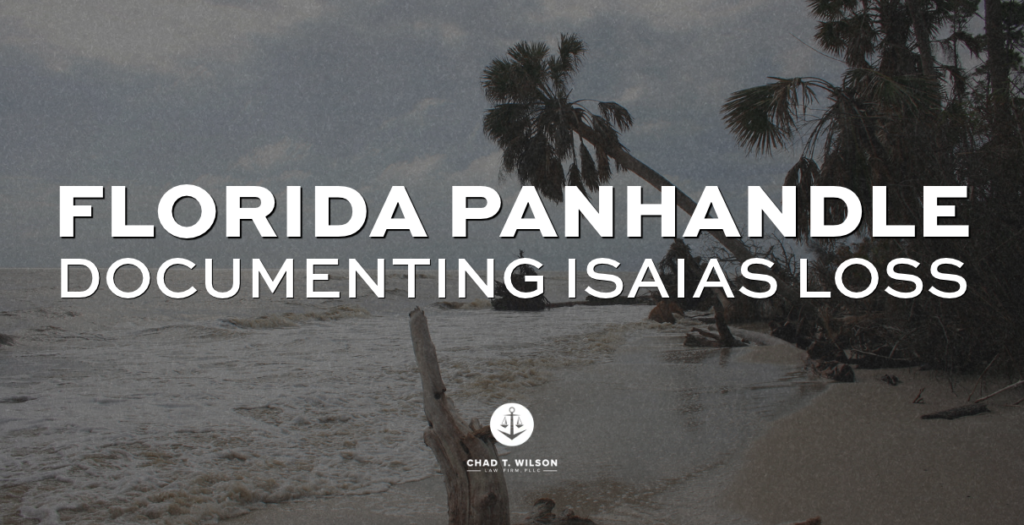
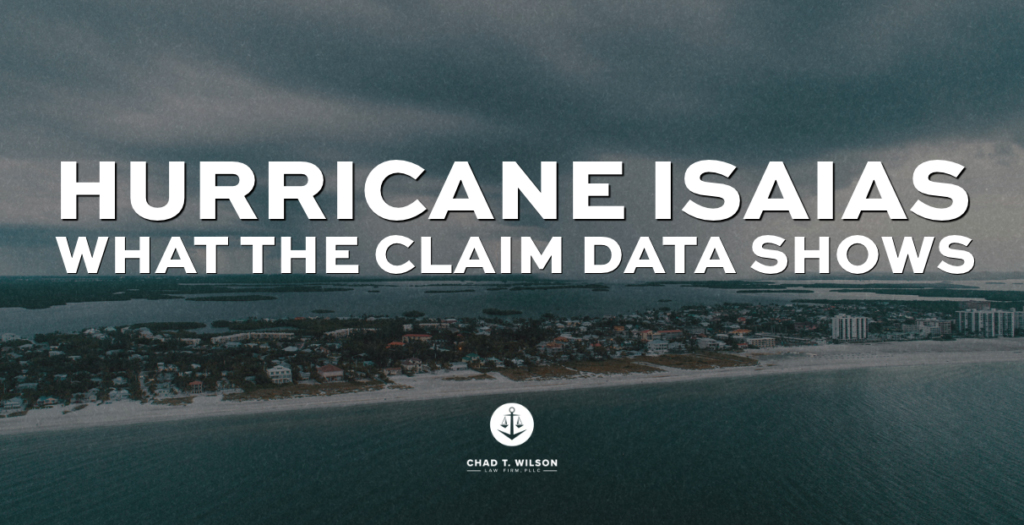
Santa Rosa County hurricane damage was among the most severe anywhere in the path of Hurricane Isaias. When catastrophe-modeling firm Verisk released its early loss estimate, it singled out Santa Rosa County — along with northeastern Escambia County — as the areas that took the worst of the storm’s wind. For homeowners and business owners along the Gulf Breeze, Navarre, Milton, and Pace corridors, that means the weeks ahead will be about turning damage into a documented, properly paid claim.

Key Takeaways

  • Verisk identified Santa Rosa County as one of the hardest-hit areas for wind damage from Hurricane Isaias.
  • Isaias came ashore near Destin as a Category 2 hurricane, with gusts reported above 100 mph in the western Panhandle.
  • Wind is expected to drive the vast majority of insured losses from the storm.
  • Thorough, dated documentation of damage is the single most important thing a policyholder can do.
  • If a Santa Rosa County claim is denied, delayed, or underpaid, a policyholder has options.

What Happened in Santa Rosa County

Isaias made landfall near Destin as a Category 2 hurricane after briefly peaking as a Category 3. The strongest winds raked the western Panhandle, with gusts reported above 100 mph near Santa Rosa Sound and Pensacola. Across the region, reporting described torn-off roofs, downed trees, and sustained power outages affecting hundreds of thousands of customers. Verisk’s post-storm assessment placed Santa Rosa County among the most severely wind-damaged areas in the entire event.

That matters for coverage. Wind damage to a home or commercial building is typically handled under a property policy’s windstorm coverage, while storm-surge flooding generally falls to the National Flood Insurance Program or a private flood policy. Knowing which peril caused which damage — and documenting it — is often the difference between a smooth claim and a disputed one.

What Santa Rosa County Policyholders Should Do Now

If your property was damaged, a steady, methodical approach protects you better than speed alone:

  • Photograph and video every area of damage before making repairs or discarding anything.
  • Make reasonable temporary repairs to prevent further damage — tarp the roof, board broken windows — and keep the receipts.
  • Write down the cause and timing of each loss: wind, wind-driven rain, fallen tree, or surge.
  • Report the claim to your insurer promptly and get your claim number in writing.
  • Keep a log of every adjuster visit, phone call, and payment.
  • Get your own independent repair estimates so you can compare them to the insurer’s figure.

If Your Claim Was Denied, Delayed, or Underpaid

Catastrophes stretch insurers thin, and that pressure can show up as lowball estimates, slow responses, or denials that lean on fine print. If that happens, ask for the insurer’s decision in writing with the specific policy language it relies on, keep your documentation organized, and don’t assume the first number is the final number. An early valuation is a starting point, not a verdict.

How Chad T. Wilson Law Firm Can Help

Chad T. Wilson Law Firm represents policyholders across the Florida Panhandle and nationwide, and has resolved more than 6,000 property insurance claims. If your Santa Rosa County hurricane damage claims or related storm damage claims have been denied, delayed, or underpaid, we can review your policy, challenge an undervalued estimate, and pursue what you are owed. Headquartered in Webster, Texas, we work on contingency — no recovery, no fee. Denied, delayed, or underpaid? Call (833) 942-0678 for a free policy review.

Practice Areas

  • Hurricane damage claims
  • Storm and wind damage claims
  • Denied, delayed, and underpaid claims
  • Commercial property and business-interruption claims
  • Bad faith insurance disputes

This article is for informational purposes only and is not legal advice. Coverage depends on your policy and the specific facts of your loss, and no outcome is guaranteed.

Sources: Artemis.bm — Verisk estimates Isaias insured onshore property losses in $1bn–$2bn range; Insurance Business — Isaias claims begin as Panhandle counts damage; Reuters — Insured losses from Hurricane Isaias could reach $2 billion, Verisk says
Hurricane Isaias Insurance Claim Data: How Florida's Catastrophe Reporting Works

Hurricane Isaias insurance claim data

By Chad T. Wilson Law Firm Staff — based on a Florida Office of Insurance Regulation data call notice, October 12, 2026. Read the original notice here.

In the weeks after a major storm, Hurricane Isaias insurance claim data starts to surface through Florida’s catastrophe-reporting process. The Florida Office of Insurance Regulation (OIR) has directed insurers to file catastrophe reports on Isaias, with submissions due at noon Eastern on set dates — including Thursday, October 15. It’s worth understanding what this reporting is, because it’s easy to misread. The short version: these deadlines belong to insurers, not to you.

Key Takeaways

  • Florida’s OIR has issued a data call requiring insurers to report Hurricane Isaias claim information.
  • The reporting obligation applies to insurance companies, not to policyholders — October 15 is not a consumer filing deadline.
  • Insurers file cumulative catastrophe reports showing claims received, open and closed claims, and amounts paid.
  • Aggregate figures measure the market, not any individual claim’s value or coverage.
  • Policyholders should focus on documenting their own loss and meeting their own policy deadlines.

What the OIR Data Call Requires

Under the data call notice, insurers authorized to write property and related lines in Florida must file a 2026 Catastrophe Reporting Form through the state’s filing system. The reports are cumulative — each one covers all claims as of the reporting date — and companies with policies in force but no claims yet file a “No Data” report. Submissions are due by 12 p.m. Eastern on each listed date, with the next deadline on October 15. The notice is addressed to insurers; it does not create any reporting duty for individual policyholders.

What the Data Can — and Cannot — Tell You

Once the OIR publishes aggregate results, the figures can be genuinely useful: total claims reported, how many are open versus closed, how much has been paid, and the split between residential and commercial coverage. They paint a picture of how the market as a whole is responding to Isaias.

What they cannot tell you is how your claim will be handled. An aggregate count does not establish the value of any single loss, and it is not a measure of whether a particular claim is covered. It’s also worth a note of caution: the existence of a data call does not, by itself, reveal official claim volumes — those come only when the OIR actually releases the numbers. Read the data as weather, not as a forecast for your own roof.

Why October 15 Is Not Your Deadline

This is the point most likely to cause confusion. The October 15 noon deadline is a regulatory reporting date for insurance companies. It is not a date by which you must file your claim, and missing it costs you nothing. Your deadlines are the ones in your own policy and under Florida law — things like prompt notice of loss and proof-of-loss requirements. Those are the dates to put on your calendar.

If Your Claim Was Denied, Delayed, or Underpaid

While the state collects its numbers, your job is simpler and more concrete: build a clean record of your loss. A few steps go a long way:

  • Document damage thoroughly with dated photos and video before repairs.
  • Report your claim promptly and keep the claim number and all correspondence in writing.
  • Track your own policy’s notice and proof-of-loss deadlines.
  • Get independent repair estimates to measure against the insurer’s offer.
  • Ask for any denial or reduced payment in writing, citing the specific policy language.

How Chad T. Wilson Law Firm Can Help

Chad T. Wilson Law Firm represents policyholders — not insurers — and has resolved more than 6,000 property insurance claims. If your Hurricane Isaias hurricane damage claims have been denied, delayed, or underpaid, our team can review your policy and, as your insurance claim lawyer, press your insurer on the specifics of your loss. Headquartered in Webster, Texas, and representing policyholders nationwide, we work on contingency — no recovery, no fee. Denied, delayed, or underpaid? Call (833) 942-0678 for a free policy review.

Practice Areas

  • Hurricane damage claims
  • Denied, delayed, and underpaid claims
  • Storm and wind damage claims
  • Commercial property and business-interruption claims
  • Bad faith insurance disputes

This article is for informational purposes only and is not legal advice. Industry and regulatory data are not a measure of any individual claim, and no outcome is guaranteed. Coverage depends on your policy and the specific facts of your loss.

Sources: Florida OIR — Data Call Notice: Hurricane Isaias Catastrophe Reporting; Florida Office of Insurance Regulation

Florida Hurricane Claim Closed Without Payment: What It Means After Isaias

Florida hurricane claim closed without payment

By Chad T. Wilson Law Firm Staff — based on reporting by Insurance Journal (William Rabb), October 13, 2026. Read the original reporting here.

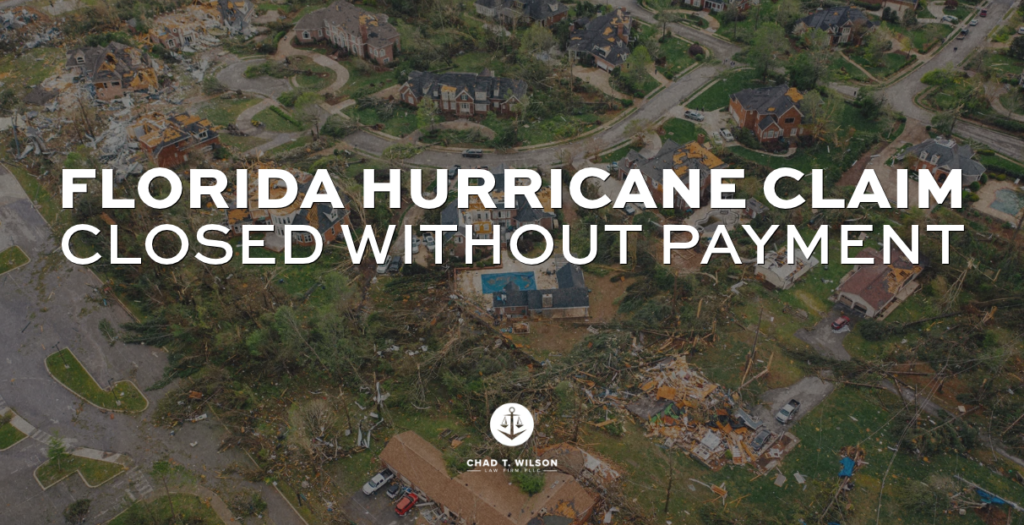
If you filed a claim after Hurricane Isaias and received a letter saying your Florida hurricane claim closed without payment, it is natural to assume the matter is over. Often, it is not. “Closed without payment” is a specific status that insurers report to state regulators, and it does not always mean your loss was uncovered or your claim was wrong. As Florida’s insurance regulator gathers Isaias catastrophe data from carriers, this is one of the terms policyholders are most likely to hear — and one of the most misunderstood.

Key Takeaways

  • “Closed without payment” is a reporting status, not a verdict that your damage was never covered.
  • Many Isaias losses fell below hurricane deductibles, which is a common reason a claim closes with no payout.
  • It is different from an outright denial and different from an underpaid claim, though the practical effect can feel similar.
  • A closed claim can often be reopened or supplemented when new or more complete damage information comes to light.
  • Reviewing your deductible, the carrier’s estimate, and the closure reason in writing is the first step to understanding your options.

What “Closed Without Payment” Actually Means

When insurers report catastrophe data to the Florida Office of Insurance Regulation, they sort claims into categories such as open, closed with payment, and closed without payment. A claim marked closed without payment is one the carrier considers finished without sending the policyholder money. That can happen for several reasons, and only some of them are a true dead end. The label describes an outcome on the insurer’s books; it does not, on its own, tell you whether that outcome was correct.

Common Reasons a Florida Hurricane Claim Closes Without Payment

The most frequent reason, especially after Isaias, is the hurricane deductible. Reporting on the storm noted that many losses came in below policyholders’ deductibles, so even a valid claim produced no check because the damage did not exceed the amount the homeowner is responsible for first. Florida hurricane deductibles are often a percentage of the dwelling coverage rather than a flat dollar figure, which surprises many owners.

Other claims close without payment because the carrier attributes the damage to an excluded cause — arguing, for example, that water intrusion came from flooding or long-term wear rather than wind. Some close because the insurer says it did not receive enough documentation to evaluate the loss. And some simply reflect a disagreement about scope: the adjuster saw less damage than the homeowner believes exists. Each of these reasons invites a different response.

Closed Without Payment vs. Denied vs. Underpaid

These terms overlap in everyday conversation but are not the same. A denial is an affirmative decision that the policy does not cover the loss. An underpaid claim is one the carrier paid, but for less than the cost to properly repair the damage. A claim closed without payment may be a quiet denial, a below-deductible result, or a file the insurer set aside for lack of information. Knowing which one you are facing determines whether the fix is more documentation, a corrected estimate, or a formal challenge to the coverage decision.

If Your Claim Was Denied, Delayed, or Underpaid

If your hurricane claim closed without payment and you believe your damage is real and covered, there are concrete steps worth taking. Ask the insurer, in writing, for the specific reason the claim was closed and the policy language it relied on. Confirm your exact deductible and how it was calculated against your dwelling limit. Get an independent contractor’s estimate for the full scope of repairs and compare it line by line against the adjuster’s findings. If new damage appears — a roof leak that shows up after the next rain is common — document it and ask to reopen the claim. Many claims can be reopened or supplemented, and a closed status is frequently the start of a conversation rather than the end of one.

How Chad T. Wilson Law Firm Can Help

Chad T. Wilson Law Firm represents policyholders, not insurers, and has resolved more than 6,000 property insurance claims. From its headquarters in Webster, Texas, the firm represents homeowners and businesses nationwide, including Florida families sorting through Isaias losses. If your claim was treated as a denied claim or you suspect it was an underpaid claim dressed up as a routine closure, our team can read the policy, test the carrier’s reasoning, and press the dispute on your behalf. We work on contingency — no recovery, no fee. Denied, delayed, or underpaid? Call (833) 942-0678 and we will help you chart the next move.

Practice Areas

  • Denied property insurance claims
  • Underpaid and undervalued claims
  • Delayed claim handling
  • Hurricane and storm damage claims
  • Bad faith insurance disputes

This article is for informational purposes only and is not legal advice. It does not create an attorney-client relationship, and no outcome is guaranteed. Claim outcomes depend on the facts of each loss and the terms of each policy.

Sources: Insurance Journal — ‘Unusual’ Isaias Brings Winds, Downed Trees but Fewer Claims Than Expected; Florida Office of Insurance Regulation — Catastrophe Reporting; Florida OIR — Data Call Notice: Hurricane Isaias Catastrophe Reporting

Filling a Florida Panhandle Hurricane Insurance Claim After Isaias

Florida Panhandle Hurricane Insurance Claim

By Chad T. Wilson Law Firm Staff — based on reporting by WJHG (Alexis Lewis), October 13, 2026. Read the original reporting here.

If you are starting a Florida Panhandle hurricane insurance claim after Hurricane Isaias, the paperwork you gather in the first days often matters as much as the damage itself. Isaias came ashore near Destin on the night of Friday, October 9, 2026, as a Category 2 hurricane, with the strongest winds recorded closer to the Pensacola area. It left downed trees, damaged roofs, broken windows, and scattered flooding across Okaloosa and neighboring counties. As recovery centers open and cleanup begins, the policyholders who fare best are usually the ones who treat documentation as the backbone of their claim from day one.

Key Takeaways

  • Hurricane Isaias made landfall near Destin on October 9, 2026, as a Category 2 storm, with heavy wind damage across the Florida Panhandle.
  • Multi-Agency Recovery Centers have opened in Okaloosa County to connect survivors with state and nonprofit services.
  • Visiting a recovery center does not replace giving prompt notice to your insurer, protecting the property from further damage, or submitting claim-specific proof of loss.
  • Bring identification, proof of residence, insurance information, and records of your storm damage when you seek help.
  • Thorough photos, inventories, receipts, and estimates give you the strongest footing if your claim is later underpaid or denied.

Recovery Centers Are a Resource, Not a Substitute for Your Claim

Okaloosa County has opened two Multi-Agency Recovery Centers to help residents affected by Isaias: one at the Destin–Fort Walton Beach Convention Center at 1250 Miracle Strip Parkway in Fort Walton Beach, and one at the Crestview Community Center at 1446 Commerce Drive in Crestview. These centers bring state agencies and nonprofit partners under one roof so survivors can reach services for food, water, housing help, cleanup, and emotional support. Hours and locations can change as recovery continues, so confirm the current schedule on Florida’s official updates page before you go.

It is worth being clear about what these centers do and do not do. They are a valuable front door to disaster services, and the state’s Insurance Assistance Hub can connect you with carrier representatives and the Division of Consumer Services. But walking through that door does not, by itself, start or settle your insurance claim. Your policy still requires you to notify your insurer, to take reasonable steps to prevent further damage, and to prove your loss with claim-specific documentation. Think of the recovery center as the harbor where you resupply — not the destination.

What to Bring and What to Document

When you visit a recovery center or speak with your carrier, bring identification, proof that you live at the property, your insurance information, and whatever records of damage you already have. From there, build your file steadily. Photograph and video every damaged area before you clean up or make temporary repairs, and keep a few representative samples of destroyed materials when it is safe to do so. Write down the date and time each photo was taken.

Keep a running inventory of damaged belongings with approximate ages and values, and save receipts for anything you buy to protect the home, such as tarps, plywood, or a generator. Hold on to receipts for temporary lodging if your home is unlivable, since many policies include additional living expense coverage. Finally, keep a simple log of every call, email, and letter with your insurer, including names and dates. Calm, organized records are quiet but persuasive.

Mitigate Damage — and Document That Too

Most policies require you to prevent further harm after a storm. Tarping an open roof or boarding a broken window is not just practical; it protects your claim. Photograph the damage first, then photograph the temporary repair, and keep the receipts. If a carrier later argues that some of the loss came from neglect after the storm rather than the hurricane itself, your before-and-after records are the clearest answer.

If Your Claim Was Denied, Delayed, or Underpaid

Even well-documented hurricane claims can stall. If your insurer denies the claim, drags out the process, or offers less than it takes to make real repairs, you have options. Read the denial or payment letter closely and ask, in writing, for the specific policy language and reasons behind the decision. Compare any carrier estimate against an independent contractor’s estimate for the same scope of work. Keep every version of every estimate. And know that Florida law sets deadlines and standards for how insurers must handle claims — a delayed or lowball response is not the final word.

How Chad T. Wilson Law Firm Can Help

Chad T. Wilson Law Firm represents policyholders — never insurance companies — and has resolved more than 6,000 property insurance claims. Headquartered in Webster, Texas, the firm represents homeowners and businesses nationwide, including communities across the Florida Panhandle recovering from Isaias. If you are weighing a hurricane damage claim or a broader storm damage claim, our team can review your policy, assess the carrier’s position, and handle the dispute so you can focus on your family and your home. We work on contingency — no recovery, no fee. Denied, delayed, or underpaid? Call (833) 942-0678 for a straightforward look at where your claim stands.

Practice Areas

  • Hurricane damage claims
  • Storm and windstorm damage claims
  • Denied, delayed, and underpaid property insurance claims
  • Bad faith insurance disputes
  • Residential and commercial property claims

This article is for informational purposes only and is not legal advice. It does not create an attorney-client relationship, and no outcome is guaranteed. Details reported about Hurricane Isaias and recovery operations may change as conditions develop; confirm current information with official sources.

Sources: WJHG — Two Hurricane Isaias recovery centers opening in Okaloosa County; Florida Division of Emergency Management — Updates; FloridaDisaster.org — Hurricane Isaias

Hurricane Isaias in Florida: Wind Versus Flood Damage and Why the Cause of Loss Matters

wind versus flood damage

By Chad T. Wilson Law Firm Staff — based on reporting by the Associated Press, October 2026. Read the original reporting here.

When Hurricane Isaias pushed across the Florida Panhandle, it did not bring one kind of damage — it brought several, arriving in a sequence that can be hard to untangle weeks later. Wind tore at roofs, then rain poured through the openings it created; surge and surface water rose in low-lying areas like Okaloosa Island. For policyholders, the wind versus flood damage question is not academic. It often decides which policy pays, which deductible applies, and whether a claim is covered at all.

Key Takeaways

  • Standard homeowners policies generally cover wind damage but exclude flood and storm surge, which usually require separate flood insurance.
  • The cause of loss — wind versus flood damage — frequently determines whether a loss is covered and under which policy.
  • Hurricanes often cause damage in stages: wind first, then rain through wind-created openings, then rising water, each with different coverage consequences.
  • Careful, dated documentation of each type of damage is the best protection when an insurer attributes a loss to an excluded cause.
  • If wind and water both contributed, how the loss is characterized can be disputed, and you are not required to accept the insurer’s version without question.

Wind Versus Flood Damage: Why the Distinction Controls Your Claim

Most homeowners policies in Florida cover damage caused by wind, including the roof, windows, and water that enters through a wind-created opening. What they typically do not cover is flood — rising surface water and storm surge — which is excluded and generally insured only through a separate flood policy, often written through the National Flood Insurance Program. Because of that divide, the same storm can produce one loss your homeowners policy pays and another it does not. The wind versus flood damage line is where many hurricane disputes are won or lost.

One Storm, Several Causes

Hurricanes rarely cause damage in a single, tidy moment. With Isaias, the Panhandle saw initial wind damage, then rain driven through openings the wind created, then surge and rising water in coastal and low areas, followed by prolonged power loss and the secondary problems that come with it. Each stage can fall under a different coverage analysis. A roof lifted by wind and the interior soaked by the rain that followed may be a covered wind loss; several feet of surge in the same home may be a flood loss outside the homeowners policy. When wind and water both play a role in the same damage, insurers and policyholders can reach very different conclusions about the dominant cause.

What “Concurrent Cause” Means for You

When two forces combine to cause a single loss — say, a wall weakened by wind that then gives way under water — the coverage outcome can turn on how the policy and the law treat those overlapping causes. These “concurrent cause” situations are among the most contested in hurricane claims, and the wording of your specific policy matters a great deal. This is not a reason to assume your claim is doomed; it is a reason to document carefully and to have the loss evaluated on its facts rather than on an adjuster’s first impression.

How to Document the Cause of Loss

Because the cause of loss carries so much weight, your documentation should speak to it directly. Photograph and video the damage in a way that shows cause, not just result: the breached roof or shattered window beside the water-stained ceiling below it, a visible high-water line on a wall, debris patterns that show how water moved. Note the date and, if you can, the time each type of damage appeared. Keep weather records and any local emergency updates for your area. Preserve damaged materials where it is safe to do so, and record them before disposal. The clearer your record of what happened and in what order, the harder it is to reassign your loss to an excluded cause.

If Your Claim Was Denied, Delayed, or Underpaid

A common frustration after major storms is the claim that is denied or reduced on the basis that the damage was “flood, not wind,” or the reverse. If you believe your loss has been mischaracterized, ask for the insurer’s findings and estimate in writing, line by line, and compare them against your own photographs, your contractor’s assessment, and the timeline you recorded. Independent inspections and engineering opinions can carry real weight when cause is in dispute. Keep your policy, declarations page, and every piece of correspondence together, and move promptly, since claim deadlines still apply.

How Chad T. Wilson Law Firm Can Help

Chad T. Wilson Law Firm stands with policyholders, not insurers, and our team has helped resolve more than 6,000 property insurance claims. From our headquarters in Webster, Texas, we represent homeowners and businesses nationwide, and we know how carefully the cause-of-loss question has to be navigated after a storm like Isaias. If you are dealing with hurricane damage claims or disputed water damage claims, we can review how your loss was characterized and whether the policy was applied fairly. We work on contingency — no recovery, no fee. Denied, delayed, or underpaid? Call (833) 942-0678.

Practice Areas

  • Hurricane damage claims
  • Storm damage claims
  • Water damage claims
  • Wind and windstorm damage claims
  • Denied, delayed, and underpaid claims

This article is informational only and is not legal advice. It does not create an attorney-client relationship, and no particular outcome is guaranteed. Coverage depends on the specific policy language and the facts of each claim.

Sources: Associated Press — Hurricane Isaias coverage; Get The Coast — DeSantis and Okaloosa officials update after Isaias landfall; CNN — Hurricane Isaias live coverage

Florida Hurricane Deductible:
How It Works and Why Isaias Could Trigger Yours

Florida hurricane deductible

By Chad T. Wilson Law Firm Staff, based on reporting by the National Hurricane Center, October 9, 2026. Read the original reporting here.

With Hurricane Isaias bearing down on the Florida Panhandle, a lot of homeowners are about to meet a line in their policy they may never have read closely. Your Florida hurricane deductible can turn out to be thousands of dollars higher than the regular deductible you expected, and knowing how it works before you file keeps the first surprise from becoming the worst one.

Key Takeaways

  • A Florida hurricane deductible is usually a percentage of your home’s insured value, not a flat dollar amount.
  • It typically applies only once the National Hurricane Center names a storm a hurricane, which Isaias now is.
  • On a 2 percent deductible, a home insured for $400,000 would owe the first $8,000 of a covered loss.
  • Florida law generally lets a hurricane deductible apply once per hurricane season, not once per storm, if you are hit more than once.
  • If a carrier applies the wrong deductible or underpays, that decision can be challenged.

What is a hurricane deductible?

Most people picture a deductible as a set number, maybe $1,000 or $2,500. A Florida hurricane deductible works differently. It is usually written as a percentage of your dwelling coverage, often 2, 5, or 10 percent. So the amount you pay out of pocket scales with how much your home is insured for. On a house insured for $400,000 with a 2 percent hurricane deductible, you would cover the first $8,000 of a covered loss yourself before the policy pays a dime. Check your declarations page now, because the percentage is printed there.

When does the hurricane deductible kick in?

This is the part tied directly to Isaias. A hurricane deductible is triggered by a storm’s official status, not by how bad the damage looks. In Florida, the hurricane deductible generally applies to losses from a storm the National Hurricane Center has declared a hurricane, from the time watches or warnings go up until a set window after they end. Isaias reached Category 3 on the morning of October 9, so losses tied to it will likely fall under the hurricane deductible rather than your standard one. A separate wind or named-storm deductible can apply in some policies too, so read the trigger language carefully.

How many times can it apply in one season?

Florida homeowners sometimes fear paying a full hurricane deductible for every storm in a busy year. State law generally limits that. For most personal residential policies, the hurricane deductible applies once per calendar year, so if a second hurricane strikes the same home later in the season, you usually owe only the ordinary all-other-perils deductible on that later claim, as long as you have records of the first. Keep your prior claim paperwork. It can save you real money if the Gulf stays active.

Where homeowners get shortchanged

A few deductible disputes come up again and again. A carrier applies a hurricane deductible to a loss that was not actually caused by a hurricane. The insurer calculates the percentage off the wrong coverage figure. Or the repair estimate comes back so low that, after the large hurricane deductible is subtracted, the net payment barely covers anything. State the problem plainly: the math on these claims is not always done in your favor, and a wrong deductible or a thin estimate can quietly cost you thousands. That is a question worth pressing on, not accepting.

If your claim was denied, delayed, or underpaid

If you think the wrong deductible was applied, or the payment came in low once the deductible was taken out, you do not have to accept it at face value. Ask the carrier in writing which deductible it used and how it reached the number. Get your declarations page and compare the percentage and the coverage amount. Keep every estimate, letter, and claim number, and mind your deadlines, since hurricane claims often run on a tight clock. An independent review of the damage and the math can show whether your hurricane damage claims were paid correctly or left underpaid.

How Chad T. Wilson Law Firm Can Help

We stand on the policyholder’s side of the table. Across more than 6,000 resolved claims, we have seen hurricane deductibles applied to the wrong losses and estimates written thin enough to erase a payout. We check the policy language, the deductible math, and the valuation, then push for what you are owed. Insurance companies have an army of lawyers, adjusters, and agents, and it helps to have someone in your corner who reads the fine print the way they do. We work on contingency, so there is no recovery, no fee. Denied, delayed, or underpaid? Call (833) 942-0678. We are based in Webster, Texas, and represent policyholders nationwide.

Practice Areas

This article is for general information only and is not legal advice. Policy terms and deductible rules vary, so check your own policy. No outcome is guaranteed.

Sources: National Hurricane Center, Isaias public advisory; NHC Category 3 update; Florida Office of Insurance Regulation newsroom

Fallen Tree Damage Insurance Claim: Georgia Guide

fallen tree damage insurance claim georgia

By Chad T. Wilson Law Firm Staff, based on reporting by the National Weather Service, October 9, 2026. Read the original reporting here.

As Hurricane Isaias moves inland, north and central Georgia are forecast to see strong gusts, soaking rain, and trees coming down over the weekend. If a tree lands on your house or car, a fallen tree damage insurance claim is probably in your near future, and a few steps taken early can make the whole process smoother.

Key Takeaways

  • A fallen tree damage insurance claim is usually covered when wind drops a tree onto a covered structure like your home, garage, or fence.
  • Coverage generally follows what the tree hit, not the tree itself, and tree removal is often capped at a set dollar amount.
  • Photograph the tree where it fell before any cutting or cleanup, since that is your proof of cause.
  • The National Weather Service forecasts gusts of 35 to 45 mph or higher, heavy rain, flooding, and possible tornadoes in Georgia tonight through the weekend.
  • If a carrier denies, delays, or underpays, the decision can be challenged.

What’s the Georgia forecast?

The National Weather Service office in Atlanta expects Isaias to bring long-duration wind gusts of 35 to 45 mph or higher starting late tonight, along with heavy rain, localized flash and river flooding, power outages, and several possible tornadoes. Saturated soil makes trees easier to topple, which is why falling limbs and whole trees are a real risk across the inland corridor, including metro Atlanta. These are forecasts, not confirmed damage, but they are reason enough to get ready now.

Is a fallen tree damage insurance claim covered?

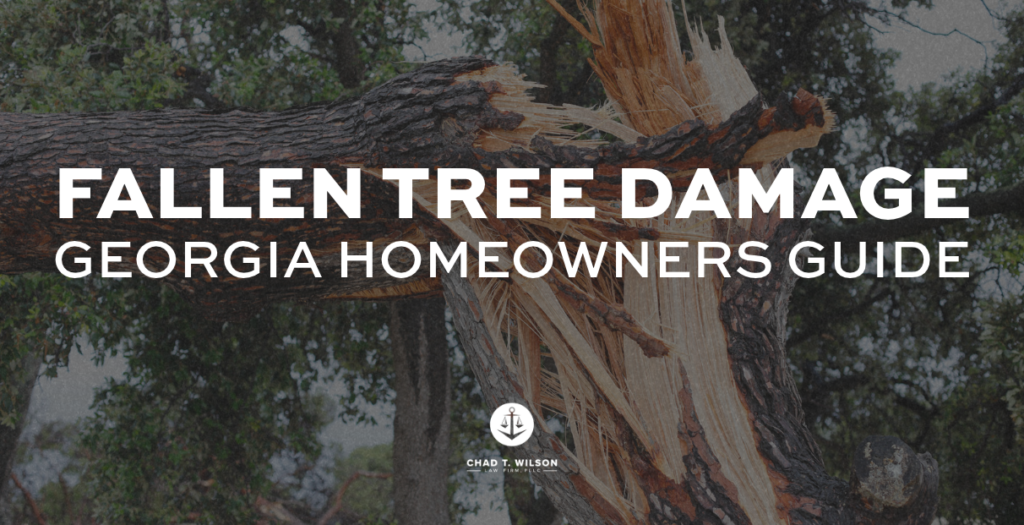
In most cases, yes, when wind is the cause. A standard homeowners policy generally covers damage when a windblown tree strikes your house, garage, fence, or another covered structure. Here is the part that surprises people: coverage usually follows what the tree damaged, not the tree as an object. If a tree falls in your yard and hits nothing, the policy may not pay to haul it away, or it may pay only up to a small removal cap, often a few hundred to around a thousand dollars. If that same tree crushes your roof, the roof repair and the removal tied to it are generally covered, minus your deductible.

Cause matters too. Wind-driven tree damage is a different conversation from a tree that was clearly dead or rotting long before the storm, which a carrier may argue was a maintenance issue. That is one more reason to document the healthy, windblown reality of what happened.

What should Georgia homeowners do first?

Start with safety. Stay away from downed trees tangled in power lines and assume every fallen line is live. Once it is safe, photograph and video the tree exactly where it fell and the damage it caused, from several angles, before anyone starts cutting. Make temporary repairs that prevent further damage, like tarping an open roof, and keep the receipts. Do not throw away damaged property until your insurer has seen it or you have clear photos. Write down the date, the time, and where the tree came from. A claim backed by that kind of record is far harder to shortchange.

Where these claims go sideways

Tree claims stall in a few familiar ways. A carrier calls the tree pre-existing or poorly maintained to avoid paying. The removal cost gets pushed onto you past a low cap even though the tree hit the house. Or the roof estimate comes back too light to cover a proper repair. State it simply: the first answer from a carrier is not always the complete one, and on a fallen tree damage insurance claim the gaps usually sit in removal costs and roof scope. Those are worth questioning.

If your claim was denied, delayed, or underpaid

You are not stuck with a no or a lowball. Ask for any denial in writing and the exact policy language behind it. Keep your photos, estimates, receipts, and claim number together, and watch your filing deadlines. If the carrier blames the tree’s condition or trims the estimate, an independent assessment can show what the wind actually did and what your policy owes. Your storm damage claims deserve a fair reading, not a fast rejection.

How Chad T. Wilson Law Firm Can Help

We represent homeowners, not carriers. With more than 6,000 claims resolved, our team knows the tactics that turn a straightforward tree claim into a fight, from the pre-existing-condition argument to the quietly low estimate. We read your policy, document the loss, and push for the full amount you are owed. We can’t stop a storm, but we can stop your insurance company from unjustly denying your claim. We work on contingency, so there is no recovery, no fee. Denied, delayed, or underpaid? Call (833) 942-0678. We are headquartered in Webster, Texas, and represent policyholders across the country, including Georgia.

Practice Areas

This article is for general information only and is not legal advice. Coverage depends on your specific policy. No outcome is guaranteed.

Sources: National Weather Service, Atlanta/Peachtree City; National Hurricane Center, Isaias public advisory; NHC Isaias archive

Your Florida Hurricane Deductible Before Isaias Makes Landfall

Florida hurricane deductible

By Chad T. Wilson Law Firm Staff, based on reporting by The Weather Channel, October 8, 2026. Read the original reporting here.

Before the first bands of a storm arrive, it helps to know what your policy will ask of you after it passes. Your Florida hurricane deductible is one of those details most people never check until a claim is open, and by then the number can be a shock. With Hurricane Isaias now the first Atlantic hurricane of the 2026 season and hurricane warnings posted along the Gulf Coast, this is the week to understand how that deductible works.

Isaias had maximum sustained winds near 80 mph on Thursday morning and is forecast to reach the northern Gulf Coast Friday night or early Saturday, most likely as a Category 1 storm and possibly a Category 2. The western Florida Panhandle sits at the center of the covered risk. None of this tells you whether your home will be damaged, but all of it affects which deductible your insurer can apply if it is.

Key Takeaways

  • A Florida hurricane deductible is separate from your standard deductible and applies only to windstorm damage from a declared hurricane.
  • It is usually a percentage of your dwelling coverage, not a flat amount, so a 2 percent deductible on a $400,000 home is $8,000.
  • The deductible is triggered when the National Hurricane Center issues a hurricane warning for any part of Florida, and it stays in effect until 72 hours after the last watch or warning ends.
  • When the hurricane deductible applies, your insurer cannot also charge your regular deductible on the same loss.
  • Your exact percentage and dollar figure are on your policy Declarations page. Read it before the storm, not after.

How is a hurricane deductible different from your regular deductible?

Most homeowners policies in Florida carry two separate deductibles. The “all other perils” deductible covers everyday claims like a kitchen fire or a burst pipe, and it is usually a set dollar amount. The hurricane deductible is different. It applies only to windstorm damage caused by a hurricane that the National Hurricane Center has named and declared, and it is almost always written as a percentage of your dwelling coverage.

That percentage matters more than people expect. Florida insurers generally offer hurricane deductible options of 2, 5, or 10 percent of your dwelling limit, with a $500 flat option available on some lower-value homes. If your home is insured for $400,000 and you carry a 2 percent hurricane deductible, you pay the first $8,000 of a covered hurricane loss yourself. At 5 percent, it is $20,000. The number is printed as a dollar figure on your Declarations page, so you do not have to do the math under pressure.

When does the hurricane deductible kick in?

Florida law sets a clear window. The hurricane deductible starts the moment the National Hurricane Center issues a hurricane warning for any part of the state, as long as the storm has been declared a hurricane. It then stays in effect until 72 hours after the last hurricane watch or warning for any part of Florida is lifted. Damage that happens inside that window from the hurricane’s winds falls under the hurricane deductible.

There is one more rule worth knowing. When the hurricane deductible applies to a loss, your insurer cannot stack your regular deductible on top of it. You pay one deductible for that event, not two. If you file more than one hurricane claim in the same calendar year, any amount you have already paid toward the deductible generally carries over, so you are not starting from zero each time.

What should you do this week?

Pull out your policy and find the Declarations page. Look for the line that names your hurricane deductible, and note the dollar amount, not just the percentage. If you cannot find your policy, call your agent or insurer and ask them to confirm it. Knowing that figure now helps you plan repairs, temporary housing, and whether a claim is even worth filing if the damage is minor.

Keep in mind that a hurricane deductible applies only to wind damage from the hurricane. Flooding and storm surge are handled under separate flood coverage, which most standard homeowners policies exclude. If Isaias brings both wind and water, your claim may involve more than one policy and more than one set of rules.

If your claim was denied, delayed, or underpaid

After a hurricane, disputes over the deductible are common. A few practical steps protect you:

  • Ask your insurer in writing which deductible it applied and how it reached that dollar figure.
  • Compare the deductible on the claim paperwork against your Declarations page. They should match.
  • Make sure wind damage and flood damage are being handled under the correct policies, not lumped together to your disadvantage.
  • Keep every estimate, photo, and letter. A clear record is your strongest tool if the numbers do not add up.

How Chad T. Wilson Law Firm Can Help

You already paid for your coverage when you paid your premiums. When a hurricane hits, the deductible is your share, but everything above it is money the policy promised you. We help Florida homeowners and business owners make sure their insurer applies the right deductible and pays what the policy actually owes. Our team has resolved more than 6,000 insurance claims, we work on a contingency basis, and there is no fee unless we recover for you. If you have questions about a hurricane damage claim, or you think your payout came up short, a conversation with an experienced property damage lawyer costs you nothing. Denied, delayed, or underpaid? Call us at (833) 942-0678.

Practice Areas

  • Hurricane damage claims
  • Storm and wind damage claims
  • Water and flood damage claims
  • Denied, delayed, and underpaid claims

This article is for general information only and is not legal advice. Coverage depends on the terms of your specific policy and is not guaranteed. No outcome is promised.

Sources: The Weather Channel, Hurricane Isaias update, October 8, 2026; National Hurricane Center, Isaias advisory archive; Florida Department of Financial Services, Florida’s Hurricane Deductible.

Storm Surge Insurance Coverage:
Wind vs. Flood After Isaias

isaias storm surge insurance coverage

By Chad T. Wilson Law Firm Staff, based on reporting by The Weather Channel, October 8, 2026. Read the original reporting here.

When a hurricane pushes the sea onto land, the damage can look like any other flooding to you, but your insurance company sees two very different claims. Isaias storm surge insurance coverage is one of the most misunderstood parts of a policy, and the confusion tends to surface at the worst possible moment, right after a storm. With Hurricane Isaias driving a storm surge warning from the mouth of the Mississippi River to Steinhatchee, Florida, it is worth sorting out now.

Isaias is forecast to reach the northern Gulf Coast Friday night or early Saturday as a Category 1 or possibly Category 2 hurricane. The National Hurricane Center has warned of life-threatening surge in vulnerable areas. If water reaches your property, the first question your insurer will ask is simple: did the wind do this, or did the water?

Key Takeaways

  • Storm surge is ocean water driven ashore by a hurricane’s winds, and insurers almost always treat it as flooding, not wind damage.
  • Standard homeowners policies generally cover wind damage but exclude flood and surge, which require a separate flood policy.
  • The line between wind damage and water damage often decides how much of your claim gets paid.
  • Flood coverage usually has a waiting period, so a policy bought days before a storm may not apply to that storm.
  • Documenting the cause of each type of damage protects you if the two get blurred together.

What counts as storm surge, and who pays for it?

Storm surge is the wall of seawater that a hurricane’s winds push inland. To most policies, it is a form of flooding. That single classification carries real weight, because a standard homeowners policy generally covers wind damage but excludes flood. Surge damage usually falls to a separate flood policy, whether through the National Flood Insurance Program or a private flood insurer.

Wind is treated differently. If hurricane winds tear off shingles, break a window, or open a wall and rain gets in, that is typically a windstorm loss under your homeowners policy, subject to your hurricane deductible. The same storm can produce both kinds of damage in the same house. The roof fails from wind while the ground floor floods from surge. Two perils, often two policies.

Why does the wind or water question matter so much?

Because the answer decides who pays. After a hurricane, carriers and policyholders frequently disagree about whether a loss came from wind or from rising water. Some policies also include language that limits payment when wind and water both contribute to the same damage. State plainly: this is where many hurricane claims get reduced or denied, and it is rarely because the homeowner did anything wrong.

If you carry only a homeowners policy and your home floods from surge, you may find that the flood damage is not covered at all. If you have both a homeowners policy and a flood policy, the two insurers may each argue the other should pay. Knowing which coverage you actually hold, before the storm, helps you see these disputes coming.

What homeowners should do

A little preparation makes the wind-versus-water question far easier to answer later:

  • Check whether you have flood coverage at all, and note that flood policies usually carry a waiting period before they take effect.
  • If it is safe and there is still time, photograph your roof, windows, and exterior from the ground before the storm.
  • After the storm, document high-water marks and the condition of the roof and openings separately, so wind damage and water damage are each clearly recorded.
  • Do not let an adjuster record everything as flood if wind clearly played a part, and vice versa.

If your claim was denied, delayed, or underpaid

When a surge claim comes back lower than you expected, or an insurer blames all the damage on an uncovered peril, you have options. Ask for the denial or the reduction in writing, with the specific policy language behind it. Keep your own photos and any contractor estimates. If wind damage is being treated as flood, or covered losses are being pushed onto a policy you do not have, that is worth a closer look by someone who reads these policies for a living.

How Chad T. Wilson Law Firm Can Help

We can’t stop a storm, but we can stop your insurance company from wrongly shifting your covered losses into an exclusion. It’s actually your money, and the carrier doesn’t always volunteer it. Our team helps Gulf Coast homeowners and businesses untangle wind and water claims and hold insurers to what the policy promises. We have resolved more than 6,000 insurance claims, we are headquartered in Webster, Texas, and we represent policyholders nationwide on a contingency basis, so there is no fee unless we recover for you. If you are fighting over a hurricane damage claim or a water damage claim, call us at (833) 942-0678. Denied, delayed, or underpaid? We are ready to help.

Practice Areas

  • Hurricane damage claims
  • Storm and wind damage claims
  • Water and flood damage claims
  • Denied, delayed, and underpaid claims

This article is for general information only and is not legal advice. Coverage depends on the terms of your specific policy and is not guaranteed. No outcome is promised.

Sources: The Weather Channel, Hurricane Isaias update, October 8, 2026; National Hurricane Center, Isaias advisory archive; Florida Office of Insurance Regulation.

Documenting Your Home Before Hurricane Isaias

Documenting Your Home Before Hurricane Isaias

By Chad T. Wilson Law Firm Staff, based on reporting by The Weather Channel, October 8, 2026. Read the original reporting here.

The hours before a storm are tense, and the last thing on your mind is paperwork. Still, a few minutes spent documenting your home before a hurricane can decide how smoothly your claim goes afterward. Good proof of what your property looked like beforehand is one of the strongest tools you can have, and right now, with Hurricane Isaias approaching the Gulf Coast, is the time to gather it.

First, the part that matters most. If officials have issued an evacuation order for your area, follow it. Your safety comes before any photograph. Never climb onto a roof, wade into rising water, or stay behind to document property. Everything below assumes you have the time and it is safe to do it.

Key Takeaways

  • Safety first: follow evacuation orders and never delay leaving to take photos.
  • Pre-storm photos help prove the difference between new storm damage and pre-existing wear, which is a common point of dispute.
  • Photograph the exterior, roofline from the ground, windows, doors, interiors, and valuable contents.
  • Save your policy, deductible details, and a home inventory in cloud storage or somewhere off-site.
  • Keep receipts for lodging and other costs if you evacuate, since those may be covered.

Why do pre-storm photos matter so much?

After a hurricane, one of the most common disagreements between a homeowner and an insurer is whether the damage is new or was already there. Insurers sometimes argue that a worn roof or an old crack existed before the storm, which can reduce or deny a claim. Clear, dated photos taken before the storm answer that question for you. They show the true condition of your property on the day the hurricane arrived, so the comparison afterward is honest.

This is not about distrust. It is about evidence. A claim built on proof moves faster and is far harder to pick apart than one built on memory.

What should you photograph?

If you have time and it is safe, walk your property with your phone and capture:

  • Each exterior side of the home, plus the roofline photographed from the ground.
  • Windows, doors, garage doors, and any shutters or storm protection.
  • Every room inside, including ceilings and floors.
  • Appliances, electronics, furniture, and other valuable contents, with model numbers where you can.
  • Vehicles, boats, docks, fences, signs, and outbuildings.
  • Any damage that already exists, so there is no confusion later about what the storm caused.

Business owners should add inventory, equipment, and any signage or storefront features that could be damaged or interrupt operations.

Which documents should you protect?

Photos are only half of it. Before you leave, gather the records that will support a claim and save them where the storm cannot reach them, ideally in cloud storage or with someone out of the area. Pull together:

  • Your insurance policy and any endorsements, along with your deductible information.
  • A written or photographed home inventory.
  • Copies of any evacuation order for your area.
  • Receipts for lodging, meals, and travel if you evacuate.
  • For businesses, closure notices, payroll records, and vendor communications.

If you evacuate and have to stay elsewhere, hold onto those lodging and travel receipts. Many homeowners policies include additional living expenses coverage that can help with the cost of being displaced, though it depends on your policy.

If your claim was denied, delayed, or underpaid

Even a well-documented claim can hit resistance. If your insurer blames pre-existing damage, moves slowly, or offers less than the repair will cost, your records are what you fall back on. Keep everything in one place: pre-storm photos, post-storm photos, your policy, estimates, and every letter or email from the carrier. Ask for any denial or reduction in writing with the policy language behind it. The clearer your file, the stronger your position.

How Chad T. Wilson Law Firm Can Help

Insurance companies have an army of lawyers, adjusters, and agents. Most homeowners facing a hurricane claim have none of that, and the paperwork can feel like a second storm. That is where we come in. We help Gulf Coast families and businesses hold their insurers to the coverage they paid for, and good documentation gives us a strong place to start. We have resolved more than 6,000 insurance claims, we work on contingency, and there is no fee unless we recover for you. If you need help with a hurricane damage claim or a storm damage claim, call (833) 942-0678. Denied, delayed, or underpaid? We’re ready when you are.

Practice Areas

  • Hurricane damage claims
  • Storm and wind damage claims
  • Water and flood damage claims
  • Denied, delayed, and underpaid claims

This article is for general information only and is not legal advice. Coverage depends on the terms of your specific policy and is not guaranteed. No outcome is promised.

Sources: The Weather Channel, Hurricane Isaias update, October 8, 2026; National Hurricane Center, Isaias advisory archive; Florida Division of Emergency Management.

1 2 3 4